James Corden didn’t forget the funny here. He fully committed: great cinematography, great writing and pacing. The whole package.
That’s the secret to comedy: you have to close your eyes and step off the top of a ten-story building. A little hop off the curb doesn’t do it. Comedy works through extremes.
Stephen Colbert did something similar with his Stephenade bit.
Now, Colbert is a genius, among the best in the world at monologues and interviews. Love him. But this was mildly amusing compared to Corden’s masterpiece.
Why?
Colbert did a sort of SNL-skit version of the idea: let’s take a baseball bat and smash things in slow motion. It was a quick, one-trick thing, and just like a SNL skit, taking it longer wouldn’t work.
Corden went big. You can tell they put time and effort into it. You or I could’ve grabbed a bat and smashed things like Colbert.
Jimmy Fallon fully committed, too, with his frame-by-frame version of Too Much Time on My Hands by Styx.
Brilliant. Just brilliant.
Here’s the original. I hit play on both and with only a little fiddling with pause & restart, they matched up exactly.
These two late-night comics prove that the music video isn’t dead–and that comedy doesn’t have to involve f-bombs and gross-out jokes.
While we are all busy BLOGGING, instead of writing what we’re supposed to, I want to steal a concept from Hollywood (thanks, sis!) that all writers can use: Screen Time.
This works for any bit of writing, whether it’s an oped in a paper of news, a 30-minute keynote speech about saving the three-toed sloths of Costa Rica or an epic doorstop of a novel clocking in at 984 pages entitled ELVES WITH LIGHTSABERS RIDING DRAGONS AND THE VAMPIRE WITCHES WHO LOVE THEM. (Note: Don’t speak of this, because it tempts me, and I may write the first chapter of that book, then email it around until we actually hold in our evil little hands 984 pages that eviscerates Game of Thrones, Twilight, the Star Wars prequels and Lord of the Rings.)
So, back to the point: Screen Time is an essential test for any piece of writing.
I could put a gun to your head and ask, “What’s this novel / screenplay / letter to the editor really about?” and you might answer, “a time-traveling World War II nurse and the men in kilts who love her / waiting for some dude who never shows up / why the federal government is building secret tunnels underneath Wal-Marts in Texas to stage an invasion in cahoots with ISIS cells hiding in Mexico.”
And you might INTEND that to be the point of what you wrote.
The Screen Time Test will say if you’re a lying liar or not.
Movies are the easiest, so let’s go with AVENGERS: JAMES SPADER IS A SHINY ROBOT WHO HATES HUMANS. You take the heroes, sidekicks, villains, minions and nameless civilians in the film and add up the the number of minutes (or seconds) they actually show up on film. If you’re feeling insanely generous, add up minutes where other characters talk about them, too, though we may call you Cheaty McCheatypants. Continue reading “Put your writing to the Screen Time Test”→
My mother drove me to the airport with the windows rolled down. It was seventy-five degrees in Phoenix, the sky a perfect, cloudless blue. (Fiction Law #1: Don’t open with the weather or your mom.) I was wearing my favorite shirt – sleeveless, white eyelet lace; (Fiction Law #2: Don’t open with what you’re wearing, because nobody cares.) I was wearing it as a farewell gesture. (Here we go, our first bit of conflict or story: a farewell.) My carry-on item was a parka. (This relates to how much it rains in Forks, and I guess you could argue it’s a bit of foreshadowing, but my God, no story on earth turns on whether a teenage girl is taking a parka as carry-on luggage versus stuffing the damned thing into her Samsonite.)
In the Olympic Peninsula of northwest Washington State, a small town named Forks exists under a near-constant cover of clouds. (This reads like was cut-and-pasted from Wikipedia, with a surplus of Things in Caps, and it is all Rather Boring.) It rains on this inconsequential town more than any other place in the United States of America. It was from this town and its gloomy, omnipresent shade that my mother escaped with me when I was only a few months old. (Conflict! A tiny bit of it, finally.) It was in this town that I’d been compelled to spend a month every summer until I was fourteen. That
Why nine? Because Top 10 lists are popular, and therefore Boring.
But listen closely, for the case is strong for writing in the first-person plural, which we thought at first was second-person plural, and if we thought about it, which we should, first is better than second.
Also, research via the google proved that languages other than English include other amazing options. Just think of a novel written in fifth person past participle without a single letter E in the text. Think of it. Then think of a book cover with black text on a black background with black accents.
That artist from the ’60s who merely painted a canvas black will get sick with jealousy, and does he even know what presumptive mood is? Unlikely. But he’d talk our ear off about acrylic versus watercolor.
And now the list: Top 9 reasons to write in first-person plural
No. 9 — We create an immediate bond with our audience. We hear our voice, and we like it.
The only way to bond more quickly is if we put instant coffee in the microwave, going back in time.
No. 8 — First person is for narcissistic nancypants, polluting each page of text with “I,” “I,” “I,” and, for variety, strings of “me” and “my.”
It’s not about you, first-person singular. It’s about us, plural. Don’t we know that now?
No. 7 — The first-person plural has roots in the Greek chorus, a sturdy trunk from Ayn Rand’s Anthem and green, modern leaves with Joshua Ferris and his Then We Came to the End, which has to be doubly good because it also has “We” in the title.
No. 6 — It’s not “the royal he,” “the royal she” or “the royal I,” is it? No, no, no.
Take it from House Windsor: it’s the royal we. Accept no substitutes.
No. 5 — Third-person is common, bourgeois, and blasé. How many novels are written in third person, and do we ever read all of them?
There are too many, and the quality varies so much. That’s a sign and an omen, our astrology tells us.
No. 4 — First-person plural creates an emotional distance from the readers, which is sometimes necessary.
It’s like having wealthy relatives we don’t enjoy. We don’t have this problem, but if we did, we wouldn’t wish to spend time with them, but we wouldn’t want to get disinherited, either.
Plus, that exquisite distance creates a sense of foreboding and mystery.
If they can never know us, and believe we have no feelings, then we are, indeed, unknowable and omnipresent, literary gods. Or half-Vulcans with Underwoods and a hankering for Jeffrey Eugenides. We’re not sure yet.
No. 3 — A singular narrator can be mistaken, unreliable, reliably unreliabe, obtuse, acute but not cute, scalene or perpendicular.
But we are many, irrefutable, infalliable, translucent, effervescent, a closed plane of certainty and confidence.
We are legion, and it is Good.
No. 2 — Great literature is truly poetry, and great poetry uses first-person plural, such as Emily Dickison and her wonderful, “We send the wave to find the wave,/ An errand so divine.”
Do we want to be great or pedestrian? We choose great.
No. 1 — While second-person point of view was employed by Albert Camus, giving it the sheen of respect, and Jay McInerney found success with Bright Lights, Big City, we cannot ignore the massive volume of pulp fiction detective novels cheapening this choice.
Every such novel began in this sort of crude fashion: “You walk into your office and she’s already sitting behind your desk, drinking your Jim Beam and playing with your .38 special. But she’s got ruby red lips, trouble with the mob, and legs that just won’t quit, so you don’t do the smart thing and turn around to leave. No. You hang up your trenchcoat, take out your notebook, and listen to her sweet, sweet lies.”
Say it’s your first time writing a novel, and you’re a smidge behind. On the 15th of November, you should’ve hit 25,000 words.
Do not despair.
Also: For those who’ve burned vacation time, dumped their significant others and sent the kids to boarding school, because you’re going to hit 50k if it kills you, I say this: dance not the dance of victory, because 50k isn’t actually a novel. It’s a novella. You want to hit 80k or 90k to be safe.
I don’t care if you’ve gotten stuck at 12,000 words or you’re already finished with your 194,000 epic involving the king of the orcs and the vampire mermaid who loves him.
Anybody new to writing a novel, of whatever genre, should ignore the word count demons in this first draft.
Say it with me: It’s a first draft and the word count meants nothing.
The word count means nothing.
One more time: I’ve got 99 problems and a word count ain’t one.
We live in an age when “Boom! Crash!” passes as a good foundation for the lyrics of a hit song. So this young upstart from NZ, Lorde, is quite refreshing in how she treats lyrics as a chance for some poetry set to music.
Maybe she gets it from her mother, a famous poet. I don’t even care if her mom helps write the lyrics, since just about every band these days hires songwriters, choreographers and engineers at the mixboard. You can buy everything and simply show up, if you want.
Here’s the music video, which is interesting:
And below are the lyrics. I like how she flips things, saying a line once, then twisting it the next time. About the only thing to pick on are the “so there” lines, which felt out of place amidst all the imagery and goodness. But it’s a far, far cry from your typical pop song.
TEAM by Lorde
Wait ’til you’re announced
We’ve not yet lost all our graces
The hounds will stay in chains
Look upon Your Greatness and she’ll send the call out
(Send the call out) [15x]
Call all the ladies out
They’re in their finery
A hundred jewels on throats
A hundred jewels between teeth
Now bring my boys in
Their skin in craters like the moon
The moon we love like a brother, while he glows through the room
Dancing around the lies we tell
Dancing around big eyes as well
Even the comatose they don’t dance and tell
[Chorus:]
We live in cities you’ll never see on screen
Not very pretty, but we sure know how to run things
Living in ruins of a palace within my dreams
And you know, we’re on each other’s team
I’m kind of over getting told to throw my hands up in the air, so there
So all the cups got broke shards beneath our feet but it wasn’t my fault
And everyone’s competing for a love they won’t receive
‘Cause what this palace wants is release
[Chorus:]
We live in cities you’ll never see on screen
Not very pretty, but we sure know how to run things
Living in ruins of a palace within my dreams
And you know, we’re on each other’s team
I’m kind of over getting told to throw my hands up in the air
So there
I’m kinda older than I was when I revelled without a care
So there
[Chorus:]
We live in cities you’ll never see on screen
Not very pretty, but we sure know how to run things
Living in ruins of a palace within my dreams
And you know, we’re on each other’s team
We’re on each other’s team
And you know, we’re on each other’s team
We’re on each other’s team
And you know, and you know, and you know
Readers and writers need each other, and we won’t connect when there are thick, artificial walls and book covers so filled with testosterone – or estrogen – that you may as well nail up signs that say “NO GIRLS ALLOWED” or “RUN AWAY, MEN, FOR YOU ARE UNWELCOME.”
I don’t want fiction so segmented that it becomes little fiefdoms, or ghettos, with this section for men, this one for women, little kids here, gay literature over there, big kids there, lesbians here, left-handed straight white guys here and right-handed women who are into quilting and cats in this corner. I read whatever Dan Savage and David Sedaris write, though I’d never have found them if you hidden them in a gay and lesbian corner, which is a bit too near a closet.
Good writing is good writing, period.
Here’s a brief plot summary for a novel. Read it and tell me where it belongs in Barnes and Noble.
Hank is an investigator who solves murders. But he can’t stop a new serial killer, at least not officially. Because that killer is going after the employees of his wife, a prominent businesswoman. This is a case Hank can’t touch and can’t ignore. The killer knows it — and he’s getting ever closer.
All too easy, right? This is pure mystery/thriller. You put it next to Lee Child and James Patterson.
Nope. It’s a romance novel. Some stores might get wild and put it in Romantic Suspense. This is BETRAYAL IN DEATH by J.D. Robb, aka Nora Roberts. All I did was change the genders of the protag and love interest.
The initials Nora Roberts put in her pen name also tell us something. Why do female authors, even crazy famous and insanely successful ones like Nora Roberts and J.K. Rowling, have to hide behind initials?
You could say J.K. Rowling went with initials long before she got famous, out of fear a female author wouldn’t be taken as seriously writing an epic fantasy novel. I blame J.R.R. Tolkien for this trend. (Sidenote: George R.R. Martin, you’re a copycat, but I love you.)
Yet after J.K. Rowling earned enough money to buy her own planet and staff it with Brad Pitt clones, she wrote a non-Harry Potter book … using the pen name Robert Galbraith.
So even the world’s richest author, who just happens to be female, still seems to feel there’s a bias against female authors.
As a writer, a reader and a man, I think that’s sincerely screwed up.
My wife has the World’s Largest Collection of Novels, including 5.92 metric tons of Deep Literature, fantasy, romantic suspense, non-fiction, plain old romance, sci-fi — basically everything. I wrote this post after comparing the backs of her romantic suspense collection to the blurbs on the back covers of my Ginormous Horde of Mysteries and Thrillers and saying hey, these are ALL THE SAME THING.
Let’s look at two more plot summaries, one for a book that turned into a movie and another for a movie.
A poor and passionate young man falls in love with a rich young woman and gives her a sense of freedom. They soon are separated by their social differences.
Has to be a romance. Even if I switched genders, there’s no other subplot involving a presidential race or a stolen nuclear bomb. Nothing but a love story, straight up.
Nope. Didn’t switch genders or touch this summary at all. Pulled it right from the IMDB page for THE NOTEBOOK by Nicholas Sparks, who says he doesn’t write romances or even love stories. He writes literature, and his stuff belongs next to Hemingway. (Not making that up. Go ahead and google it.) And yeah, they don’t shelve his books in the romance section, because “Duh, he’s a man.”
I’ve met a ton of romance authors from this silly blog, and whether they write historical things involving men in kilts, romantic suspense or wild stuff involving Shapeshifting Dolphin-Men and the Women Who Love Them, they are united behind one core belief: a burning hatred for Nicholas Sparks. (Related post: The Red Pen of Doom guts THE NOTEBOOK)
One last shot, this time a movie:
Vanessa is beautiful, rich — and haunted by the deaths of her parents and her lover, who died during Vanessa’s secret crusade against the criminal empires tearing at the city. Now a recluse, Vanessa is jolted when a charming burglar steals her mother’s pearls while a new villain threatens the entire city. Should she open her heart up to the handsome new member of her board of directors, or should she risk everything by trusting the cunning thief in a risky battle to save the city?
Tough one. Might flip a coin here. Here’s the trailer for this movie, and yeah, all I really did was switch genders and leave out a description of the Batcave.
You might argue these are isolated cases, and that romantic suspense is a very different genre from romance, seeing how the love story is far stronger than what typically passes for a love interest in mysteries and thrillers written by male authors.
That argument is weaker than a half-cup of Folger’s Instant Decaf.
Lee Child is the kings of thrillers today. Every one of his novels has a love interest, typically the biggest character aside from the hero, a strong woman with a badge and a gun who (1) is crucial to helping Reacher beat the bad guys or (2) gets kidnapped along with Reacher, so it’s just the two of them against the idiots who made the fatal mistake of breaking our hero’s folding toothbrush.
Want to get more literary and old school? Take away the relationships and love scenes from the Easy Rawlins books and you’d cut them by two-thirds, making Walter Mosley cry. From reading every book in this series, I can say the heart of it isn’t really solving mysteries or racism back in the day, but the bromance between Easy Rawlins and his deadly best friend, Mouse.
The villains get far less attention. The latest Easy Rawlins novel has a villain showing up in the climax that I barely knew existed, and that was fine, because the real point was connecting Easy with all his friends and family one more time, especially Mouse.
You could argue all those books are written by men, and these other books, well, they’re written by women. And sure, there are women who’ve always written thrillers or mysteries and their work has always gotten shelved in the neighborhood of Lee Child and James Patterson. But not many.
The reverse is also true. There are men writing regular genre love stories novels … but hardly any use their own name, or even initials. They’re using female names.
Online, these walls fall away. Books don’t have to get shelved in only one place – you can tag them in all kinds of categories. However, I’m one of those people who likes to go to actual Stores of Books, and hold them in my hand, and buy them using pieces of paper decorated with dead presidents. Call me crazy.
There is a benefit to a few walls. There’s no point in throwing everything together and making people search for books alphabetically.
I’m saying it’s possible to go too far in the other direction, and to miss out on broader readership by making tinier and tinier niche markets, year after year, with only a few books by big-name authors marketed to everybody. Keep this up and we’ll have one tiny shelf labeled MAINSTREAM and it’ll all be authors who’ve figured out they’re so big now, they don’t even have to write the novels, because they can put their name in big letters, the co-author in little print and let the checks come in the mail. Hey, it’s not a bad gig, if you can get it, and these authors worked hard. James Patterson is a master of co-writing a zillion books and you can tell he works hard with co-authors so each book is in his signature style.
What’s crazy is how far this trend has gone, seeing how an author being dead isn’t a barrier anymore. Books by Tom Clancy and Robert Ludlum will keep haunting prime real estate of bookstores as long as lesser names are willing to cash the lesser checks.
It’s like Hollywood sequels made long after the original director and star died. Even if the book or movie is great — and Eric van Lustbader is a far better writer than Ludlum — it still feels weird. All those Tom Clancy books that Tom Clancy never wrote will, for years and years, take up a crazy amount of prime real estate at book stores. And that’s what I’m really talking about here: real estate at book stores, which is getting so Balkanized, the Balkans are going to sue for copyright infringement.
Break the mold, then set it on fire
“We’ve always done it this way” is a bad strategy. If you study breakout hits in any medium, they don’t stick to the mold. They pick that mold up, break it and set it on fire.
The first Harry Potter book was clearly aimed at kids. Look at the cover. And sure, 12-year-old boys buy books, and they see a lot of movies, and yes, Michael Bay has made 6.2 bazillion dollars with endless TRANSFORMER movies based on this demographic alone. Yet it wasn’t just 12-year-old boys who bought all those Harry Potter books.
People actually pay more attention to something out of the ordinary, as long as you don’t try to keep it caged up in its own little demographic closet.
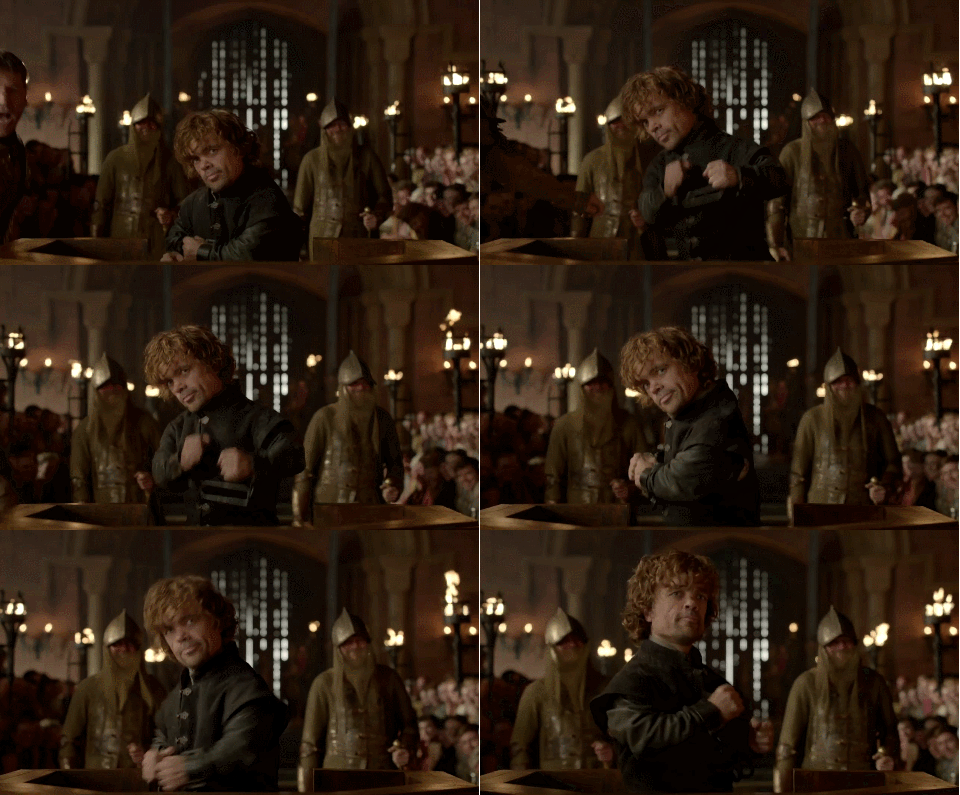
It’s not true that men only want to read books, written by men, about young, perfect tough guys who are 6’4 billionaires. Who’s the most popular character on GAME OF THRONES, among men and women and whoever? This guy. BECAUSE HE’S AWESOME.
On paper, Peter Dinklage should get nowhere in Hollywood, while all the tall, young actors with chiseled abs should skyrocket into fame every time they’re cast into the latest action movie that costs $300 million and still bombs. Dinklage, Brian Cranston and the rest of the cast of Breaking Bad prove that actors don’t just have to look like Abercrombie and Fitch models to make it. Acting skills kinda matter.
Mike from Breaking Bad is an old man, but he’s far tougher, and more interesting to watch, than 99 percent of the perfect 20-something actors who get asked to carry movies like TRANSFORMERS 15: OPTIMUS PRIME GETS AN OIL CHANGE.
Find a wrecking ball
These days, publishers and booksellers are doing plenty of other demolition work. Every time a novel becomes a hit movie, teams of carpenters show up at Barnes and Noble to create a new section for this new genre that isn’t really new:
Young Adult Fantasy (HARRY POTTER clones)
Young Adult Fantasy Romance (Hey, TWILIGHT made a bazillion dollars, why not us?)
Young Adult Dystopian Craziness (HUNGER GAMES, DIVERGENT)
Next month, it’ll be Young Adult Zombie Dystopian Coming of Age Stories in Stick Figure Graphic Novel Form, (DIARY OF A WIMPY KID meets WORLD WAR Z)
Blake Snyder was onto something with his SAVE THE CAT books, where he smashed the myth that story and genre is about setting (westerns are in the Old West! Sci-fi happens in space!). Doesn’t matter whether your protag with a badge and gun wears pants or a skirt – it’s a mystery/thriller.
Snyder broke down story into what happens and why, and how the story works. In the old, stupid model, JAWS is a horror movie, FATAL ATTRACTION is a domestic drama and ALIEN is a sci-fi film. Wrong. That’s looking at the setting instead of the story.
All three of those movies are a primitive, visceral version of the story he calls Monster in the House, which is one of the oldest tales ever. There’s a monster in the house, and either you kill the monster or it kills you.
Eating you is optional. Villain’s choice.
So this is my not-so-plaintive cry, which is different than a plaintiff’s cry, because I’m not suing anybody: I don’t care whether the story was written by a man or a woman, whether the protag is a man or a woman, straight or gay, short or tall, young or old. I don’t give a rip whether the story is set in 18th century London, present-day Seattle or a space station orbiting the seventh moon of Jupiter.
All I care about is whether the story is any damned good.
Thrill me, surprise me, make me laugh.
Bust the locks on some of these literary cages. Unshackle authors and readers from the obsolete expectation that demographics is destiny.
Want to become a better writer? Learn from bad writing: how to spot it, how to fix it and how to prevent the disease from happening in the first place.
Note: All writers, including myself, tend to go overboard at times. As a reformed journalist who now writes speeches, blog posts and novels, I will happily say that I’ve committed every possible writing sin at one time or another–and no, this is not meant to make anyone recycle their Underwood and switch to pottery.
So as a public service, here are the Six Horsemen of the Writepocalypse:
1) The Ivory Tower of Pretentious Poppycock
This comes from never learning that out in the real world, nobody wants to read blog posts, novels or screenplays written in the same dense style of term papers about dialectical materialism.
How to spot it: There is never a short, simple sentence, not when long, insanely complicated ones will do. Pretentious Poppycock will have sentences flavored with giant German words that are too intellectually sophisticated to be translated into English, though schadenfreude has appeared in low-brow venues such as Newsweek often enough to lose all its previous cachet.
Writers of Pretentious Poppycock are actually offended if the masses (a) buy, (b) read or (c) dare to enjoy their work, because that means (d) it is not dense and sophisticated enough and (e) they have therefore failed via mainstream success and must (f) become an elusive recluse working on a new, six-volume masterpiece that will take 26 years to complete.
2) The Gonzo Kool-Aid Acid Trip
There are subspecies of gonzo, entirely dependent upon which substance the writer employs to destroy his liver: gallons of whiskey, blunts the size of telephone poles or some kind of toxic toad sweat they picked up in Brazil.
The whiskey types tend to go hyper-macho. Their sentences are shorter than Hemingway, because Hemingway was a wussbag nancypants who only watched bullfights. Get in there. Kill a bull, with your bare hands.
This trap is a particular danger for newspaper reporters who decide to write novels.
Another form of gonzo writing happily bounces around through time, since chronological order is for squares — or goes ironic hipster with a 500-page book, written all in haiku, about a retired accountant who makes sculptures out of lint from the dryer.
While the style of writing is completely different than the Ivory Tower of Pretentious Poppycock, gonzos are also typically unhappy if too many of the masses buy, understand or like their work, because that means they sold out and not enough fans took up their suggestion to “steal this book,” though the money does allow them to pay steady rent and purchase a higher class of bourbon and psychedelics.
However, a taste of success will also remove the last remains of internal censors from a gonzo of any stripe.
3) The Purple Prose of Cairo
This is gonzo writing without the drugs, Loony Tunes Lit-rah-Ture, performance art with ink. It’s passages chock full of modifiers or throwing words around the canvas of Word like Jackson Pollack chucking paint on the floor.
Tell me if you’d pay money to read more of this:
Ethel. Ethel. Ethel. Next to barber. Next to barber bury. Next to barber bury china. Next to barber bury china glass. Next to barber china and glass. Next to barber and china.
Whether you’re a reader, English Lit professor or a mom wondering if your teenager is alright upstairs, this sort of text is makes you buy something else at Barnes and Noble, scribble a big fat F with a red marker or google “therapist” on your iPhone.
It’s bad, right? Incoherent, and I didn’t make this up or pick a bad section of something that gets better. The whole poem is like this. But no, this is Gertrude Stein, so it is magical and amazing and you’re just too low-brow and uneducated to understand how brilliant that bit of word wizardry truly is.
4) Dear Diary
Everything is in the first person: blog posts, poetry, newspaper stories, memoirs, novels, screenplays.
It all goes through the filter of me-me-me.
The Series of Tubes has enabled this to reach epic, world-wide proportions. In the bad old days, being a writer meant slaving away at a newspaper, writing novels that didn’t sell until you died and became famous or writing in an actual diary that you locked up and hide in the sock drawer so your brother Steven, the snoopy creep, couldn’t read it and tell his idiot friends at school.
Now every writer is required by law to have a blog, be on Twitter and live on Facebook, so it’s quote possible to spend 20 percent of your day writing a masterpiece and 80 percent of your time at the keyboard documenting every tragedy, insult and triumph.
Dear Diary can be mundane, giving you daily updates about the type of sandwich they’re eating (PB & J today, then some laundry!). It can be full of humblebrag name-dropping nonsense. Or it can be one giant Pity Party.
If Dear Diary writes a screenplay or novel, the hero is a barely disguised doppleganger, except younger, taller, better looking and richer.
You also find this in bad mysteries about often written in the first person. Here’s a great first line from a 2013 entry to the Bulwer-Lytton contest for truly wretched first lines: “This was a very easy mystery for me to solve, so I never considered putting it in a story until I was telling some friends about it, and I realized the average person, such as yourself, has trouble figuring it out, although it is really laughably simple.” — Thor F. Carden, Madison, TN
The most epic Dear Diary moment in fiction I can remember is an entire chapter of a Clive Cussler novel where his hero, Dirk Pitt, has a classic car race with a car collector and Dirk-Pitt clone named … Clive Cussler.
5) The Never-Ending Lecture
This style of writing has an agenda and woe unto those who ignore it. It beats you over the head with a literary sledgehammer, damning you for not understanding how right the writer is, and how wrong the world is for not seeing it the first 593 times they explained it.
Lectures don’t even attempt to be subtle. Every bit of prose and dialogue is on the nose and characters are made of the thinnest cardboard.
Combined with the Ivory Tower, the Never-Ending Lecture may spend 235,000 words on the history of natural gas industry in Paraguay and the lessons to be learned about America’s telecom monopolies.
Matched up the Purple Prose of Cairo, a Lecture may give birth to THE FOUNTAINHEAD and another novel, ATLAS SHRUGGED, that contains a speech that goes on for sixty pages. Yes, not six pages, sixty. (Note: Was that too easy? Yes, yes it was.)
6) The Grammar Nazi
This is the polar opposite, and mortal enemy, of both Gonzo and Loony Tunes Lit-rah-ture.
Each sentence is absolutely fine in terms of usage. There are no dangling modifiers or split infinitives — and nothing ever, ever ends in a preposition.
Text written in the Grammar Nazi style devotes all of its energies into being technically correct, but at the price of having no soul, no life, no heart. And you are bored out of your gourd, even if YOU HAVE NO GOURD AT ALL.
How to fix and prevent this nonsense
Despite the incredible variety in this list — and you could probably come up with six more types — there’s a common thread to all bad writing.
That thread is this: the writer treats the audience with indifference, if not arrogance and contempt. It’s all about doing things their specific way. Readers who want to enjoy or understand their work, and complain about it being difficult, dense, narcissistic or weird — well, clearly all those readers are the problem, not the writer.
You can avoid all six of these bad kinds of writing by remembering the First Rule of Rhetoric, which is three simple words: “Know your audience.”
The audience isn’t you. Never is and never will be.
The audience isn’t even your mom, who might be the only person willing to read the thing, and even then, mom tends to lie and say yes, she loved it, where’s the rest?
If you want to write for you and you alone, do it in a diary and lock it up in that sock drawer.
Writing should be read, understood and enjoyed other people. Period.
That doesn’t mean good writing is shallow, low-brow and always happy.
Paul Krugman, Malcolm Gladwell and every issue of The Economist prove you can write intelligently about deep subjects without resorting to any of these types of bad writing.
People want actual substance, some real meat on those writing bones. They want to laugh and cry, to learn new things.
They want to think and ponder, and sometimes have so much fun that they read it again and again.
Let them.
It’s that simple.
Bad writing puts barriers between readers and all of those things.
When your ego puts up any of those walls–and it happens to every writer–go back and tear them down.





 The Red Pen of Doom