As a reformed journalist, these kind of stories make me (a) snort coffee through my nose, which is a tragic, because EVERY DROP OF JAVA is precious, (b) shake my head in awe and (c) wonder what other epic things are happening, every day, that we don’t hear about, because if a burger with onions makes a man like this go all Michael Douglas in FALLING DOWN, what happens if he gets into a fender bender? Will a SWAT team have to be called to Powell’s Books if somebody glances at the books he’s buying and raises one eyebrow, like Spock?
First, the story itself. Then we’ll analyze this, to see what it tells us about onions, and burgers, and America.
Burger with onions ignites ‘McFury’ at McDonald’s by KING 5 News, KGW KTVB.COM Posted on September 26, 2012 at 10:49 AM
GRESHAM, Ore. — A Gresham, Oregon man is accused of going on a violent rampage in a Portland-area McDonald’s fast-food restaurant Sunday.
Jayme Leon will be charged with harassment and criminal mischief following the violent episode in which police said he threw a soda in the face of the McDonald’s manager and smashed a cash register.
According to the Oregonian newspaper, Leon’s rage ignited when he received a Quarter Pounder with onions. He reportedly asked for no onions.
After placing the order, police said Leon called the restaurant to complain. He was told to bring the burger back for a refund, but said he had already eaten it.
Leon returned to the restaurant, upon which police are quoted as saying he went into a “McFury.”
Police arrested him a short distance from the McDonald’s. He was booked into jail but released on his own recognizance.
# # #
What stood out to you?
For me, the icing on the McFury cake was this fact: he ate the offending burger with onions. All of it.
Then he went back to raise hell, break things and get arrested.
Normal people would peek at the burger, notice the onions and tell the 16-year-old at the counter hey, this is a mistake. Be great if you could fix it. And any restaurant will fix it. Everybody on the planet knows this. Maybe in Stalinist Russia around 1955, all burgers came with onions, and YOU WILL LIKE THE ONION BURGER, but I’m making that up.
You could be the mousiest, least aggressive person in the world, saying something like, “I think maybe I sorta ordered a burger without onions, and it’d be great — not to trouble you at all, because you’re busy and underpaid — it’s just be great to have a plain old burger, and if that’s a bother, I’m happy giving this one away to a starving person outside and handing you another buck and a quarter to buy a separate burger without onion, since there’s a 1 percent chance I maybe ordered it wrong, though that’s not what my receipt says.”
Even if you went all nicey-nice, they’re gonna replace your burger. Probably give it to you free and throw in some french fries or whatever.
That’s why this story jumps the shark.
People get mad all the time. There are brawls in the parking lots of Waffle Houses, apparently so often that fark.com may retire that as a meme. People rob gas stations all the time, so it isn’t news until a rednecks in Florida start a trend of dressing up like ninjas to rob 7-Elevens, which still resists using AP style and going with Seven-11. Listen to Patrick Stewart: resistance is futile.
The other reason this story jumps the shark is normal people, like you and me (OK, maybe just me) do a little cost-benefit analysis before resorting to Things that Will Get Us Arrested and Mocked throughout the Series of Tubes.
What is the benefit of raising hell at McDonald’s and trashing the place? Maybe they give you a replacement burger … except they won’t, because they’ll be busy looking for mops to beat you with and talking to dispatchers on 911 instead of frying up a new pattie of cow.
Weigh the benefits (zero) versus the costs (whoah, dude) and the decision for you and me is easy. But maybe you and I don’t harbor a deep-seated hatred of onions.
So this studio works for years to produce ROSA, a beautiful little short about an apocalyptic android goddess with kung fu powers on loan from Neo, who’s busy not using them in the Matrix — oh, wait?
One lone man did this?
NO WAY.
But it’s true. Take a look.
Hollywood took notice, and now ROSA is becoming a full-on movie, with popcorn and everything. This makes me happy.
Peoples of the Series of Tubes, and the Twitter, what’s your favorite short film that deserves to be made into two hours of movie goodness?
Now, the usual music video features (a) some kind of singer or rock band (b) singing and rocking, and possibly trying to (c) dance, though if they can’t dance, the can (d) look tough or (e) let their backup dancers go crazy while the singers and rockers look tough. The toughest part is whether to film in an empty warehouse or on top of a roof.
For pop singers and boy bands, it’s even simpler: they have to sing WHILE dancing, and it doesn’t really matter where.
Music videos that tell a story, like some kind of moving picture, with a script and such, are rare. Because that sort of thing is work, you see, and the rock bands who try usually shoot for “artsy” and merely slam hard into “the Wall of Pretentious.”
This isn’t quite art, and it doesn’t quite make sense, but it is interesting and different and ambitious. I salute the Shins for aiming high instead of setting up their drums and amps in the parking lot of a vacant K-mart, just to be ironic.
For you musical types, here are the lyrics for you to dissect and decipher:
Well, this is just a simple song,
To say what you done.
I told you ’bout all those fears,
And away they did run.
You sure must be strong,
And you feel like an ocean being warmed by the sun.
When I was just nine-years-old,
I swear that I dreamt,
Your face on a football field,
And a kiss that I kept,
Under my vest.
Apart from everything,
But the heart in my chest.
Chorus:
I know that things can really get rough,
When you go it alone,
Don’t go thinking you gotta be tough,
And play like a stone.
Could be there’s nothing else in our lives so critical,
As this little home.
My life in an upturned boat,
Marooned on a cliff.
You brought me a great big flood,
And you gave me a lift.
Girl, what a gift.
When you tell me with your tongue,
And your breath was in my lungs,
And we float up through the rift.
Chorus:
I know that things can really get rough,
When you go it alone.
Don’t go thinking you gotta be tough,
And play like a stone.
Could be there’s nothing else in our lives so critical,
As this little home.
Well, this would be a simple song,
To say what you done.
I told you ’bout all those fears,
And away they did run.
You sure must be strong,
When you feel like an ocean being warmed by the sun.
Remember walking a mile to your house,
Aglow in the dark?
I made a fumbling play for your heart,
And the act struck a spark.
You wore a charm on the chain that I stole,
Especial for you.
Love’s such a delicate thing that we do,
With nothing to prove,
Which I never knew.
If you are a child of the ’80s, or even alive and conscious during that decade, you remember some nutty TV shows that — at the time — we thought were cool.
THE A-TEAM is unwatchable today. Go fire it up on Netflix or whatever. The fourth time in a row that (a) Mr. T says “I pity the fool” as (b) bullets spray all over the place and (c) bad guy cars jump in the air and do that half-flip, you’ll do a facepalm, and right in the middle of that facepalm, Col. Hannibal will light up a cigar and say, “I love it when a plan comes together.”
Other things we watched and thought were cool: AIRWOLF and that show where some American guy thinks he’s a ninja because he has an old wise mentor and is constantly fighting some actual ninja who actually should be the hero, seeing how he was the only real ninja within 100 miles.
Anyway, the point is, they’re rebooting one of the nuttiest relics from the Glowing Tube back in the ’80s: MANIMAL.
This is great news for America, and for bored college kids looking for something watch and dissect, as a group, when they’ve had too much Pabst Blue Ribbon to write that term paper about dialectical materialism as it relates to Madonna’s early videos, the ones before she’d married Sean Penn.
Here’s the classic MANIMAL intro.
Watch the hero as he trasforms, and no, they didn’t get this idea when they hired the special effects guy who turned Michael Jackson into a werewolf.
Special bonus: SPACE SHERIFF triple transformation
Note that I have no idea what this show is, aside from a possible father of POWER RANGERS, but it is awesome.
If you live in the Seattle, or the Kirkland — or even Denver, Portland and Instanbul — there’s an author on tour you should meet. (See when and where below.)
C.C. Humphreys is not only a literary muffin of stud, but a former actor and FIGHT CHOREOGRAPHER (bonus points). He actually knows how to use a sword, which gives me an excuse to play the Best Swordfighting Scene in Any Movie Not Involving Lightsabers.
He’s a genuinely interesting human being, a man who speaks with one of the sweetest British accents on the planet, maybe because he grew up in the U.K. despite the fact that he is technically Canadian. Is all that legal? I DON’T KNOW.
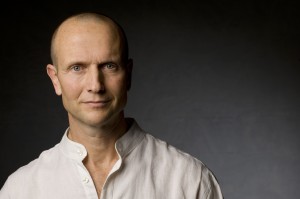
Author C.C. Humphreys is a literary muffin of stud, and a genuinely decent human being. Visit his blog or visit him on his book tour. DO IT NOW.
This accent gives everything he says an extra bit of charm and gravitas, even if he’s telling you, “Listen, you’re being rather beastly.”
All you want is for him to keep talking.
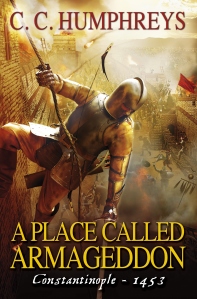
So: he has a new novel out, A PLACE CALLED ARMEGEDDON, which is about the siege of Constantinople, though you have to say which siege, because the place got attacked all the time.
“Alexander the Great, what are you doing this weekend?”
“Oh, the usual. Maybe drink a bit of wine and take a long ride on one of my horses. I have a stable or six full of those things.”
“Come with us. We’re gonna sack Constantinople — it’ll be great.”
“OK, that sounds fun.”
C.C.’s novel is about the siege of 1453, a particularly good year for a siege, hearty and full. It goes well with filet mignon. Anyway: This man can write like nobody’s business, and the novel is worth it.
A PLACE BY ARMAGEDDON, the latest novel by C.C. Humphreys.
Also: If you go to a writing conference and hit one of his seminars, you’ll remember him, because he puts on a show. This may be because he was an actor on stage and screen. I believe all of his grandfathers were actors, too. It’s in his blood. The man played Jack Absolute, the 007 of the 1770’s, and he also played Caleb the gladiator on an NBC series.
Also-also: most of his readers are women for some reason, even though he writes swashbuckling historical novels about battles and blood rather than romances involving men in kilts.
EITHER WAY: I truly like and respect this man, and his books. You will, too, if you (a) see him on tour, (b) buy one of his novels, (c) lurk on his blog, which you can read here, or (d) chat with him on the Twitter at the mysterious handle of @HumphreysCC.
Epic slow-motion. Soaring music. Stunned reaction shots — this commercial from Denmark has it all, and they do it better than Michael Bay without even resorting to 593 explosions.
Think of what they could have done with an explosion or seven.
So I see this on the interwebs, and my brain says, “Ah, here we have James Cameron, busy at work on AVATAR 2: BLUE MONKEYS VERSUS HUMANS AGAIN, BECAUSE I WANT ANOTHER BILLION DOLLARS.”
But no, this is a real animal here on Earth instead of whatever that Avatar planet is named, though I believe this blue dragon would be something the blue monkeys ride if they’re traveling by sea. Also, it probably eats unobtanium for breakfast, because blue dragon mollusks munch up deadly poisons from prey and recycle that stuff with a shrug. Can you do that, Mr. Top of the Food Chain? I DON’T THINK SO.
And before we get to proof that this isn’t some PhotoShop or CGI thing, or some kind of sasquatch prank by college kids who got all Dr. Frankenstein with two oysters and a bunch of model paint, here’s the Wikipedia page on blue dragons, which boffins (scientists) call “glaucus atlanticus” for some boring reason involving science and such.
HOWEVER: Some people call these “blue dragon sea slugs.” Even if they are related to sea slugs — say, sea slugs are their ugly uncle — it’s wrong to call these beautiful little guys “slugs.” No. They’re 5.92 bazillion times cooler than boring gray slugs, which don’t ingest deadly toxins for breakfast and can instead be killed by plain old table salt. No self-respecting thing can stroll into a super-hero bar and say, “Hey, my super power is, like, crawling all over plants to get my slime on them, but my super-weakness, uh, is, you know, table salt.”
The blue dragon mollusk, now, can float into that same bar looking awesome and not have to say a word, because if you disrespect it, say hello to a little free dose of deadly toxic whatever.
You have questions, random peoples of the Series of Tubes, and do I have random answers? Maaaybe.
Question: Where can I buy a blue dragon mollusk?
Answer: At the blue dragon mollusk store. No, I am kidding. These are not pets. These are aliens from the planet Xenu, and if you try to keep them as pets, their buddies show up in a wicked spaceship and zoom off to find more venomous things to eat for breakfast.
Question: Does the blue dragon mollusk really eat deadly venomous animals?
Answer: Yes. They eat stuff like the man-of-war, which is only found in the ocean, and not pet stores, making it even harder for people to feed their kidnapped blue dragon mollusk they’re trying to keep as a pet. Though I think the plural should be “men-of-war” or “men without hats,” who are only found in Australia. I also believe they eat peppers, like the ghost pepper, in their salsa. Sour cream and guacamole is too wussy for them.
On to the footage: blue dragons in the wild.
More blue dragon footage, because I’m still not convinced.
OK, I’m convinced, and want some for pets, as long as they don’t evolve into those giant VW-sized facehugger things from PROMETHEUS.
Oh, if I could go back in time, and whisper in the ear of my younger self during journalism school.
Not that I was busy screwing it up. Editor-in-chief of my college newspaper, graduated No. 1 in my class, won a bunch of awards, blah-blah-blah. (Related: Who is this Guy?)
But the traditional things that most journalism students think they SHOULD be doing — well, often those are seven separate kinds of wrong.
And there are other things Serious Journalism Majors scoff at, things that you actually should not only embrace, but hug tightly to your bosom.
So here we go with the Top 10 Myths of Journalism School.
Myth No. 10: Hard news is the only true love of a Serious Journalism Major
Sure, unfiltered Marlboros and Jim Beam come close. But nothing beats a scoop about an amazing scandal. You laugh at people trying to make the words flow for their feature story on dumpster divers, a story packed with all these photos, which are for nancypants who don’t have the stones to write more words.
Here’s the truth: hard news is all about news gathering and using the inverted pyramid, which is a horrible structure for any sort of writing and needs to be taken behind the barn and shot.
Hard news is worthy, and does the public a great service. Yet if all you do is hard news, you won’t truly learn journalism — or how to write.
Myth No. 9: Journalism school will teach you how to write
Once you get that pigskin from j-school, and land your first journalism gig — at The Willapa Valley Shopper or The New York Times — you’ll go home after 12 hours of banging on the keyboard to stay up past midnight, banging on the keyboard some more while smoking Gallouise Blondes and drinking cheap whiskey sours as you write (a) the next Great American Novel, (b) a Broadway play involving a debutant who falls in love with a struggling young reporter or (c) a Hollywood screenplay about a vast government conspiracy unraveled by an intrepid young intern at CBS.
This will be a lot of fun, and you’ll remember this as being the Best Thing Ever until you’ve been doing it for seven months and turning every draft of your extra-curricular writerly fun into three-point attempts. Also, you will miss this thing we call “sleep” and these other things we call “money in the checking account” and “a social life that does not involve typing on a keyboard chatting with a person who may, or may not, actually exist.”
J-school will teach you to be a journalist, but not how to write. You’ll know the AP Stylebook better than the people who wrote it, and your noggin will be stuffed full of the mechanics of writing news stories, how to put out a newspaper or produce a magazine. It may even teach you how to produce radio and TV shows.
Journalism school won’t, however, make you an all-purpose writer. And to truly learn how to write, you need to learn how to edit. I don’t mean copy edit or proof.
Sidenote: I wrote this in a crazy hurry and have not proofed it, or copy edited it, much less edited-edited the sucker. My apologies. God knows what kind of felony crimes against journalism were committed on this silly blog today.
Myth No. 8: Copy editing is editing
Sure, you sleep with your AP Stylebook, and proof-reading marks are like a second language. But that’s not editing.
There’s proofing, copy editing and true editing. Vastly different things.
Anybody who’s literate can proof. Do I want a great proofer? Sure, I want the best around, because errors are inevitable, and it takes a special person to have the stamina to read page after page. This isn’t rocket science, though.
Copy editing is important. When something is written on deadline, in a huge hurry, the copy editor is a Writing God, saving you from making gigantic factual errors or crimes against the English language.
True editing, though, is different, and you won’t learn it in journalism school. Not unless you seek it out.
Myth No. 7: You should specialize in your special thing while pish-toshing PR, because that’s for cheerleaders
Maybe you’re a sports guy, and all you want to do is write about baseball. It’s your passion. In fact, it’s your dream to cover the San Francisco Giants as a beat reporter. Anything else would be a let-down.
Out in real newsrooms, you’ll switch beats — and newspapers, or TV stations, or whatever — all the time. One month you might be covering politics and the next month it’s a huge murder trial. As a reporter, I covered city council meetings that lasted until midnight, got up the next day and did a flood, a fire or a bumbling serial killer. You never knew what was going to happen, and that’s why journalism is fun. The smaller the paper or media outlet, the more different things you get to cover. The bigger the paper or TV station, the more specialized you get.
So in college, try everything you can. Features, sports, the opinion page. Give radio a shot, and TV if you can. Somebody who can do lots of things, and is interested in many things, is a lot more marketable and fun than a journalist who’s obsessed with one solitary thing.
Also, public relations isn’t something journalism majors should take because it’s a required course. Chances are, you won’t do journalism forever.
Maybe five or ten years after you start working at papers of news, you’ll meet an amazing girl, or a wonderful boy, and the two of you will get married and decide that living on Top Ramen was fun for the first year, and kind of unfun the second year, and if you ever want to have babies and buy a house and send your pookie to college, the job thing may need to get revisited. And instead of selling Toyotas, you want to stick with some kind of writing gig, except one that pays decently and won’t make you worry about the next round of layoffs and such.
This happens. It’s OK, and public relations is a growing field — social media PR is crazy hot right now — while traditional journalism is shrinking before it changes and takes flight again. (I have hope.) Take the PR classes and learn from them. You will not die.
Myth No. 6: All you need is a pen and notebook
These days, it’s a pen, a notebook, a laptop, a camera and a smart phone, though the phone is a given, and would require a surgical team / SWAT team / NFL team to separate most people from their phones.
A lot of print reporters are taking their own photos these days, with newsroom cutbacks for photo staff. There are far fewer photographers on staff than reporters. Can’t send a shutterbug out on every story, only the biggest ones.
Get a decent SLR and practice. A lot.
That camera will also shoot HD video, and most papers and radio stations are also putting video up on their blogs. Learn how to edit video a little, and to edit photos a whole bunch.
Sidenote: when I say “learn to edit photos,” I don’t mean firing up Instagram and applying the Lux effect.
Myth No. 5: Creative writing and drama people are weird
Yeah, they dress in black and like to quote Sylvia Plath and Oscar Wilde.
Get over it. Instead of taking tons of political science classes and such (I was guilty of this), take all the creative writing and drama that you can. Because you want to be a great journalist and writer instead of a U.S. Senator, right?
If your college has a screenwriting class, take it. If they don’t have screenwriting, buy SAVE THE CAT by Blake Snyder and STORY by Robert McKee. Read them all the way through while taking notes. Then go back and read them again, because those two books are all about structure, which is the secret to great writing. Not pretty words. Structure.
Also: speech and debate — or editing the opinion page of your college paper — are both crazy smart. You need to learn how to (a) speak in public and (b) persuade other human beings to do things, such as (c) getting sources to reveal secrets to you and (d) charming editors to run your story on Page 1 instead of burying it on Page 15 next to the obituaries. I got lucky by doing speech and debate, and being an opinion page editor, along with all the hard news. Those things gave me different ways of writing aside from the inverted pyramid. So hop on the happy train of storytelling and rhetoric. DO IT NOW.
Myth No. 4: Your resume, GPA and 5-pound stack of clips — those are the ticket to success
They’re important to get into grad school, sure. And yeah, employers are a lot more impressed with somebody who has a 4.0 and a great resume than a loser.
But after your first real job, nobody cares about your grade point average and such. Or even where you went to school, unless it’s something insanely great (Harvard) or wacky beyond belief (French Polynesian College of Scientology and Barber School).
Here’s a secret: people get stacks of resumes that tower over their desk. They spend about two seconds per resume to sort them into three piles: YES, NO and MAYBE. Three-page resume? The NO pile. Weird font? NO. Paper as stiff as cardboard or so flimsy it tears? NO.
Here’s the cat who helps bosses around the world sort through stacks of resumes.
Then they go back into the YES pile and winnow it down until they’ve got enough people to call for interviews. And that’s if they even ask for resumes.
Also: one amazing clip with photos is better than three great clips or 5 pounds of good clips. NOBODY WILL READ ALL YOUR CLIPS. They’ll read the lede of the first graf of your first clip, maybe. I’d throw some more journalism slang in that sentence, but it’d just be piling on.
Myth No. 3: You can apply for any open job
A lot of times, jobs aren’t advertised. You won’t ever know they existed.
Why? Because people off the street are always a risk. Somebody with the Greatest Resume Known to Man could be a sociopath.
This is why the most important thing isn’t “who you know” but “who already knows you.” There’s a difference, and that segues to the next myth.
Myth No. 2: Internships are glorified slavery
You’re not getting paid for this free work. Why dress up, shave (face or legs), fight traffic and work like a dog while this paper of news / TV station / magazine makes all kinds of money from your free labor? Who cares if you’re late by 15 minutes or leave early? Who cares if you play Angry Birds on your phone during meetings?
Here’s the truth: internships mean jobs. Bosses would much rather skip the whole advertising for a job thing, which involves tons of paperwork, sorting through resumes and sitting through weeks of interviews. It’s a royal pain. If there was a couple interns they just had, people who were professional and hardworking, why not call them both up and hire one of them?
This happens far, far more than you think. And not just with internships. I’m ten times more likely to answer an email from somebody who’s chatted with me on Twitter than a total stranger (delete). The same thing is true for freelance jobs.
Myth No. 1: You’ll win the Pulitzer prize and retire to a villa in France
After you work for six months, putting in all-nighters to uncover the Biggest Scoop Journalism Has Ever Seen, and blow the socks off every Pulitzer Prize judge, your hometown will throw a ticker-tape parade, the mayor will give you the keys to the city and The New York Times will fight it out with The Washington Post to see who can give you $1.3 million a year along with your own set of minions.
Oh, that’s a nice dream. It would make a great movie. I know people who’ve won the Pulitzer Prize for Journalism, and while it’s a great honor, they didn’t get snatched up by the national biggies or have buckets of monies rain upon their noggins. Yeah, it’s a big deal, and the best possible award for journalists, and everybody pronounces it wrong.
Despite all that, winning the Pulitzer Prize is not like holding the winning ticket to MegaMillions.
HOWEVER: Journalism isn’t about getting famous or getting rich. It’s about serving your audience, and giving them news and information. The profession is interesting and fun, and even though it’s changing fast, the need for information — and for people who can write — is only growing.
If you choose journalism, you won’t get rich. You won’t get famous.
What you will get is an interesting life. And that’s something worth more than paper decorated with dead presidents.







 The Red Pen of Doom