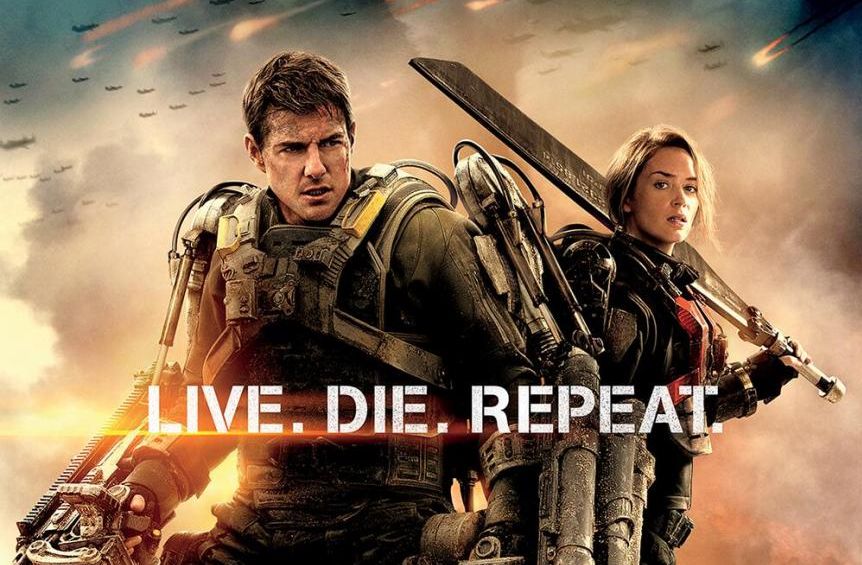
Top 5 reasons EDGE OF TOMORROW works — and why it redeems Tom the Cruise

Edge-of-Tomorrow-Poster

Not because the movie is great, though it is.

Not because the director the same amazing man behind THE BOURNE IDENTITY. And not because Emily Blunt and the other supporting actors nailed it.

I almost didn’t see this film because of my antipathy for Tom Cruise, and yeah, I’d lost respect for him the last few years. But this bit of cinema goes a long way toward rehabbing Cruise as a blockbuster star, though not for the reasons you’d expect.

Warning: spoilers. Also, I refer to action heroes as “he” for simplicity, and yes, Ronda Rousey and other female action stars are amazing. 

5) Reversal of tough-guy expectations
Most action stars have an actual background in Being a Tough Guy.

Arnold Schwarzenegger was the king of bodybuilding. The rest of the cast of THE EXPENDABLES 12: ANARCHY AT THE AARP MEETING is full of martial arts maniacs, pro wrestling hulks and mixed-martial arts studs.

The fact that Tom Cruise is short in real life isn’t an impediment here. Jackie Chan, Jean Claude Van Damme and Jet Li could all fit in the back seat of a Yugo.

Doesn’t matter. They look big and tough on screen.

The difference? While he did all his own stunts in this movie, just like the toughest Tinseltown tough guys, Tom the Cruise can actually act. Shockingly, acting ability tends to matter on the big screen.

4) Humor that’s deeper than one-liners and puns
Another staple of action movies is a bit of comic relief to balance out all the explosions.

Bond is notorious for bad puns, like “She always did like a good squeeze” after Remington Steele dispatched Onatopp, who later fell in love with Wolverine.

Schwarzenegger is famous for his one-liners, too. I’ll say the phrase and you’ll know the movie:
“I’ll be back.”
“Consider that a divorce.”
“Stick around.”

For action stars, that’s about all the humor than can typically muster, unless their name is Jackie Chan or Jason Statham and they know how to make a fight itself funny.

The humor in action movies is almost always about other characters. The hero is a straight man.

EDGE OF TOMORROW has humor throughout, and it’s far more sophisticated and varied than puns, one-liners and physical gags.

That takes actual acting chops, which Tom has. He uses them, often to get laughs at the expense of his own character. It’s different and refreshing.

3) Acting range
ROADHOUSE is a cult classic that turned Patrick Swayze into a believable action hero, if only for one movie, despite the insane chasm between dirty dancing with Jennifer Gray and bar fights alongside Sam Elliot.

But the range of most of these stars goes like this: brooding while looking off into the distance, brooding while ignoring the love interest, brooding while training, brooding while handling weapons and gear and, finally, grimacing in pain while being tortured by the bad guy before he escapes, throws the villain down a bottomless pit and broods while walking off into the distance.

Not a lot of range there. It’s like the famous internet chart, the Many Moods of Batman.

Tom has plenty of range, which he uses to connects with his co-stars — and connect with the audience in a variety of ways. Other action heroes typically focus on a variety of ways of dispatching bad guys.

2) Improving on the graphic novel

The movie differs from the original graphic novel, and this time, that’s a good thing.

In the novel, the alien Mimics reset the day with three separate ingredients: a Server alien, an Antennae and a Backup Antennae.

Bit complicated. And the novel has the Emily Blunt character turn on the hero at the end, because she figures out she’s the Backup Antennae and the day will keep resetting unless the hero kills her.

This is all too Connor McCloud vs. Duncan McCloud.

The movie simplifies things: there’s an Alpha alien that looks different than the others and has the power — along with the big, immobile Omega brain — to reset the day. If you kill the Alpha and get its blood splattered all over you, that power to reset the day gets transferred. The catch: you have to die, every day.

In the movie, Emily Blunt’s character doesn’t fight Tom Cruise and make him kill her. The climax does something great: it strips Cruise and Blunt of all their powers and gadgets.

Before, she and Cruise both had mech suits and Cruise had the power to reset the day. The climax takes those things away. Cruise only has one shot, one life, and they have to do it without the suits and guns. The stakes are much, much higher.

1) Go ahead and hate him in Act 1
A huge weakness of most action movies is there’s no character arc, no growth.

The hero is a smooth, handsome killer in Act 1. He breaks necks (and hearts) in Act 2 as a warmup, then mows down an army of bad guys in Act 3.

The hero doesn’t really change: he’s awesome the first time you see him, the most skilled and deadly killer around, and it takes an army of bad guys to even match up with him.

In this film, Cruise’s character starts out as a jerk and a coward. Not a little jerk. A big one. And not simply a coward, but a soldier who tries everything to avoid going to the front lines.

So if you started out disliking Cruise, as I did, his character isn’t trying to change your mind. At all. He isn’t saving the cat (Blake Snyder!) in the first scene. The script embraces your ambivalence or dislike of Cruise, and the movie works better if you don’t have a TOP GUN poster in your bedroom and all of his movies on BluRay.

Because the more you dislike or hate Cruise in Act 1, the bigger the journey will be by Act 3 — and real momentum comes not via intensity, but from the emotional distance traveled. If you love a character in Act 1 and love him in Act 3, there’s no journey.

The script doesn’t flip a magical switch, either, and say, “Okay, now you’re supposed to love the guy from here on out.”

Cruise’s character evolves, slowly, and not always in a linear way. There’s a great scene where he gives up. Instead of fighting the same battle on that beach for the 159th time, he steals a motorcycle, goes to London and has a giant pint of beer. This isn’t a throwaway scene. The director, and screenwriter, are surprising us by letting the character make different choices. The hero isn’t your typical action hero robot, plowing ahead to save the day no matter what. He’s human and flawed.

In the end, Cruise’s hero sacrifices himself to protect others. There was a lot of resistance, internally, to him making those choices. His character didn’t always do the heroic thing.

So there’s more to saying this movie is like GROUNDHOG DAY crossed with INDEPENDENCE DAY, and yes, I bet somebody on YouTube already posted a mashup called GROUNDHOG INDEPENDENCE DAY.

Bill Murray’s character in GROUNDHOG DAY also starts out as a selfish jerk. There’s no single moment that turns him into a nice guy. He does bad things and makes all kinds of bad choices. Only in the end does he figure out that becoming a better person takes more than charm and wit. It takes sacrifice and selflessness to get him there.

EDGE OF TOMORROW might have worked with another, unblemished actor. Matt Damon is talented and worked with this director before, and he put on a similar mech suit in Elysium, so I bet he could strap it on just fine. But the movie wouldn’t be as good.

Let’s give props to Tom Cruise: just as Robert Downey, Jr.’s past troubles helped make him the perfect choice for Tony Stark, Cruise’s long rise and fall from grace helped make him the perfect person for this movie. He nailed it in a way that a lesser known – and better liked — actor simply couldn’t.

Top 3 reasons why DEAR KITTEN won the interwebs

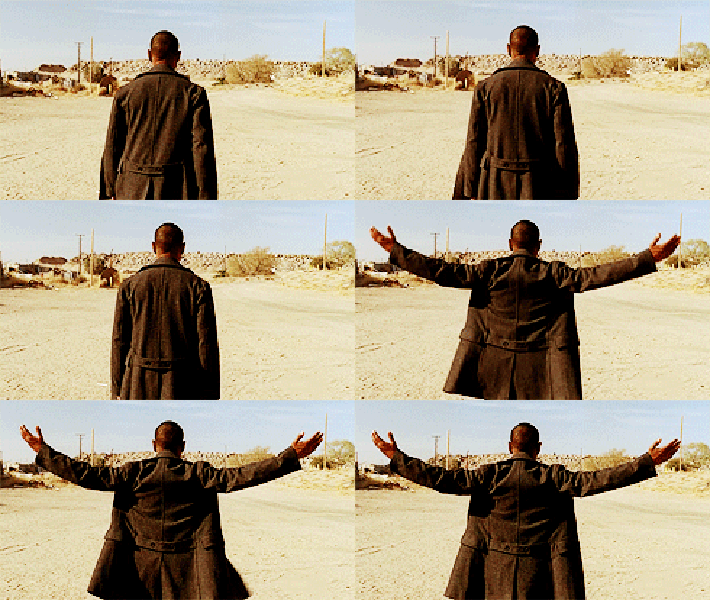
tinseltown tuesday meme morpheous

This is three minutes of film, via the Series of Tubes, that doesn’t have a single special effect or Michael Bay explosion. Yet it’s blowing up the Series of Tubes like nobody’s business, and not simply because it has cats.

Watch it, then we’ll dissect this to see how — and why — it works so well.

Beautiful, right?

Here are the top 3 reasons why this snippet of film by BuzzFeed works so well:

1) This is actually a long ad for Friskies … with barely a glimpse of the cat food they’re trying to sell you.

So right there, it’s refreshing, since 99.999 percent of TV ads are in your face, hoping to grab your attention for three seconds before you (a) change the channel, (b) pull out your iPhone or (c) amble on over to pillage the pantry.

Even the insanely hyped Super Bowl ads, the ones that are so famous that we get backstory about the advertising folks who created them, despite the fact they look more like your neighbor Bill the Accountant than Don Draper — well, those supposedly amazing ads are typically disappointing. They try too hard. Too fast, too loud, too much. You can see all the money on the screen and yeah, a lot of it is wasted.

Instead of 30 seconds of cars zooming and Danica Patrick in a bikini selling web domains (don’t get that one, either), we get 3 minutes of slow, leisurely voiceover from a cat while B-roll runs wild.

And it is hilarious.

DEAR KITTEN is also different from some of the better Super Bowl ads, like the Darth Vader kid who starts the car using the force. Those are more like one-joke skits, except not so much that the repetition drives you nuts like a bad SNL bit that’s gone on too long. This kitten business isn’t Johnny One Note at all.

2) A different kind of funny

Most ads aim for broad humor, things that the lowest common demographic will get in a heartbeat. You know, people falling down, exasperated moms, Santa actually coming down the chimney and frowning because LIttle Billy ate all the cookies and drank all the milk.

DEAR KITTEN is a higher form of humor, with great writing. Here’s a section of the script I love, even after hearing it three times:

You should be aware that there are two kinds of food. The first is sort of a brown, dehydrated nibblet. I think they give us these because they are training us to be astronauts. Just a guess. The second kind is wet food. It is so special they keep it in little armored metal casings that no claw can penetrate. With no claws to speak of, the humans can somehow open them. It’s like some dark magic.

Now, that’s great writing, full of sweet little setups and payoffs.

3) Building up to a climax

The writing is good in the beginning, gets better in the middle and rocks at the end.

This is the opposite pattern from most movies, novels, TV shows and circulars in The Willapa Valley Shopper, and not simply because many writers got started at these things called “papers of news” where you’re brainwashed to write using the Inverted Pyramid, which is inherently boring and should be taken behind the barn and shot.

The best stuff goes first because when you pitch a movie, book or TV ad, that’s what you lead with. Otherwise, the thing won’t get off the ground. And that’s what they want to see in the script or the dailies: the awesome stuff you talked about, whether it was dinosaurs roaming the earth again or aliens invading Nebraska, you know, because their spaceships run on corn or whatever. But if you put the very best material up front, by definition the middle will get your junior varsity stuff and the ending will be complete rubbish, the bottom of the tank, the leftovers, the scrubs.

Check out the last part of DEAR KITTEN.

Dear Kitten: I should warn you of the monster known as “Vac-Koom”. It can eat and yell at the same time. And I’ve seen it eat everything. Seriously, like a paper clip and two cat toys. Didn’t even flinch. To hide from Vac-Koom, you may use the curtains of invisibility. Oh yeah, you’re good. Good hiding. Hoh, boy.

Dear Kitten: One final note. Once in a while, you might see a little red dot. I’m going to tell you this right now. It is real, and it can be caught. I did it once. I held it for a full minute. But when I lifted my paws, it was gone.

So Kitten, welcome to the household. You’ll do just fine.

Brilliant. I’m glad they saved the best for last. Vac-Koom and the Curtains of Invisibility will become part of internet lore now.

French filmmaker’s epic tribute to BREAKING BAD

Gus to the cartel: Bring it.

This video by Alexandre Gasulla contains everything I love about BREAKING BAD: the beautifully framed images, the music, the menace, characters who actually suffer and change and die.

Most television series are packed full of cardboard stereotypes and cliches that never change from episode to episode, unless the actor breaks out and bails for Tinseltown paychecks.

Even the best shows either jump the shark (Fonz actually did this on a motorcycle), forgets that when you turn a great villain into a pseudo-hero you have no villain at all (HEROES), gets seven times weirder than necessary (LOST) or simply limps on too long past its expiration date until the network cancels the thing and the showrunners throw together a Giant Flashback Episode, because otherwise, all the actors who bailed to become movie stars won’t be in the finale at all (every TV show ever).

BREAKING BAD ended on its own terms, the story complete. Thank you, Alexandre, for making this work of art celebrating a work of art.

Related post: Top 5 reasons Breaking Bad was insanely good

Why the classic movie DUNE is a hot mess

tinseltown tuesday meme morpheous

I remember watching DUNE in the theater and thinking, “Whoah.”

Then again, I was a whippersnapper with no taste when it first came out. So on Old Movie Night, we popped in DUNE and fired it up.

Oh my.

There’s no doubt that DUNE is a hot mess. The question is, why?

Suspect No. 1: Horribly Cheesy Special Effects

This is a good place to start. You can’t excuse David the Lynch for not having access to better special effects, not when this movie came out after all three of the original STAR WARS movies were out.

Check out the trailer and tell me the effects are up to snuff, even for the era.

So, the effects in DUNE are Dr. Who-level lame. You expect the rocks to some styrofoam they bought off the old Star Trek set.

But bad effects aren’t the main reason this film is a hot mess. An audience will forgive bad effects if the story and characters are compelling.

Suspect No. 2: All Kinds of Crazytown

You don’t hire David the Lynch to direct a normal movie. You hire him to spice things up and go a little nuts.

Being absurdly weird can earn your movie cult status, with college kids playing it simply for the biggest excesses and worst moments of wackadoodle.

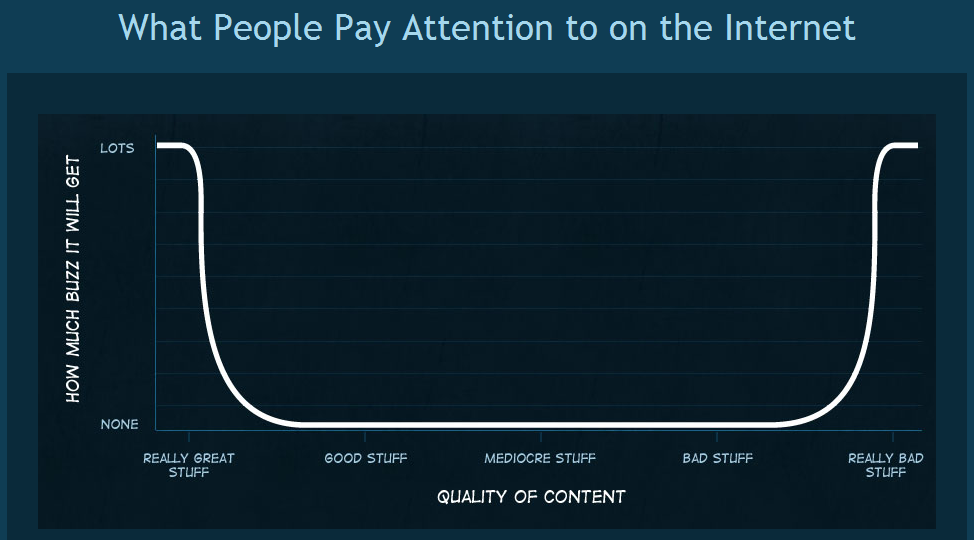
Moderately good or bad things are mediocre and boring. Give me stuff that's horrifically good or amazingly bad, then we'll talk. Kthxbai.
Moderately good or bad things are mediocre and boring. Give me stuff that’s horrifically good or amazingly bad, then we’ll talk. Kthxbai.

Then again, the tough part is once you base-jump off the Cliff of Normalcy, there’s no guarantee your chute will open.

And this film sprints away from Normal, stiff-arms Edgy and slides right into Bizarre.

This is half of the reason the film is a hot mess. You’re constantly distracted, sometimes by the bad effects, but more often by the weird, bizarre and gross sideshows that don’t truly move the story. The Baron Harkonnen’s massive zits get a ton of screen time. The Guild Navigators are grotesque. The bad guy troops have reverse mohawk hairdoes while the good guys wear surplus World War II uniforms. It’s constantly and consciously odd, which pulls you out of the story.

But if the story kept moving, I wouldn’t have had time to focus on all the weirdness.

Suspect No. 3: Ponderously Beating the Audience with the Cudgel of Pretentiousness

This is the true culprit.

Audiences will believe in sorcerers and elves if you don’t explain them. They’ll buy lightsabers and aliens who are into M & M’s — but not if you get pretentious and deep trying to explain all those things.

See, audiences want to believe. If you set things up from the start, they’ll stick with you. What you can’t do is (a) switch mid-way though a normal book or movie to say “Hey, actually the hero is a vampire. Surprise!” (b) commit the Hollywood sin of double-mumbo jumbo — trying to have a story that’s about dragons and trolls … plus space witches with lightsabers or (c) constantly stop the story to intrude with pretentious narration and dialogue that’s on the nose.

It’s that last sin that DUNE commits right away, with a long narration setting things up following be another and another and another.

Every time the story moves forward two inches, somebody has to stop to explain it to the audience for three minutes, as if we aren’t smart enough to watch the story and understand.  It feels less like a movie and more like a lecture. Then the credits roll.

I bet there’s a supercut of DUNE somewhere, a lot like STAR WARS: THE PHANTOM EDIT where some kind person sliced out all the boring nonsense, like Jar Jar Binks and all the talkative scenes where George Lucas is patiently over-explaining things to you and ruining the Force forever by saying it’s caused by space bacteria or whatever. No.

DUNE breaks new ground with the Unnecessary Voiceovers by having every actor whisper a voice-over of what they’re thinking, which is usually stuff the audience already knows, but hey, beat them on the head with it again.

Which is too bad. There are great actors in here like Kyle MacLachlanPatrick StewartSting and Jürgen Prochnow. A less wacky, less ponderous film with the same cast would have been awesome, even with the same cheesy special effects. It would also be far shorter and more watchable.

Why THE LEGO MOVIE works like magic

tinseltown tuesday meme morpheous

Movies based on toys, or cartoons from the ’80s designed to sell toys, tend to suck like Electrolux.

THE LEGO MOVIE is a happy exception to this rule. It’s worth talking about how they accomplished that trick.

They didn’t do it with snazzy special effects and big-name actors. Just about every film based on toys has great CGI explosions and big actors who aren’t so big that they won’t cash a giant check: BATTLESHIP had Liam Neeson, TRANSFORMERS had Megan Fox, G.I. JOE movies have had the Rock and Bruce Willis.

What makes this movie about interlocking bricks any different?

Reason Number 1: The Humility to Make Fun of Yourself

You don’t see the other toy movies doing this. They try hard–too hard–to be serious, and real, and only tangentially related to all the toys they want your kids to buy.

THE LEGO MOVIE has the guts to poke fun at itself, not once or twice, but during the entire film. Relentlessly. Brutally. Hilariously.

Reason Number 2: Subverting and Smashing Conventional Storytelling

This is the real secret. THE LEGO MOVIE picks up typical Hollywood structure by the throat and body slams it to the asphalt.

A normal action movie features a cartoon hero (Schwarzenegger or Stallone, Bruce Lee or Bruce Willis) who’s tough and cool in Act 1 and doesn’t change by Act 3. In fact, this hero doesn’t change, suffer or grow in any of the sequels.

Instead, the writers of this movie picked a hero who’s an Everyman that the prophecy says will become great and powerful, and save the world … except he never really gets those powers, and the prophet (Morgan Freeman!) admits in the end that he made it all up. There is no prophecy.

In parallel, the screenwriters take Batman, who stands in for your typical cool/tough hero, and show that he’s actually a hot mess. Is he still tough and capable? Sure. But you see the real man behind the façade, and it’s funny and insightful.

The villain is where the writers truly nail it.

In a typical action movie, there’s a cartoon villain doing evil things for no apparent reason other than he’s a villain and that’s what they do. Then in the finale, the hero kills the villain in a dramatic one-on-one gunfight, swordfight or fistfight.

Not this time.

The villain in the Lego world is President Business, whose secret identity is Lord Business, and his evil plan is to freeze the Legos into position with his super weapon, the Kragle (Krazy Glue) while the hero is the only one who can stop him with the Piece of Resistance (the cap to the Krazy Glue).

The writers make the bold choice to break POV here, to switch over to the real world for the first time, showing a little boy playing with a city of Legos in the basement. It’s a museum that his father set up, with signs everywhere warning against not touching what has been perfectly constructed based on the exact instructions.

These aren’t toys, his father tells him. They’re interconnecting plastic construction modules.

In real life and the Lego world, the hero doesn’t win by killing the villain, who has the upper hand. There’s no miracle comeback by the good guys.

The Lego hero echoes the language of the little boy and convinces Lord Business / Dad in Real Life that he doesn’t have to do this, that he’s the most amazing and talented person, who could build anything, and that it doesn’t have to be this way.

There’s an acid test for any story, when you’re trying to figure out who’s the hero. Sometimes, it’s not obvious.

In this movie, the person who makes the biggest leap is the villain, who gains insight and makes the decision to reverse course and allow his son (and daughter) to play with what had become a Lego museum, a no-fun zone.

A brave and brilliant choice, and to me, that’s what makes the movie different.

Bonus featurette:

A little girl discovers rain — and what we all can learn from her

tinseltown tuesday meme morpheous

This video is simple, short and wonderful. Watch it for a second, and then we’ll talk about it. Because there are important lessons for any writer or storyteller.

Why does this work?

There are no words, no script, no production values. It’s just a little kid seeing and feeling rain for the first time in her life, and reaching out to touch it, taste it, feel it.

But it’s impossible to watch this without smiling and laughing. Without FEELING something yourself. And that’s a lesson grown-ups could learn from this toddler.

You have to feel the emotion you want your audience to feel. This is true whether you’re giving a keynote speech, writing a novel or filming a movie that Hollywood is spending $212 million for all kinds of robots and CGI explosions.

Watching this video, you feel pure joy and surprise. Why? Because that’s what this little girl clearly feels. She doesn’t need to use words to say it. We don’t need a narrator to explain it. She shows it with her face and body. And that’s more than enough.

Why WORLD’S END ended with a wimper

tinseltown tuesday meme morpheous

On four different British Airways 747’s to India and back, I watched many, many movies. And it’s worth talking about them not in a “hey, this is out on DVD, so should you fire up Netflix?” kind of way, but in a storytelling way.

Did it work? Why or why not?

WORLD’S END proves that talent doesn’t always equal success. This is a movie with great comedic actors, yet a structural problem kills it. Because it’s truly two different movies slammed together.

The first movie is a comedy about five mates in England getting back together for an epic pub crawl they didn’t finish as college kids.

The second movie involves robots from space, which comes as a huge surprise, and not a good one.

Simon Pegg is brilliant, and he teams up with his sidekick once again, like in SHAWN OF THE DEAD and HOT FUZZ. Brilliant!

This movie had potential but is not up to Simon’s usual snuff. The thing is, fixing this film wouldn’t take much.

While the Simon Pegg character is talking his buddies into returning to their home town for the crazy pub crawl, he could’ve dropped hints about drunken fights in pub bathrooms with possible robot imposters. A single line like that could’ve saved this movie.

But instead, we get an orphaned payoff with no real setup.

Bonus: Simon continues the stunt casting of former James Bonds with facial hair playing villains. Timothy Dalton with a Tom Selleck mustache was in HOT FUZZ and this time we’ve got Remington Steele with a goatee. Loved this.

A montage set to music: The best movies of 2013

tinseltown tuesday meme morpheous

Movies are all around us. Kind of like the Force, before George Lucas ruined it with all that claptrap about midichloridians or whatever.

Films live inside your TV, your iPhone, your laptop. They’re sitting on shiny metal disks and even being celebrated in these insanely large and dark stadiums where you pay $12 for popcorn and a Diet Coke that costs 20 cents.

And if you’re anything like me, movies are something magical.

So there’s this professional movie critic, David Ehrlich, a man you’d think only takes joy in ripping apart SMURFS 3: ARE WE THERE YET, PAPA SMURF while praising some black-and-white existential French movie where the hero finally kisses the girl and promptly gets hit by a bus–well, you’d think critics like him wouldn’t create something so joyful and beautiful as this.

Except of course he would. Why does anybody become a movie critic, book reviewer or rock journalist? Because they love nothing more than movies, books and making fun of Axl Rose and Vanilla Ice trying to stage a comeback.

THE AMAZING SPIDERMAN 2 skips right to three villains, which is nuts

tinseltown tuesday meme morpheous

So, it’s the second movie in the series that already had three movies in its previous incarnation. Let’s skip the usual insane pattern of having two villains and go straight to three: Electro, the Green Goblin and Rhino. Seriously?

This is getting a smidge ridiculous. Will we see four villains in the third movie and five in the fourth? The original trilogy of Spiderman movies starring Tobey Maguire went like this:

SPIDERMAN: one hero, one villain (Green Goblin, played by Sergeant Elias from PLATOON). Well done.

SPIDERMAN 2: one hero, two villains (Doc Octopus and James Franco, who likes to write novels while going back to college, plays the angry Son of Green Goblin by using all of the acting range of that dude who played Anakin Skywalker).

SPIDERMAN 3: one hero, three villains (Sandman, Venom and grumpy Son of Green Goblin).

THOR also followed this silly formula, with one villain in the first movie (Loki) and two villains in the second (angry pasty space elf plus Loki again).

The first movie that started our current comic-book movie craze, the original Batman directed by Captain Crazypants (love you, man), had one hero (the Batman, by Michael Keaton when he had hairs), one villain (the Joker by that dude from THE SHINING) and Alec Baldwin’s ex-wife No. 2 or whatever as the girl for Batman to kiss.

BATMAN RETURNS had two villains: Danny Devito in a fat suit, munching on raw fish, plus Christopher Walken with crazy hair, while the love interest was Michelle Pfeiffer rocking a catsuit.

BATMAN FOREVER featured Val “Top Gun” Kilmer as Batman, some man from Grays Anatomy as Robin, Jim Carrey going insane in a green bodysuit as Riddler and Tommy Lee Jones trying to camp it up as Two Face–so yes, so technically, this third movie in the series didn’t have three villains, but it’s a hot mess of a reboot directed by Joel Schumacher, so all bets are off.

BATMAN AND ROBIN gave us two sidekicks (Robin again and a Clueless blonde famous for being in Aerosmith videos) plus three villains: Arnold in a neon suit spouting his worst one-liners ever, Uma Thurman wasted as Poison Ivy and Bane as a walk-on. This film was also directed by Joel Schumacher and is an even bigger mess than his first one.

It doesn’t have to be this way.

The rebooted and awesome Christian Bale-Christopher Nolan trilogy of Batman movies wisely veered away from the Hollywood formula of “For every new movie in a superhero series, pile on more villains and sidekicks until we have to reboot this train wreck.”

BATMAN BEGINS had two villains: Qui-Gon Jinn as Ra’s al Ghul (nobody can pronouce either name, so don’t even try) and Mr. Pretty Face himself, Cillian Murphy, doing an amazing Scarecrow, and yes, he was rumored to be in the running to play Bruce Wayne in the first place. Keanu Reeves would say, “Whoah,” except guess who turned down THE MATRIX to do some other movie? Will Smith. DOUBLE-WHOAH.

THE DARK KNIGHT gave us the two best acting performances for comic book villains ever, with Heath Ledger nailing the Joker and Aaron Eckhart rocking as Two Face.

THE DARK KNIGHT RISES could have three villains, if you count the cameo by Scarecrow, but let’s go with two and say Bane plus the sneaky Miranda Tate, daughter of Qui-Gon Jinn, and let’s give credit to Anne Hathaway as the best love interest ever for Batman.

So what can we learn from all this?

Hollywood executives, please pour your energies and not into hiring three different screenwriters for $2 million apiece to rewrite these train wrecks, but focus from the start on a simple truth: the more villains and sidekicks you throw into a script, the less you get out of them.

Why Hollywood is plagued by The Invincible Hero problem

Now that the Avengers have assembled into a giant machine that prints dollar bills, the X-Men are getting rebooted and Batman/Superman are teaming up to create billions more for an entirely different set of studio executives who live across the street from the Marvel folks, there’s something we need to discuss.

Because there’s a common problem with all of these movies–except for Batman, and we’ll get to that.

The Invincible Hero problem.

I’ve seen all three movies involving Thor and his hammer, and yes, the hammer has some crazy Norse name, and even though I’m a Swede nobody knows how to really pronounce the thing. IT’S A HAMMER.

Those movies are fun, and great, but tell me this: how do you hurt Thor, or kill him?

Because I don’t have a clue.

So there’s hundreds of millions of dollars in CGI explosions happening, and Iron Man grabbing Thor to fly him into trees and a cliff and such, but all amazing special effects that cost more than my house and your house and every dollar we’ll ever make in our lifetime, well, they don’t really move me, because I’m never worried about Thor being injured or killed.

You can throw the man around, blow him up, stab him with Loki’s sneaky dagger, punch him with the Hulk, and none of that really matters. The only proven way to hurt Thor is to remove Natalie Portman from the picture.

The first Thor movie was better than the sequel because for a good chunk of it Thor didn’t have his powers. He was just a man who could get hurt, lose a fight or even die, and it was his willingness to sacrifice himself and die that made Odin restore his powers.

See, when a hero is invincible, you don’t worry about them. And when you don’t worry about them, you stop caring about bullets and thugs and whatever else the villain is throwing around.

Superman is the worst offender. When you look at heroes on the screen like Wolverine and Captain America, they don’t seem to get hurt, since both guys regenerate and such. But they’re powers aren’t crazy like the boy from Krypton, who can (a) run faster than a speeding bullet, (b) fly, including going into space without needing to breathe, (c) shoot heat rays from his eyes when they’re not (d) busy taking x-rays of your bones, (e) ice anything with frost breath, (f) move so fast he GOES BACK IN TIME and (g) 17 other powers I don’t have time to list.

When you’re so powerful and invincible that tank shells bounce off your skin (Superman, Hulk) or armored suit (Iron Man), it’s hard to ramp things up without jumping the shark. Should we have Hulk get hit by a comet, or throw Superman into a black hole to see what happens? Also, no barber could cut Superman’s hair or trim his beard, right? He’d look like the lost fourth member of ZZ Top.

Batman is a better, more interesting hero because he’s simply a man. You know his bones can break, that the villain can truly hurt or kill him. It matters.

Hollywood could fix this problem, if it cared to, by setting up in each of these bazillion-dollar stories not just how cool the hero is and what amazing things he or she can do.

Tell us, up front in Act 1, what the hero can’t do. Show us a few weaknesses and how they can get hurt or even killed. Because then in Act 2 and 3, we’ll care a lot more about those CGI explosions and bullets as part of the story instead of eye candy that doesn’t really affect the story.