A classic, and the first video I remember seeing on MTV, and one of my favorites.
Great song. Great video.
As a special bonus, I found the lyrics.
All of them.
And yes, the Red Pen of Doom couldn’t resist taking a shot at interpreting each line.
Boy!
(My friend, who doesn’t need to be named, and is a male, though possibly not a man, and definitely not a boyfriend, but a buddy.)
Boy!
(I say this twice to reinforce my greeting and to use it as a shout, sort of a combination of “Hey!” and “Man!” and “Can you believe this nonsense?”)
Down in the street there is violence
(There are sometimes assaults and murders that I did not commit, or authorize, and this worries me.)
And a lots of work to be done
(I have things to do, people. I don’t always hang out in my living room singing at the TV or ride my motorcycle around empty streets.)
No place to hang out our washing
(The economy is so bad, and living quarters so cramped, not only do I fail to own a washer and dryer, I don’t even have enough space to hang my clothes out to dry.)
And I can’t blame all on the sun, oh no
(The fact that the weather here is glorious doesn’t cause anyone to be unsuccessful. There are other reasons.)
Alexandra popped a steaming potsticker into her mouth and bit down. The crisp bottom skin gave way and thick, salty pork stuffing spilled (“thick, salty pork stuffing spilled” is a whole lotta modifiers and alliteration) salty pork spilled onto her tongue. She waited for the spicy heat of the sriracha to start burning up the back of her throat, but it didn’t come. Chewing, chewing, chewing, and no heat. Without a thought, she plucked the skillet from the heat and dumped the rest of the plump, white puffs into the trash. with a sliding sizzle (More alliteration brought to you by the letter S, which is too much for the same paragraph)
Shesnapped (snapped is bitchy) turned around, coming face to face with the new prep cook, Marcus, who waited on her response. His brown eyes round (I believe most eyes are round instead of square ), he stared back in unblinking silence. Lexi (Hold up: is this a new character, or the same one? Let’s pick a first name for the heroine and stick with it) slammed the skillet onto a cold burner and sucked in what she hoped was a menacing breath.
“How much hot sauce did you use? Precisely.”
Marcus stammered,. He picked up the wrinkled,hand-scribbled (Do people scribble with toes or put notecards in their laser printer?) notecard, and skimmed it. (Three commas in that little sentence is maybe three commas too many. Two short sentence with no commas is better.) “I followed the recipe.”
“You eyeballed it.” She drew closer to him, suddenly aware of how much she towered over his willowy frame. (Wait, is this a little kid, a student? I did not sign up to read LOLITA meets HELL’S KITCHEN) A quick twinge (Of what, chest pain?) almost made her back off, but Fiona’s words rang in her ears: hHow can you teach these kids if you don’t come down on them? How like Fiona (Who is Fiona?) to encourage beating someone into submission. Channel your inner Domme, honey. Easier said than done.
Notes from the Red Pen of Doom
There’s a deep connection between food and sensuality, so even a giant Swede like me can understand where Camryn is going with the whole foodie-romance thing. While Camryn the Rhys is a great writer and a good friend, I will resist the urge to go easy on her. She’s the female version of Batman — she can take it.
It’s well done. Nice mix of action, description and dialogue. Emotions also come through clearly.
Camryn can clearly write.
I like the idea of food and romance. Great. And the setup of this heroine — Alexandra or Lexi, whichever name you want to go with — is fine for a romance.
Little things threw me off, especially the kid thing. Do I want to picture a towering teacher being all mean to a scared little student? No. Lexi doesn’t seem sympathetic.
We need to see her save the cat, as Blake Snyder says, before we see her be this snappy and unpleasant.
But forget the little things. Let’s think about the big things for a bit.
Page one is the beginning. How is this character going to change on the page that says THE END?
My wild guess is that she’ll still be tough, if not dominant. That she won’t change that core part of her personality.
Maybe I’m wrong. Maybe she flips, and becomes kind in the kitchen and elsewhere after realizing that she put thousands of high school students and ex-lovers in therapy. Maybe she becomes a nun in Tibet after reading a biography of Mother Theresa.
I do know this: whatever genre the story may be, the best stories make characters take long, interesting journeys. Not as tourists snapping photos. As people.
For any romance, the ending is up, right? Two lovers get together.
So for a big journey, the hero or heroine should be alone and unloved on page 1.
And if we’re doing a foodie-romance, the end has the hero or heroine eating delicious food with a yummy love affair cooking on the front burner. Let’s think of the biggest possible journey: if the end is her being in control, in love and in touch with all her senses, then Page 1 should start with her being alone, afraid and out of touch with her senses.
So: I’d like to see this Lexi change and learn and grow. Is this a flat character that goes on a series of romps, or is there a real journey? Page one is where that journey starts.
What if the person on Page 1 lost their sense of smell and taste in an accident, and had to rediscover cooking and kissing and all of that? Hmm. That would be a big journey, wouldn’t it?
The Verdict: Good writer, good writing. I worry about the head fake toward LOLITA meets HELL’S KITCHEN, and I want to see Alexandra/Lexi/Fiona or whoever actually change and grow from Page 1 to THE END.
The news about Walter Berglund wasn’t picked up locally – (add spaces here to match dash format in 2nd graf) he and Patty had moved away to Washington two years earlier and meant nothing to St. Paul now – but the urban gentry of Ramsey Hill didwere not so loyal to their city as not to(if we can replace 10 words with one word, those 10 words are deader than Charlie Sheen’s acting career) read The New York Times, which ran According to a long,and very unflattering story in the Times, on how Walter had made quite a mess of his professional life out there in the nation’s capital. His old neighbors had some difficultytrouble reconciling the quotes about him in the Times (“arrogant,” “high-handed,” “ethically compromised”) with the generous, smiling, red-faced 3M employee they remembered pedaling his commuter bicycle (maybe bicycle geeks know or care, but humans do not get into bike vs. commuter bike, and I’m entirely unclear whether Walter was a U.S. Senator or a staffer or a lobbyist, and how he made the transition from bigshot in Congress or whatever to 3M employee on a bicycle, or whether he started as a nothing at 3M on a bike and went to D.C. or is now pedaling to work after screwing up big enough to be in the Times yet not go to federal prison) up Summit Avenue in February snow;. (let’s use a period, because semi-colons at the end of endless sentences are for professors and pretentious chowderheads)It seemed strange that Walter, who was greener than Greenpeace and whose own roots were rural, should be in trouble now for conniving with the coal industry and mistreating country people. Then again, there had always been something not quite right about the Berglunds.
Walter and Patty were the young pioneers of Ramsey Hill – the first college grads to buy a house on Barrier Street since the old heart of St. Paul had fallen fell on hard times three decades earlier. They paid nothing for their Victorian and then killed themselves for ten years renovating it. (contradicts last sentence of the first graf, since buying a beater house and working crazy hard to fix it says there’s something very right about the Berglunds)Early on,Some very determined person torched their garage and twice broke into their car before they got the garage rebuilt. Sunburned bikers descended on the vacant lot across the alley to guzzledrink Schlitz and grill knockwurst and rev engines at small hours until Patty went outside in (Drunken bikers would be afraid of some housewife? Um, no.)
(end of page 1)
Notes from the Red Pen of Doom
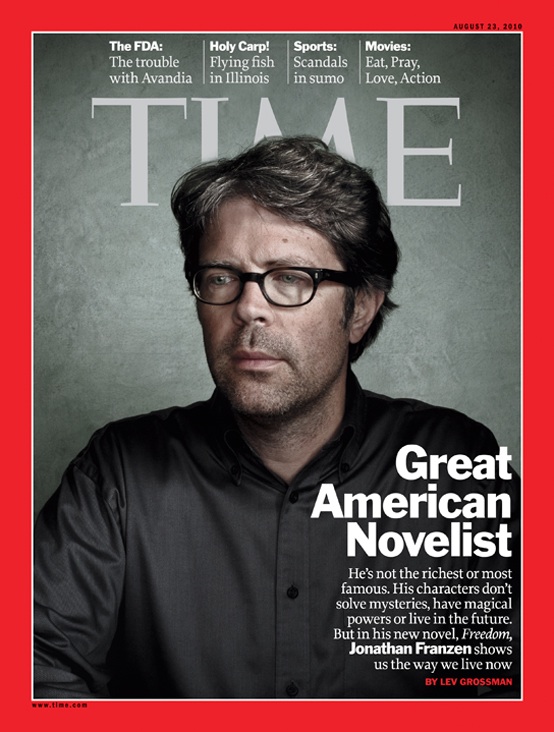
Yes, I know that critics went gaga over this book, and they loved THE CORRECTIONS, too.
I hate this first page. It rubs me wrong, and makes me feel like I’m about to read a 895-page doorstop of a book, something my sadistic Contemporary English Literature professor assigned me to read as punishment for my literary sins.
Here’s the deal: Franzen writes about families in the suburbs. Basically, the same topic that every sitcom has tackled for the last 50 years. Instead of making it funny, he makes it deep and depressing.
Is what Franzen writes – when he closes his eyes and composes after receiving inspiration directly from a muse that circles his head and descends, like a butterfly, or a silken bat, to kiss his unshaven cheeks with the kiss of creative genius – is it fun to read? No.
Don’t care about Walter and Patty as characters. I’d rather read about that biker gang guzzling Schlitz and grilling knockwurst while the talk smack and plan crimes that go epically wrong.
As with all literature – as Camryn Rhys or Elisa Logan would say, LIT-rah-SURE – the beginning is deep and mundane and depressing. It only gets worse from there. While the writing may be beautiful and amazing (though it is not beautiful or amazing on this first page yet) that’s not going to make me want to read more of the story. If I want to be depressed, I’d watch daytime TV.
The first page is all over the place. Also, he adores adjectives and adverbs, while I believe, deep in my dark heart, that all those modifiers simply mean Franzen should’ve picked stronger nouns and verbs in the first place.
It pains me that Franzen is half-Swedish and spent time in Germany as a student, because I am Swedish and lived in Germany as a child. But we are nothing alike, and I care nothing for this first page.
Which is too bad. Franzen has talent to burn. I bet if he wrote about the biker gang instead, it would be seven separate flavors of awesomesauce, and the Coen brothers would make a movie out of it.
Verdict: From this first page, you’d have to hand me stacks of purple euros to convince me that reading FREEDOM would be a good use of my limited time on this planet.
I marvel at how people like Snooki and The Situation and the Kardashian sisters are famous, or infamous, though they wouldn’t know the difference if you flew in a Harvard linguist professor to explain it to them every morning.
Snooki has a book deal. The Kardashian sisters have clothing lines and money coming out of their ears.
The joker who calls himself The Situation in on track to earn $5 million this year.
I have witnessed episodes from the first season of Jersey Shore by using the power of the internets, and I have come to an epiphany.
These people are not making scads of money, scoring book deals and dancing badly on “Dancing With A Few Stars and A Bunch of Other Schmucks” in spite of their obvious handicaps in the areas of brains and common sense.
Just up the road from the beaches of New Jersey are thousands of people on Broadway who can sing, dance and act. Many of them are gorgeous. In every way, they are clearly superior to the reality stars picked by producers to invade our lives. So why aren’t they making $5 million a year and getting on the covers of all the tabloids?
Let it be known: These reality stars are not chosen and elevated in spite of their lack of common sense. They are famous precisely BECAUSE OF this very flaw.
Normal, well-adjusted people are boring. They don’t make for exciting television.
If a film crew followed you or me around for 24 hours, they wouldn’t get footage of four random hookups, two screaming matches and a bar fight. They’d get film of us driving to work, doing our jobs and fighting traffic on the way home to have dinner. If you’ve got pookies, maybe you take them to soccer or baseball or whatever. If you’re young and single, maybe you catch Arcade Fire if they’re in town.
You would not spend three hours showering, spray tanning and doing your hair to get ready to go clubbing, then get into a bar fight.
You would not steal your roommates latest girlfriend, as they have been a steady item for at least 48 hours, which is a record. You would not drink all of the booze in the house and call your father at 3 a.m. while you were crying and whining about your boyfriend being pissed about that fact that you slept with a roommate or three.
You would not not order pizza and tell the pizza man that your last name is Situation and your first name is The.
And therefore you do not have, and will never have, a reality show.
Howard Roark laughed. (I approve of this. It asks a narrative question – who is this guy, and why did he laugh? – and I like short sentences anyway.)
He stood naked at the edge of a cliff. The lake lay far below him.A frozen explosion of granite burst in flight to the sky over motionless water.(Whoah, whoah, hold up. So far, it was all tight and Hemingway-esque. “The pants fit him. They felt good.” Now you suddenly switch to purple prose, with granite bursting in flight? I didn’t know that granite rocks flew, or exploded when they did decide to take wing. No.)The water seemed immovable, the stone flowing. The stone had the stillness of one brief moment in battle when thrust meets thrust and the currents are held in a pause more dynamic than motion. The stone glowed, wet with sunrays. (More purple prose. Hate it. Though I do smile at all the double-entendre action. Let’s try again.)
The lake below was only a thin steel ring that cut the rocks in half. The rocks went on into the depth, unchanged. They began and ended in the sky. So that the world seemed suspended in space, an island floating on nothing, anchored to the feet of the man on the cliff.(What? I think Ayn Rand was smoking a bowl here.)
His body leaned back against the sky. It was a body of long straight lines and angles, each curve broken into planes.(Things are either curved, straight or angled. That pretty much covers it. Maybe the only other people in this book are Flat Stanley and the Blob.) He stood, rigid, his hands hanging at his sides, palms out. He felt his shoulder blades drawn tight together, the curve of his neck, and the weight of the blood in his hands. He felt the wind behind him, in the hollow of his spine. The wind waved his hair against the sky. His hair was neither blond nor red, but the exact color of ripe orange rind. (No man would ever describe his hair as “ripe orange rind.” He’d say, “I’m a red-head” or “I’m blond” or “I don’t know.”)
He laughed at the thing which had happened to him that morning (Oh, right. So funny!) and at the things which now lay ahead. (Yes — also hilarious. I laugh at that all the time. Maybe let’s use different ways to hint at backstory and do foreshadowing.)
He knew that the days ahead would be difficult. There were questions to be faced and a plan of action to be prepared. He knew that he should think about it. He knew also that he would not think, because everything was clear to him already, because the plan had been set long ago, and because he wanted to laugh. (Enough with the laughing about things that may or may not have happened, and difficult plans, and thinking about not thinking. We can go to this well once or twice, but not every sentence.)
He tried to consider it. But he forgot. (Or maybe we can jump into that well and stay there forever.) He was looking at the granite.
He did not laugh (Oh, we’re NOT laughing now?) as his eyes stopped in awareness of the earth around him. His face was like a law of nature— (You have got to be kidding me.)
End of Page 1
Notes from The Red Pen of Doom
I believe the readers of today – like me – don’t want (a) tons of purple prose, (b) paragraph after paragraph of character description or (c) 3.4 metric tons of purple prose that’s all character description and internal dialogue.
But there are bigger fish to fry here, both in the literary sense of Is This A Good Page One? and in the story sense.
Ayn Rand is a deity among conservatives, because her novels underpin what she calls the “philosophy” of objectivism, which says it’s quite unselfish to be selfish. This is obviously counter-intuitive and quite appealing in a juvenile kind of way, because hey, it’s now my moral duty to do whatever I want. The best way to take care of others is to only care about yourself. The surest path to aid the poor is to cut taxes for the rich. And so forth.
This philosophy intrudes upon the story. Roark, the hero of this novel, roughly has his way with Dominique, the heroine, when they first meet. She later describes it as rape. Dominique makes Sylvia Plath look mentally stable. To show her undying love for Roark, she marries … some rich man. Then she tries to destroy Roark, divorces that rich man to marry another rich dude, keeps on trying to destroy Roark, then finally divorces that other rich schmuck to marry Roark in the end, but only after Roark TRIES TO BLOW UP A BUILDING that he designed.
If you said “This is a book that makes a hero out of a selfish architect who’s a strong-willed, good-looking rapist and terrorist,” you’d kinda sorta be accurate. And yes, I read the entire book. Twice. I WROTE A PAPER ON IT.
So the first page does foreshadow a lot of things. Ayn Rand has “a frozen explosion of granite” in the second graf. She has a whole bunch of imagery and descriptions of Roark’s perfect body.
HOWEVER: If I hadn’t already read this book, I’d see this first page and think it was some kind of historical romance, with Roark’s kilt and dirk sitting over on that rock, his trusty horse waiting for him after he took a swim and rode off to rescue his favorite maiden, a red-haired beauty held captive by the twisted and disfigured Baron of Whateverthehell.
Otherwise, I don’t hate her writing per se. I merely despise it.
Usually, I can fix a line or a paragraph. Big chunks of this first page simply need to die. The best thing is to cut them out.
Does that whack about half of this first page? Yes.
Would that make it better? Yes.
There’s a weird mix of styles going on here. You get short, clipped sentences, tight and hard, with zero fatty modifiers. But then Ayn the Rand switches to long stretches of not only purple prose, but outright wackiness I expect from college sophomores writing flash fiction at three in the morning on the deadline day after hitting the bong FAR TOO HARD.
The Verdict:
There’s a reason 12 publishers rejected this novel before it found a home. Hate the first page. Hate the hero, and the heroine who tries to destroy Roark because she loves him so much. Hate the story. Hate the “philosophy.” It’s a tough call, whether THE FOUNTAINHEAD or OUTLANDER are more deserving of being thrown across the room. But I’m going with THE FOUNTAINHEAD.
Twitter isn’t built to sell books. Or anything else.
Yet if you belong to the Twitter, you see all sorts of authors pimping their books.
Some do it subtly, or randomly. Others do it faithfully, if not relentlessly.
And even if they mount a full Social Networking Offensive — a combined-forced attack with tweets on the ground, blog battleships at sea and Facebook fighter planes swooping down from above — even if they do all that, they will fail.
Attack of the Internet Fanboys
Oh, this is sacrilege. I know it.
Internet Fanboys believe that the Twitter, the Book of Face, blogs, the entire series of tubes — hey, that’s the future. Old Media is so old. They say, “Social media once was the student, and now it is the master. If you only KNEW the power of the Dark Side…”
Except they’re wrong. No matter how much you want it to work, how hard you squeeze your eyes and reach for that Internet lightsaber, it doesn’t fly through the air and into your hand. Even when you pick it up and push the button, nothing happens.
Faith isn’t enough.
Here comes the science
But spam works, right? And it uses the series of tubes.
Sure spam works. That’s why most email being sent today is spammalicious. Scammers send billions of emails every day, despite all the spam filters and barriers, because all they need to make money is a 1 percent response rate.
One percent. That’s a terrible success rate. Horrible. That’s like asking 100 girls out and hoping one says yes. But with enough volume, you can make money.
Surely, authors will do better than spammers. They aren’t peddling cheap Viagra and penis pills. They’re (a) pitching great books and (b) targeting their audience to book lovers rather than random people, therefore (c) the response rate for authors should be way, way better than 1 percent.
These are your internet friends, fans and family, right? They know you. They talk to you every day. They’re gonna buy your book.
But they don’t.
Want to know why?
Snooki vs. Nathan Bransford
Snooki can’t string a sentence together without committing sins against the English language. Yet she “wrote” a novel.
Nathan Bransford, on the other hand, is a muffin of stud.
He was a literary agent and understands the business of selling books
The man looks like a movie star.
He’s got 100,000-whatever Twitter followers and a blog with a lot of hits
He wrote a great book — a YA novel, which a hot genre, and his book got buzz and good reviews
THE MAN LOOKS LIKE A MOVIE STAR
If there ever was a picture of literary studliness, it’d be Nathan.
This isn’t an agent writing a book about writing (cliché). This man is writing a novel (brave!). So if anybody was poised for success using the Series of Tubes, it’d be this man.
I don’t know Nathan, but what I’ve heard of him made me root for the man. People say nothing but nice things about him. Every indication is that he’s smart, talented, good-looking — a literary rock star.
And his book had buzz before it even came out. I expected — and hoped — that he’d have a best-seller.
Snooki, on the other hand, is firing blanks.
She’s more infamous than famous
No sane human being would call her a writer and nobody believes she wrote this novel of with her name on it
She’s a walking, talking train wreck — would you let her borrow your car or babysit your firstborn?
It’s safe to say Nathan’s audience — people who follow him on Twitter and read his blog — are literary types who not only love books, but actually BUY book via the series of tubes — or, if they’re feeling really frisky, walk inside giant buildings stacked with bazillions of books where they hand people pieces of paper decorated with images of dead white guys, or let them touch a rectangle of plastic, then the people who seem to live in this giant buildings hand you books of your choosing and complete the ritual by asking you to have a nice day.
You could also bet the farm that 99 percent of people who know Snooki’s name and have seen her on the Glowing Tube would never guess, not even if you put a Nine against their noggin and started counting down from five, that Snooki has ever read an entire novel, much less written one. Her most avid fans, the ones who don’t watch her for the live-action train wreck and the irony of wallowing in low-brow nonsense, are 125.6 times more likely to be in a tanning booth than a bookstore.
Before we make our predictions about how well Nathan’s book did vs. Snooki’s book-like substance, let’s do some math.
The math, it is BRUTAL Nathan having 100,000 Twitter followers should be a huge marketing advantage.
Marketing Architects used this formula: “If half the people in the networks actually see my posting, and one percent of them respond, and 5% of the responders buy, what will the outcome be?”
(possible audience) x (% who see it) x (% who pay attention) x (% who buy it) = sales
So for this example with Nathan: (100,000 followers) x (50 % see it) x (1 % pay attention) x (5 % buy it) = 25 sales.
Here’s another bit of math from Dan Zarrella, social media scientist, who I believe is the World’s Greatest Expert on Twitter.
He takes raw data from bazillions of tweets and studies the heck out of them. The rate for retweets is actually even more pessimistic than the first bit of math I used above from Market Architects. Now, retweets cost you nothing. The actual purchase of books, movies and whatnot will be far lower than the rate of retweets.
But let’s be generous and go with the actual math of what Dan has discovered from sifting through all that Twitter data.
Viral math formula from social media scientist Dan Zarrella, who is a Muffin of Stud.
Go read up on Dan the Zarrella, especially this post: Viral Math: R-Naught and Zarrella’s Hierarchy of Contagiousness. He’s a brilliant man, dedicated to using real science and math to get things done, and he hates the whole unicorn-and-rainbow advice out there about the series of tubes.
Back to the math: it’s brutal and evil. Surely this didn’t happen to Nathan, who I do believe is a literary muffin of stud. If I were a betting man, I would say no. He should buck this bad math and sell better.
Most authors don’t even have up-to-the-minute sales figures. We can’t know exactly how many books sold. We can get a good peek at Amazon sales, though, and if the Internet Fanboy theory is right, when you pimp your book via Twitter and Facebook, people click their mouse and presto, massive online sales.
The Amazon sales rank of Nathan’s book is 267,136 — which doesn’t tell us anything yet.
Rachelle the Gardner, another literary agent with a blog and a brain, blogged about a study from a major publisher that tracked Amazon sales rankings and sales over six months.
Books ranked 1 to 750 = 75 to 275 sales per week
Books ranked 750 to 3,000 = 40 to 75 sales per week
Books ranked 10,000 or above = 0 to 5 books sold per week
So that rough math isn’t crazy, at least in terms of sales on the Series of Tubes. I bet Nathan sold more than that. Maybe his physical book sales were a lot higher. HOWEVER: the Internet Fanboy theory that tweets lead to online sales of books gets shredded here.
What’s the Amazon sales rank of Snooki’s novel? 13,812.
How could a literary loser like Snooki do better — with a terrible book — than a literary rock star with a great book and a huge online following of book-loving writer types?
Why this happened
Part of the reason is simply this: if you’re friends with 500 writers and authors, you can’t buy all their books. Because you couldn’t afford to pay rent.
Same thing with politics. People who work in politics naturally know hundreds of elected officials and candidates, but donate to very, very few. Why? Are they heartless? No. They can’t afford to do otherwise. If you work in politics and gave $200 to all 200 candidates you know, that’s $40,000 out the door. You’d be living in a cardboard box.
Same thing with books. Most of the 13,000-whatever folks I’m connected to on Twitter and the blog are writers and authors. Love these people. Some authors send me free ARCs or e-books, which is great, and I do buy books from authors I know sometimes. But you can’t buy them all. Let’s say only half of those folks have books out this year. $10 times 6,500 is $65,000 in books.
Therefore, I’m not shocked that book-loving followers don’t buy books from each other all day. We’d go broke.
Back to my favorite New Jersey train wreck, Snooki. She isn’t a special case or some crazy outlier.
There are scads of untalented hacks — people who couldn’t write their way out of a paper sack if you handed them a sharpened pencil, people who typically don’t even WRITE THEIR OWN BOOKS — who sell more books than great writers.
It doesn’t even matter how bad the ghostwriters do their job. These books sell like hotcakes anyway.
And no, I’m not talking about some weird subgenre of books that live an in alternative universe. These untalented non-writers sell all kinds of books: fiction, non-fiction, children’s books, whatever.
What’s the secret?
You know their name.
That’s it. Name recognition. Nothing is more powerful.
Kim Kardashian could do nothing more than wave her mascara wand over a manuscript that her agent had some ghostwriter crank out, and yet she’d sell more copies of KIM KARDASHIAN’S ILLUSTRATED GUIDE TO QUICKIE MARRIAGES AND DIVORCES than 99 percent of people who’ve dedicated their lives to writing literature so good you cry tears of unbearable joy and beautiful sadness.
Here’s a number that will blow your mind: Kim Kardashian makes $10,000 per tweet.
That’s right. Kardashian makes more for some 140-characters of product placement — something she probably has a staffer write for her in about 30 seconds — than some authors get for an advance on a book they spent years polishing and perfecting.
Kardashian got a reported $10 million for her fake wedding and could earn $5 million for her divorce. Yes, that’s a link to a story quoting an expert who has math backing him up. Click it and cry.
This doesn’t happen because Kim Kardashian is the prettiest woman on the planet or because oozes from her every pore. There are thousands of actresses on Broadway who can sing, act and dance circles around any of the Kardashians, but those Broadway actresses don’t have their own reality TV show.
Kardashian and Snooki make money, and sell books, because they are famous. Because you KNOW THEIR NAME.
I’ve written about name recognition for The New York Times’ about.com, as their expert on public relations, publicity and whatever. They sent me checks that said The New York Times on it, and I cashed those checks. As a journalism major, that was fun. The next three links are from stuff I wrote for that blog. There are reasons why corporations spend billions on ads that repeat the name of their company billions of times. Also, there is real science on how name recognition works — read it here at the brilliantly titled post, How Name Recognition Works — and finally, there are ways — evil, secret ways — to boost your name recognition.
(Yes, I know the last post says “Four Ways to Boost Your Name Recognition” when the url-whatever says Five Ways — this is a mistake. The internets, they are fallible, and I told folks to fix that long ago.)
Back to talentless celebrities who write books which make more money than people with writing talent on loan from God.
Glenn Beck wrote a terrible thriller, something that people said sounded like a bad parody of a bad parody, and yet it became a best-seller. Is he a talented writer? No. Did he even hire a talented ghostwriter? Nah. There’s no point in bothering with that when your name alone sells things.
Sarah Palin has “written” best-selling books that are — and this is a strange coincidence — all about Sarah Palin.
The fact these celebrities had best-sellers has nothing to do with talent and everything to do with name recognition.
That begs the question, how did they get such amazing name recognition?
Here’s the answer that will blow the minds of Internet Fanboys and make them wish they had the strength to run from the keyboard and wrap their Cheetos-covered fingers around my neck and squeeze really, really hard: all that name recognition came from dead, tired, obsolete OLD MEDIA.
It came from the millions of people who see Snooki and Kim Kardashian and Paris Hilton on the Glowing Tube.
It came from the covers of People and US and The National Enquirer, who seem to be spending a lot of ink on real housewives who are on reality shows despite the fact that many of these women are not housewives, or married, or interesting at all except in a train wreck kind of way. But they’re on TV.
It came from newspaper interviews and entertainment sites like TMZ and from tired, obsolete Old Media standbys like Entertainment Tonight and hip new cable shebangs like The Colbert Report.
And it came from the millions of people who listened to Glenn Beck on the radio.
All these people with huge name recognition are doing something far, far different than the hordes of authors and writers placing their faith in the power of social networking and the Series of Tubes.
They’re using Old Media. There’s a reason it’s called “mass media.” It reaches the masses.
Bottom line: You could spend three years building a popular writing blog and getting to 10,000 Twitter followers, or 100,000 followers, and it wouldn’t be as useful as 10 minutes on a cable reality show with a weekly viewership of 3.5 million.
Think about that. Ten minutes beats three years.
Social networking — it’s not social media — is for meeting people. A few hundred people, or a few thousand, but not millions.
Social networking is meant for dialogues, not monologues where you spew links asking people to buy something, even something as nice as a book.
If you want to reach a mass audience, you must use the mass media. Must. Not “should.” Must. IT IS REQUIRED.
Now, it is true that big corporations are spending a lot of money on internet advertising. Banner ads do reach millions of people. That’s advertising, not social networking. And yes, it boosts name recognition. It just costs a lot of money. Earned media — coverage by the press — is free and has more credibility than ads.
Even the worst movies are a publicity godsend It’s not an accident that a ton of big-shot authors got a rocket boost to their careers when one of their books became a movie.
Stephen King started out with CARRIE, which was a bestselling novel and then a movie — boom, off he went.
Scott Turow had an injection of Harrison Ford with PRESUMED INNOCENT.
Joseph Finder, Carl Hiaasen (funny man – but he needs more vowels, doesn’t he?), Elmore Leonard, Tom Clancy, Clive Cussler, J.K. Rowling — a ton of authors that are household names got that way not just from having bestselling books, but from having movies made from those books.
The power of name recognition is also why Hollywood has lost its mind and is busy making movies out of board games (Battleship – seriously) and Every Bad ’80s Cartoon Known to Man (G.I. JOE, TRANSFORMERS, HE-MAN, SMURFS and so forth).
Why are those good fodder for movies? We already know the name.
Here’s the rub: the movie doesn’t have to good, or a hit, for the author to get a massive shot of sales. That’s because studios spend millions promoting each movie.
You see endless trailers on TV, ads in the paper, posters. You hear radio ads and read reviews of the movie in the newspaper. The entertainment shows and blogs plug the movie, or pan it. The movie stars go on the talk-show circuit. Publishers put out new editions of the book that say, “Now a major motion picture starring this handsome man and that sexy woman on the cover, the two of them kissing while they hold a gun or whatever.”
Even if the movie bombs, the author just got millions of dollars in publicity, seen and heard by hundreds of millions of people around the world.
Am I saying you need a movie to sell a book? No, that’s not the point. I’m saying even the worst movie, and the worst book, will sell a lot simply because of the publicity budget Hollywood spends.
Let’s take a horrible example: BATTLESHIP was a bad, big-budget movie based on a board game. It only got made because toy companies like Hasbro realized they’ve built up so much name ID with G.I. Joe and Monopoly and every other toy, they can make bad movies with those titles and people will see them. And as a bonus, they can sell more toys, including special movie editions of Battleship and G.I. Joe dolls (sorry, “action figures”) and even rush books of the novelization of the movie.
Those bad books about bad movies based on toys? They’ll sell. Quality doesn’t matter when name ID is high.
Here’s the math: let’s saying only 200 million people get exposed to the trailers, reviews and hype for a movie. That’s a huge understatement, since movies make most of their money overseas now, and publicity campaigns for movies are global today, aimed at billions. Either way, I’m going with 200 million out of a sense of fairness, justice and equality or whatever.
(200,000,000 people) x (50 % see it) x (1 % pay attention) x (5 % buy it) = 50,000 sales.
That’s a bestseller right there.
The point is, quality doesn’t necessarily matter when exposure is that high.
The new math: to sell thousands, you need to reach millions
If you’re going from the other direction — high quality, no advertising and publicity budget — you can’t get to the audience needed via social media.
Without a big advertising budget, you’ve got to use the mass media to reach the masses. That means earned media, and reaching audiences in different ways.
Some people rely entirely on the Glowing Tube for entertainment and news. Other people listen to NPR as they drive to work. Others read the paper.
If you only focus on the series of tubes — and you don’t have a presence on radio, TV and print — then you don’t exist to those people. They’ll never see or hear your name.
But don’t tell the Internet Fanboys trying like mad to add more Twitter followers and Facebook friends and blog hits, like this is some kind of Tetris game where the winner is whoever racks up the highest score. “You just don’t understand the power of new technology — Old Media is so 1982.”
Think about big-shot authors again. What do they have in common? They go on book tours. They give interviews to newspapers and magazines and TV shows. They get movies made from their books.
They don’t just use mass media. They use the hell out of it.
Do most bigshot authors go all-out for social networking? No. Some ignore it entirely. Others have people handle that. Because it’s not critical. It’s a bonus rather than a pathway to success. They know something most people don’t: to sell 50,000 books, it’s not enough to tweet to 10,000 followers, or even 100,000.
You need to reach for a mass audience. Millions — or hundreds of millions. The only way to do that is through mass media.
The thing people can’t wrap their head around is that by using the Series of Tubes, anybody can reach any mass media market anywhere in the world, for free. But you need to know how to do it, and you need something worth that free ink and airtime.
The fact that your punk rock album / novel about elves with lightsabers / book of poetry Gertrude Stein would write if she were alive today is “super, super great” doesn’t get any ink and airtime. You can’t pitch quality — you need something worthy of free ink and airtime. And that’s a different topic entirely.
Daniel Craig put grittiness into James Bond — no more invisible cars and silly nonsense. He makes you believe he could kill you with a spoon.
Top Ten Thriller Clichés
Act I: A wealthy, disfigured foreigner toils late into the night
1. The Villain of the Week is a wealthy, disfigured foreigner who (a) steals a nuclear warhead, (b) plans to kidnap the president or (c) discovers a lock of Hitler’s hair and is busy cloning the Führer.
2. The Standard Hero is tall, dark and deadly. He used to work for the government, wears anything as long as it’s black — wet suit, tuxedo or cat-burglar outfit — and solves every problem by beating it up, blowing it up or sleeping with it.
3. The Villain of the Week has an endless army of faceless minions except for two people: (a) the femme fatale, who has a special bond with our hero because her wardrobe is also exclusively black, just tighter, and (b) a giant, impossibly strong thug who never speaks and has a signature way of killing people.
Act II: The Standard Hero wakes from his slumber to blow things up
4. The hero is out of the business and cares nothing for money, but the state appeals to his patriotism — or the villain kills his wife/girlfriend.
5. Although our hero is a lone wolf, he must now work with a team, including (a) one beautiful young sidekick who knows kung fu almost as well as the Kama Sutra and (b) a science nerd who provides exploding pens and tech support. He will also have (c) a Bureaucratic Boss, who will suspend our hero, then turn out to be a mole working for the Villain of the Week.
6. If the president isn’t involved, the prime minister of Britain shows up, plus a politician involved in the conspiracy, who will either be a slick, greedy senator with a southern accent or an ancient and decadent member of the House of Lords.
7. Between car chases and explosions, the femme fatale tries to kill the hero, who bests her, making her decide to sleep with him. This is how you know she is doomed.
Act III: The Big Showdown ends in a fist fight; never mind all the guns
7. The hero infiltrates the villain’s lair with the help of the femme fatale, who betrays him. The villain doesn’t kill him right off. He delegates death-by-torture to the femme fatale, who sets the hero free, then turns bad again at the last minute so she can have a long catfight with the beautiful sidekick.
8. After our hero kills countless minions, he faces the invincible giant. The hero uses the invincible giant’s signature killing move against him.
9. Despite the carpet of dead thugs clutching AK-47s, the Villain of the Week decides to fight the hero bare handed as the lair self-destructs. The Standard Hero dispatches the villain by (a) tossing him down an endless chasm, (b) impaling him on a massive spike or (c) throwing him down a chasm that ends in a massive spike.
10. Nothing changes. Our hero doesn’t change or grow — he’ll be back for more in the sequel.The world doesn’t change. The average person in Cleveland has no idea anything happened at all.
I’m having having a travel photo show — Pieces of the World: Photos on Canvas — 6 to 9 p.m. Friday, Nov. 18 at my favorite restaurant, Savory Faire.
Bottom line: canvas rocks. If you shoot photos, don’t print them on glossy paper and show off your pile of 4x 6 snapshots that you keep in a shoebox. No. Print your favorites on canvas. DO IT NOW. Because you could get hit by a truck tomorrow.
Sidenote: Is the title of the show just pretentious enough without being obscure and stupid? Maaaybe. Could I have gone with a photo-geek route with F-Stops in Eight Places? Sure, if I was a photo geek, but I actually hate messing with f-stops and whatnot.
Other rejected titles:
Snapshots of Where I Ate Fish Curry and Fermented Shark Hey, These are Actually In Focus, Mr. Fancy Camera Man I Rode on 43 Different Stupid Airplanes to See This Stuff
Some of the photos:
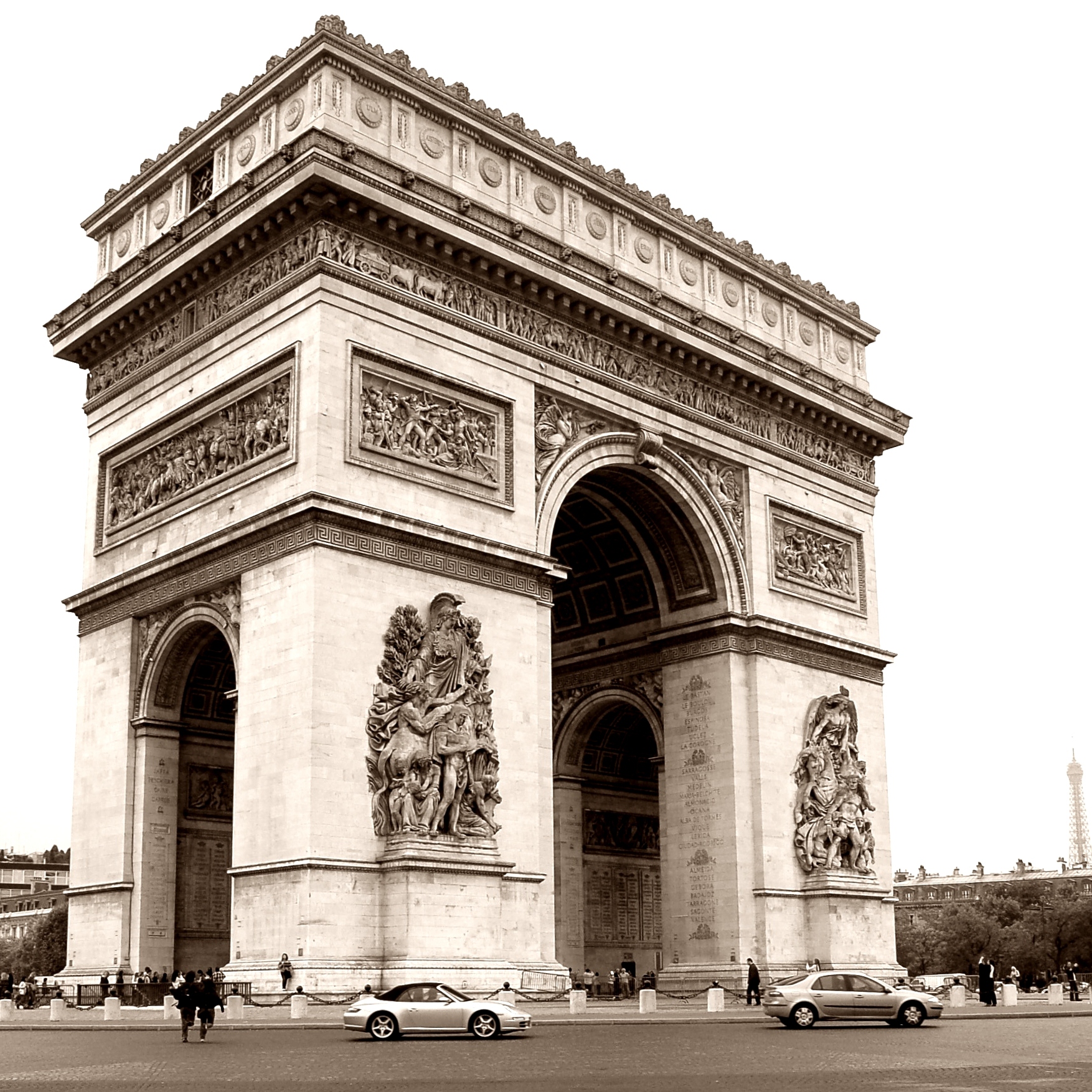
Arc de Triumphe in Paris, France. Photo by Guy Bergstrom.Houseboat in Kerala, India. Photo by Guy Bergstrom.Sunset in Stockholm, Sweden. Photo by Guy Bergstrom.Kerio volcanic crater, Iceland, where Bjork held a concert from a floating raft in the lake. The acoustics are glorious. Photo by Guy Bergstrom.Dune bashing in Dubai. Photo by Guy Bergstrom.
2002 Hyundai Elantra simply refuses to die. Comes in any color you want, as long as it’s black. Invisible at night. Unflinching in the rain. This automobile eats gas and spits out miles.
Automatic transmission and cruise control, with airbags out the wazoo.
Comes with an Obama bumper sticker and Smith & Wesson wheel grips, both removable, by why? It’s already perfect for a liberal who packs heat and needs cheap, reliable transportation. You can roll down the window and drive with one hand as you shoot zombies, if there are zombies to be shot, and you can do it IN THE SNOW, because for some reason, the Epic Black Car flies over snow with total control.
History
This auto has travelled 165,000 miles without a major hiccup. That’s like circling the world a bunch of damn times without exploding.
It was lovingly constructed in 2002, right when Hyundai stopped making crap and started producing cars just as reliable as Toyotas, but without the extra feature of uncontrollable acceleration to 8.35 gazillion miles per hour, followed by a rousing smash against a highway underpass. (Note: I’ve owned Toyotas and this problem seems to be fixed. Carry on.)
The Epic Black Car can hit 8.35 gazillion miles an hour in a controlled fashion and bring you to a nice gentle stop, because it has new tires and brake pads, and because it likes you, unlike other cars that try to kill you like a horse bucking off a rider or a bull shark biting your body in half, when all you’re doing is swimming along in a black wetsuit that makes you look exactly like a seal.
Standard features
It’s got a stereo with CD player and speakers that go to 11, air conditioning for the four days a year that it’s hot in the Pacific Northwest and wiper blades and a unique waterproof ROOF for the other 361 days when it rains.
It’s got bucket seats and floor mats, a glove box that nobody puts gloves in and a cigarette lighter thing that does not light cigarettes, because this car doesn’t want you dying of lung cancer. Instead of dealing in death, the cigarette lighter magically gives life to iPhones and Droids and laptops.
Four doors. Four cup-holders, including two secret ones in the back, James-Bond style. A trunk capable of storing thousands of rounds of ammunition or cases of fine Spanish and Italian wine you picked up at Trader Joe’s for six bucks a bottle because you’re not some nancypants dipstick who drives a Porsche 911 and tells everybody he won’t drink wine that costs less than $120 a bottle.
Power windows. Power steering. Power whatever-you-want.
Asking price
The Kelly Blue Book proclaims that the Epic Black Car is worth $2,955.
I don’t know who Kelly is, or why his book is blue, but he insults the honor and integrity of this humble, hard-working car, which took me to Olympia and back, five days a week, often with the Gas Empty light on, for eight years.
It never complained. It never ran out of petro, no matter how hard I tried. It never blew a tire and left me stranded ten miles west of nowhere, also known as Elma.
The Epic Black Car — like the Dude from The Big Lebowski — abides.
Logging trucks tried to kill it by kicking boulder-sized rocks at the windshield. Drivers with hamburger patties for brains tried to sideswipe it on the highway. It’s happily hopped over roadkill from porcupines to a wolf outside Elma, close enough to Forks to make me wonder: Taylor Lautner? I can only hope.
Every deadly attack was foiled, leaving only scratches and dents. Nothing could kill this car. It is fast and nimble and invincible. If it wanted to, it could whip you up breakfast or pour you a martini.
I will sell this car to the highest bidder, unless that bidder is Mike “The Situation” from Jersey Shore.
The bidding starts at $2,500. I’ll take cash, checks, rounds of Dutch cheese or purple 500-euro notes, which look like this:
If you need a safe, cheap, reliable car — or have a college kid leaving the nest — this is your car.
If your name is Gordon Freeman, this is definitely your car. It has been waiting for you. I will hand you a crowbar and the keys.
If you have a high school kid who needs wheels, this is not your car. No. You need a Gremlin or a station wagon with fake wood panels that are peeling off, because such a car is the Most Effective Form of Birth Control Known to Man.
What you must do
Interested? Write a comment to this post and tell me why you are worthy of being the next owner of this fine piece of South Korean engineering.















 The Red Pen of Doom