Expensive Monsters, made by pop stars and rappers, and these videos have budgets bigger than the gross national product of Paraguay.
Shoestring Specials, shot on your buddies iPhone and edited by Carl, who dropped out of UCLA film school but still has his subscription to the Adobe Creative Suite, so you pay him in beer.
Obscure Weirdness, where all the wild things live.
It’s the obscure stuff that’s the most fun, because you never know what you’ll find. Sometimes it will be gross, or lame, or shocking. But other times, it’s like finding buried treasure without a pirate map.
Here’s what I just saw. Take a look and a listen.
It’s silly and stupid, right? But also brilliant. So maybe stupidly brilliant.
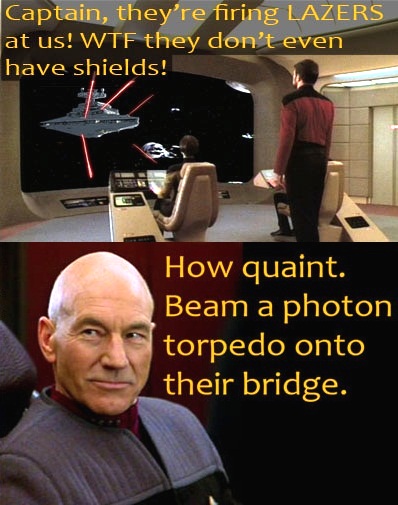
The sets and costumes are COMPLETELY SPOT-ON, like they bribed the night shift guy at Paramount–maybe he’s a cousin of Carl’s.
I’m loving the actor’s facial expressions, which are perfect, especially when he’s playing Data.
So: I’m required by law to like this. It’s creative, and a lot more fun than watching your average music video from a Far Too Serious Pop Star.
There’s a science to cute animals—Charismatic Mega Fauna—with their big eyes. They look like babies to us, even if they’re fully grown.
And there are reasons why we are irrationally afraid of the opposite, which I’m naming Scarymatic Mega Trauma.
The fear is there regardless of the actual threat.
Murder Hornets belong in this category. They look scary, even if the actual threat is low, and they have arrived in my square-shaped state on the Left Coast of ‘Murica.
Great White Sharks, crocodiles, and snakes all fall into this category. They have squinty little eyes and sharp teeth and a total lack of pettable fur.
Yet the numbers show we’re completely wrong to fear most Scarymatic Mega Trauma.
HERE COME THE MATHS.
Doesn’t matter.
Still scared of getting into the ocean with them. Thanks, Spielberg. I will never learn to surf because of you.
Sharks kill an average of six people per year. Worldwide. Moo-cows are far more dangerous at 20 per year.
Wolves (scary!) kill 10. Adorable dogs? 17,400.
There are some animals that do scare us for good reasons. Lions, tigers, and elephants are on that list, along with crocodiles, scorpions, and snakes. Do not mess with any of them, or try to have them as pets. Joe Exotic is not a role model.
Others creatures are deadly, but neither scary nor cute. Freshwater snails (4,400) do not inspire fear. They just murderize you.
Goats seem cute, despite their horns. You’re not afraid even if 200 of them take over your streets in California.
The biggest killer is the lowly mosquito, who we see as more of a tiny nuisance than the second coming of Ted Bundy. Mosquitos take out 830,000 people per year, which is insane.
I think our caveman brains explain the lack of fear of the mosquito. We don’t just divide animals into (a) Charismatic Mega Fauna and (b) Scarymatic Mega Trauma. There’s also (c) Can I Take This Wild Animal?
That’s the acid test: if we locked you in the Thunderdome with Animal X, would you come out alive and victorious? You see things like mosquitos as so small and easy to smoosh that it doesn’t register as any sort of threat. With a skeeter or freshwater snail, we’re overconfident. No problem, despite the deadly diseases of the blood sucker or the poisonous venom of the tiny snail. Who’s afraid of a snail? Come on.
So yes, there are Murder Hornets in my backyard, and they qualify as Scarymatic Mega Trauma, but I am not afraid. Keep your snakes and snails away from me, though.
Also: There’s a recent photo on the Series of Tubs of this man holding an adorable little octopus in his hand, except it’s a blue ringed octopus, which has enough venom to kill almost 30 humans. Don’t pick those up.
Listen, we’re all in quarantine so what are you gonna do, watch the same movies you’ve watched SEVEN BAZILLION TIMES?
No. You need some fresh content, new stuff. And the best stuff hiding on Netflix is definitely foreign films.
THE PLAGUES OF BRESLAU is tight, fast, and twisty. All the things a good mystery/thriller should be.
And that’s why I want to talk about it. Because structurally, it’s interesting, and well done. This film also brings up nerdy storytelling debates, such as, “What the hell is a mystery/thriller, and how is it different than a mystery or Jack Reacher punching people in the face one more time?”
Mysteries, thrillers, and mystery/thrillers
Mysteries are easy to spot: there’s (1) a murder in the beginning, (2) a grizzled, alcoholic detective who investigates multiple suspects, starting with trip to the local nudie bar–this is apparently required by law, and (3) a series of sketchy suspects who are all plausibly the killer.
In the end, our detective sobers up enough to unmask the killer and either slaps on the handcuffs or poses a math problem.
Thrillers are also pretty easy to define.
A bad thing may happen. The central narrative question is, can it be stopped?
That question is the same whether the threat is a great white shark going nom-nom-nom, an alien on a starship with Sigourney Weaver in a T-shirt, or a terrorist who stole a nuclear weapon or three.
So what’s a mystery/thriller?
Good question.
Pinning down mystery/thrillers
You can’t really pin them down, not before doing single-leg takedown and going for an armbar.
Okay, you can pin them down.
A pure mystery has ONE murder and makes you wonder who did it, why they did it, and whether they’ll get away with it. Which they won’t, so really the surprise is who, why, and how the hero catches them.
Mysteries merge into Thrillville, population zero because everybody dies in Act 3, when they do two things: (1) boost the public stakes by putting more people at risk, or underground, and (2) identify the villain far earlier in the story, when it pivots to a thriller.
You gotta have those two ingredients. More people in danger, or turning up dead, and that earlier pivot.
THE PLAGUES OF BRESLAU does this perfectly.
We find out who the villain is earlier than a pure mystery, and learn why they’re doing it. The stake are higher than a pure mystery because it’s not one murder, but a series of killings. A mystery is about getting justice for that one death. Thrillers are about stopping carnage.
What’s great is this movie doesn’t cheat. There are tons of mystery/thrillers where the villain’s motivation is paper-thin, or non-existent. And there are plenty of mystery/thrillers that aren’t suprrising or shocking. You see them coming, and that puts the B in Boring.
I truly enjoyed THE PLAGUES OF BRESLAU, which does a great job of subverting the detective genre.
SPOILER: the villain wins, despite dying, and the hero wins, too, because the villain prods her into getting rough justice for the death that haunts her. (Fiance/husband/partner? Not sure — I watched this thing with the subtitles on).
It reminds me of SHIMMER LAKE, where the character you think is the hero is really the anti-hero/villain, doing the wrong things for the right reasons. And you understand why and agree with him, because he’s getting justice when the system failed.
If you haven’t watched it yet, finish up the Polish mystery/thriller goodness, then fire up SHIMMER LAKE, which is funny, shocking, and brilliant. It’s also a movie told in reverse, except it’s not a Cheaty McCheatface like MEMENTO.
Listen: I adore Patrick Stewart, who’s a brilliant actor and a beautiful human being.
And I’d pay cash money to watch P-Stew (a) go grocery shopping, (b) walk his dog, or (c) drink a few pints and talk smack with his best friend, Gandalf the Grey.
HOWEVER: We’re talking serious business here, a new STAR TREK series on the televisions, and these things are so rare and beautiful that five got announced while I made some fresh coffee. But a Trek series with Captain Picard? That’s special.
So yeah, I watched the entire series, start to finish, as a public service.
Here’s the deal: it’s a hot, hot mess.
Let’s start with the ending
You don’t need to know the entire plot. Going right to the end explains a lot of why PICARD went south.
For the entire series, we’re told there’s a secret society of Evil Romulan Spies who want to kill artificial life forms like Data, who’s already dead. Bear with me here. Data secretly had twin daughters, and the Evil Romulans killed one because they believed she’d kill all life forms by summoning the Angry Robot Monsters From Another Dimension or whatever.
In the last episode, we learn THE VILLAINS WERE RIGHT, because Data’s daughter and her android friends do build a beacon and summon the Angry Robot Monsters, who start bringing their 1987-style graphics robot tentacles through the portal until Picard convinces She-Data to shut it down.
So…we spend all these episodes fighting the Romulans who turned out to be completely right.
As a special bonus, there are about a half-dozen deus ex machinas and stupid plot holes in the same final episode. A partial list:
She-Data’s twin may have died in the first episode, but look, there’s another android on the robot planet clearly played by the same actress, but she’s not exactly her twin, though she is evil, and kills to get her way and start summoning the Tentacle Robot Gods.
Riker is totally retired and hanging out with Troi, so when Picard stupidly takes on the entire Romulan Bad Guy fleet of warships with a ship he’s never flown before, Riker magically re-enlists in Star Fleet and shows up with 5,000 identical starships to scare off the Romulans, who I want to remind you WERE RIGHT THE ENTIRE TIME.
Picard is dying from some brain disease, so when he does sacrifice himself by flying up there to fight, it doesn’t totally hit you in the feels because he’s dying anyway, and yeah, that stinks–but after he dies, and hangs out with Data in the Matrix, boom, they stick his mind and soul into a robot body that looks exactly like him, so no big deal, bring on Season 2!
If you’re going to kill a character everybody loves, and make them feel, you have to do it forever–or make the resurrection very, very hard. STAR TREK 2: THE WRATH OF KHAN killed Spock and made us all cry, then spent an entire move searching for Spock and bringing him back, making us cry more. You don’t get to do the old death switcheroo in, like, five minutes.
There are other stupid aspects of the finale that I won’t even get into.
The finale just feels sloppy, especially the static shots of a giant fleet of identical Romulan ships standing off against a giant fleet of identical Star Fleet vessels, like the director just told the CGI boys to hit cut-and-paste five hundred times.
STAR WARS knows how to do a space battle the right way.
STAR TREK, STAR WARS or LORD OF THE RINGS?
Half of the episodes, it feels like they’re trying to be Star Wars, with a big fight in a casino full of weird-looking cantina aliens and dusty, desert locations.
There’s are three common ingredients in every STAR TREK series, good or bad: a captain, a ship, and a crew.
These ingredients are incredibly weak in PICARD, where he’s not a captain, but a passenger. The ship is hired, and the crew is half holographic for some reason, with the actor playing the man who owns the ship also playing the ship’s medic, engineer and a bunch of other parts to show off how many accents he can do. It’s confusing and weird, and this scruffy captain’s ship is far too gigantic and squeaky clean. What STAR WARS got right is the Millenium Falcon is a dirty piece of junk, and Han Solo is always broke and in debt.
Other times, I swear the writers were dropping acid and binge-watching LORD OF THE RINGS. On a Romulan refugee world, Picard picks up some kind of elf-samurai Romulan man, I kid you not. It does not work.
Who’s on first?
Even though I’m not a Trekkie, or Trekker, or whatever the right name is today, I’ve seen enough movies and TV shows to know a Klingon from a Vulcan from a Romulan. For decades, Vulcans have had a specific style of dressing, speaking, and acting. Same with Klingons, those short guys with the big ears who love money.
Not in PICARD, where I can’t tell the Vulcans from the Romulans, who are all over the place. Some have deep forehead ridges, kinda like Klingons, while others look like elves and still other Romulans are shaggy hair dreamboats who sorta look like tall hobbits. And don’t start with the accents and speaking styles. Some of the Romulans had posh British accents and others talked like gangsters from LA–they were just all over the place. It kept throwing me off.
How to fix this dumpster fire
Hey, you’ve got Patrick Stewart, who I’d say is the best captain ever to put on the uniform. Absolutely beloved.
He doesn’t sneak around like a common criminal. That’s not his style.
Give him a ship–but make it a relic, obsolete, something Star Fleet was going to junk. Make his crew total newbies from the Academy, cadets who are on the edge of dropping out, and he’s only getting them on the promise that he’ll get them coached up and passing their exams after a little shakedown cruise.
Those are the three crucial ingredients to any STAR TREK series: a captain, a ship, and a crew.
After you have those three things in a way that makes sense, it’s a lot easier to fix the plot holes and random stupidity.

Listen: as a four-year-old, you can’t deduct and reason your way out of the mystery of Who Is Santa Claus.
What my sister and I did was sneak out after bedtime to hide beneath the couch in the living room. This was base housing in Tacoma, row after row of identical ranchers. A simple couch in the simple house of an enlisted man.
We waited until a tall man, a giant to us, came into the room and put present after present under the tree.
And as a kid who didn’t talk except to Pam—my sister, interpreter and guardian—this was a brave and grand adventure. I used to stand in front of the fridge until Pam came along, opened it and took out the food I pointed at, with petrified carrots under my pillow as a long-term food supply in case something happened to her.
Hiding under that couch, waiting to learn the identity of Santa Claus, was one of my first memories.
Because hiding under that couch was how the huge mystery got solved: Santa Claus was our father.
This only added to his mythical status to me. He wore an Air Force uniform and disappeared at work for long shifts. All we knew was he worked on F-15’s and other military jets, like the bombers his father flew during World War II and the Cold War.
That he rode motorcycles, could pick us up like we weighed nothing, ate Daddy Go to Work Sandwiches and seemed to know everything.
When the military transferred us to Germany, and then the Netherlands, he drove us on weekends in a white VW van with a kitchen sink and room to sleep. We visited castles all over and saw a lot of Europe, with my sister taking the wrong train once and heading to east Berlin before the Wall fell.
We had a dog that was already trained, so you had to speak Dutch to it to have it sit, and base housing in the Netherlands was unlike any military housing on the planet, with nice brick houses that weren’t boring boxes thrown up by the lowest bidder.
It was an adventure, and I can still recognize F-15’s and F/B-111’s by their profile in the sky or the sound they make roaring overhead. I remember watching second-run movies for a dollar at base theaters, mowing lawns to make money and going to see Star Wars or Indiana Jones once a day all summer. Why not? It was a buck.
I remember my father telling me crazy GI stories, like the one where enlisted men would always drive across Lake Champlain during winter when you could go from base to Burlington, Vermont, except people always had to push it, every year, and drive when the ice was too thin. There’s a fair number of pickup trucks that fell through the ice.
This is the father I knew growing up. The one my wife and son never got to see.
By the time my wife met him when we were in college, he was a disabled vet, long retired, and already sick–diagnosed with cancer when I was in high school.
Our son didn’t see him until ten years after we got married.
So this isn’t an obituary, which I find dry and boring. I wrote plenty of those as a journalist. Obituaries are usually a series of dates and places, recitations of facts that really don’t tell you anything about the real person.
And I’ve seen enough people die by now to have some thoughts about it beyond the raw emotion of grief.
I went through all of my grandparents dying. Some fast, some slow. Losing my grandfather was especially hard, and I’m bothered by the fact that I can’t remember if he flew B-24’s or B-17’s in the Pacific, though I know he flew B-52’s for decades after the war and once had a heart attack mid-flight, with a load of nuclear bombs, and landed on a dry salt lake in Utah.
I remember my favorite journalism professor, Pete Steffens, and a great philosophy professor, Rex Hollowell.
Robin Boyes, my mentor on speechwriting and rhetoric, found alone in his home, every room filled with books. My boss, Jim Richards, dying unexpectedly last year, right before his son’s wedding.
And I believe two things: that everybody has a list like that, a list that keeps growing year by year, and that your list never gets lighter or easier.
You don’t just mourn the inability to see them again, to talk or laugh or go on a trip. It’s the loss of everything they could ever do, or should have done, with or without you.
I miss the stories my father told about growing up on the farm, like the cow named Stupid that his brother rode, pulling its tail to go left or right and straight up to stop, which worked fine until the cow ran too fast and pulling up made it stop too fast and my uncle flew into a pile of manure.
When he needed my labor after he retired from the service, he’d yell for me and say he required my strong back and weak mind. We re-roofed a barn that’s now falling down and fixed the carburetor on the Plymouth Fury I drove in high school, a beast of a car older than me, one he bought new and put into storage when we moved to Europe.
That car never ran right after we fixed the carb. Tended to stall and die all the time. But I’ll always remember doing that with him.
He was terrible on the phone but great at stories and jokes, and incredibly social when I was growing up.
My wife and son never really got to see him at full strength like that.
So this isn’t for my father, who’ll never read it.
This is for Pam.
This is for my brother Nate, for my wife and son.
And it’s for me, to remember that he was a soldier, a father and will always be Santa Claus.
Listen: I am not one of those people who watches movies or shows to find 23 hidden easter eggs in Baby Yoda’s bowl of bone broth or whatever. I DO NOT HAVE TIME FOR THAT.
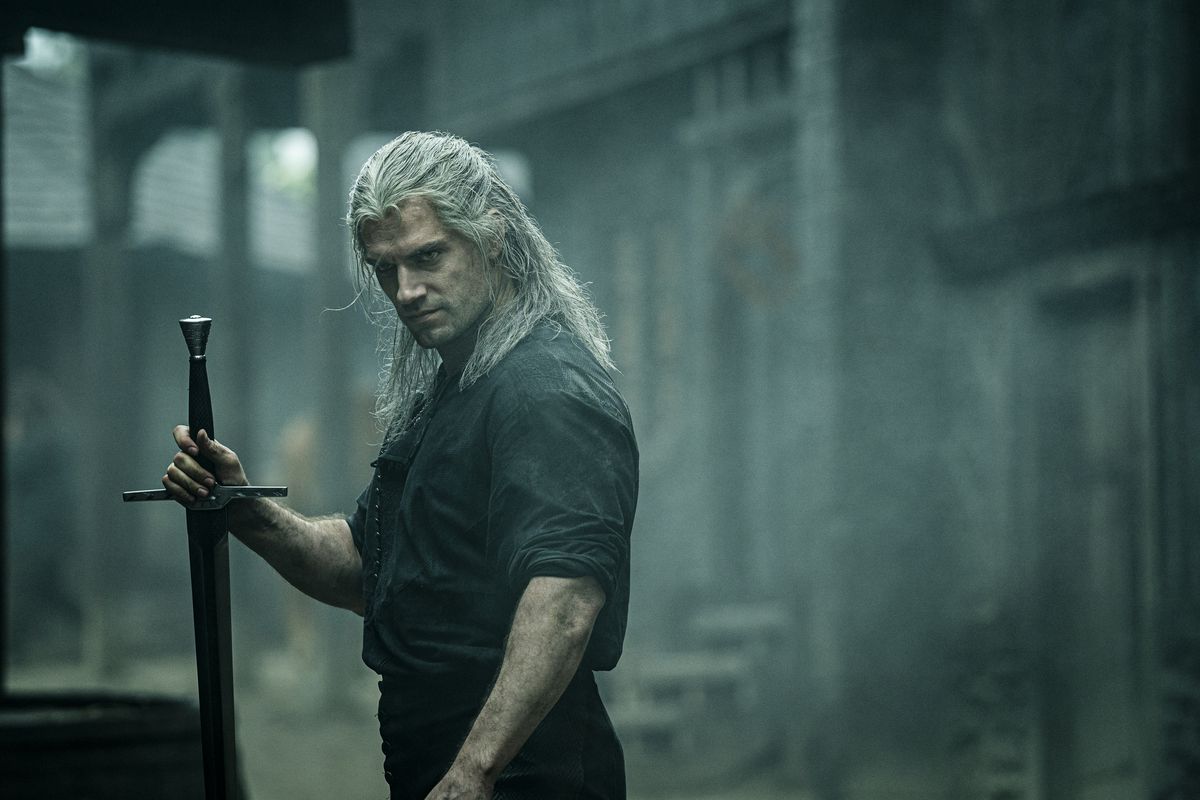
In fact, I have about five minutes to write this, and no, I did not play the Witcher game, or read the novels, so we are not diving deep into whatever Witcher craziness you’re into.
HOWEVER: If you own some form of Glowing Screen, whether it’s (1) a supercomputer in your pocket that was once used to make these things called telephone calls or (b) the lastest 120-inch, 8k television that cost more than my car, even though there is no 8k content to play on your expensive toy, then you should (c) fire up Netflix and watch all of THE WITCHER.
The whole thing. Start to finish.
Skip through the boring bits, though there aren’t many.
Here’s what I think they did right, what they could’ve done better, and why I’m looking forward to SEASON 2: THE WITCHER GRUNTS SLIGHTLY MORE DIALOGUE WHILE KILLING EVERYTHING.
What they did right
All the actors. Seriously.
All. Of. Them.
You may not know the name Henry Cavill right off, though you will remember the last actor who played Superman in a couple of movies, and the bad guy in the last Mission Impossible, and yeah, it’s that guy.
He’s amazing.
I won’t name all the other characters. The bard is funny, the sorceress is cool, the bad guys are sufficiently bad and scary. It’s well done.
Also good: sets, costumes, special effects. You know, all the things.
What they really did well: building up to a climactic battle where the good guys lose.
What they could’ve done better
Honestly, the only real flaw is jumping around in time.
I didn’t take notes, because nobody was making me write a term paper on this thing.
Halfway through, though, I’m wondering if all the queens in this thing are brunettes, and is this other queen related to the one I remember dying? Then five episodes later, I figure out oh, that’s not the dead queen’s sister or cousin, ruler of some other land, that’s the same dead queen, just earlier in time.
It’s not super clear. And honestly, the story would’ve worked chronologically, which is just a fancy way of saying, “Without jumping around in time like a rabid squirrel.”
Why I’m looking forward to Season 2
Not just because of the good acting, writing, sets, effects and all that.
Mostly because the showrunners had the guts and wisdom to put their heroes up a tree and throw rocks at them.
They really do lose the battle at the climax of the season. Things are not Good.
I like that.
It makes for better storytelling.
If the Witcher killed every monster and won the battle at the end of Season 1, why would you worry or care about what happens in Season 2? You’d expect him to keep on kicking butt. It would be a romp, and yes, romps can be kinda fun, like when your favorite football team absolutely smokes the Patriots, or when the hero of an action movie punches and kicks his way through 492 bad guys armed with meat cleavers and such.
Romps, though, aren’t actually that interesting or fun to the audience.
The Witcher was plenty of fun. 11/10 would watch again.
And just for kicks, here’s the cast of the show talking about it.
You can’t make this stuff up, which is what makes it so great.
Finland, Sweden and Iceland are really into heavy metal. I mean, seriously into it. There’s like FIVE BILLION heavy metal bands in Finland, which is like the population of Akron, Ohio or whatever. (I’m kidding. 5.5 million people, with 53 heavy metal bands. Not in total. 53 bands per 100,000 people. Daaaaamn.)
One of the bands is Hevisaurus, which you don’t need to understand Finnish to know it talking about “heavy metal + dinosaurs.” And they’re not screwing around. Their audience is kids, and they’ve got good songs and high production values. Check it out.
Good, right? Shocking so.
What really got me were (a) the puppetry with the dinosaur eyes and (b) the fire-breathing dinosaur. That’s metal.
Usually, a little theater goes a long way for a rock or metal band. KISS got a crazy amount of mileage from wearing makeup. Hair bands in the ’80s sold a lot of records with perms, spandex and a little eyeliner.
Hevisaurus is going the extra mile here. These costumes are movie-quality (kid movies, sure, but way better than a band needs for the stage).
Wikipedia quotes/translates a Finnish source that says: “According to legend, five dinosaur eggs made from metal survived the mass extinction some 65 million years ago in the mountain of wizards. In the year 2009, witches gathered at the same place. A giant lightning bolt hit the ground and simultaneously created ash and revealed the eggs. From the power of the witches’ chants, the eggs exploded open and five Hevisauri hatched.”[15] Hey, most Marvel and DC superhero origin stories would kill to be half that cool.
Also: Heavisaurus is going all “Artist Formerly Known as Prince” with a dispute involving their music label, Sony, and it doesn’t get any more metal than sticking it to the Man.
Verdict
Could not love this more. Give me more Hevisaurus.
When you see a tool or weapon used again and again throughout history, in just about every culture, it makes you think: yeah, that’s pretty useful.
Hammers and saws. Ropes and wheels.
Swords and shields.
Previous posts have looked at what gear, weapons and vehicles might be smart for any flavor of apocalypse, whether you like (a) zombies going nom-nom-nom, (b) robots turning sentient and deciding they don’t like being slaves or (c) climate change turning Waterworld into prophecy. And listen, every flavor of apocalypse tastes equally bad. I pray to whatever gods that listen that we can avoid calamity and chaos.
HOWEVER: It is fun, and interesting, to talk about this stuff, and figuring whether you want to look Lowes or the mall first. (I know you want to do that. It’s okay.)
And shields are a serious thing to think about. They keep popping up throughout history.
So let’s talk it through.
A Mondo Vibranium Shield of Invulnerability
The temptation is to go all crazy and build the toughest shield possible, a work of art that will laugh at arrows, eat bullets and make swords break in half.
I mean, that sort of shield works great for Captain America and Wonder Woman, right?
Okay, yeah. Raise your right hand if you want a shield, your left hand for a lightsaber and keep them up if you’d sell your car to get a shield AND a lightsaber.
Everybody who didn’t raise both hands is lying.
Here’s the problem: you’re not making Wonder Woman / Captain America shield.
Not today, in your heated garage with electricity and power tools.
Not tomorrow, after you buy a bunch of welding equipment and somehow find a bunch of titanium, vibranium and uranium.
And not during any sort of apocalypse, where you won’t have electricity or power tools. Seriously. You won’t, and any book or movie about the apocalypse that features electricity is Cheaty McCheatypants.
Another clue that the movie or book cheats harder than the Astros and Patriots in a game of Who Can Steal Signs Better: clean-shaven, well-groomed heroes. Nope. Everybody in the ‘pocalypse gonna make the Duck Dynasty boys look well-groomed.
Time to get brutally practical
If you read a little about shields throughout history , a few things pop out immediately.
First, any shield had to be light enough to carry on long marches. Ten pounds is about it.
Second, even the armies that really relied on shield-and-spear formations–which isn’t a bad way to go–didn’t actually have heavy metal shields. They had light, wooden shields, reinforced with all sorts of stuff: metal or rawhide edging, linen and glue, leather.
Third, soldiers didn’t see shields as some kind of invincible, long-term tool. They knew a shield would get beat up and possibly destroyed, so these things weren’t expensive family heirlooms like swords or suits of armor. Shields were disposable and replaceable. If one saved your life exactly one time, hey, it worked. And if a shield got smashed up, making a new one wasn’t hard.
Making a scrapyard shield of the apocalypse
Our limitations are pretty logical, then:
(a) raw material that’s easy to find
(b) hand tools instead of power tools
(c) a final shield that’s lightweight and easy to repair or replace
So I tested it out and made one, then learned from my mistakes and made a SECOND SHIELD, embracing the scientific method of “make a Serious Plan, follow it to the letter until you learn that it Seriously Sucks, then give it another go.”
Shield Number 1: Wooden Pallet Craziness
As for raw materials, I went with the following main materials:
A pallet of wood. The boards were about 5.5 inches wide by four feet long, thick enough to be sturdy. Pallets are insanely common and basically scrapwood.
Two wooden stakes to hold it together. Also common and easy to find.
Wood glue and common screws to finish it off.
This thing had the shape of an octagon (think stop sign), which would seem to make sense at first, being a rough circle.
How did it turn out?
Using a wooden pallet may sound smart. Common sense.
Nope. This is a terrible idea.
Wooden pallets have poor-quality wood. Spectacularly so. The wood they use in pallets is also thickier and heavier than you’d want in a shield.
Gluing the pieces together was also a giant mess that didn’t work out. Wooden pallets have incredibly rough cuts.Smooth, perfectly straight wood might glue together fine. These things weren’t meant to be glued.
When finished, the shield was not just too big, but incredibly heavy, and more useful as a portable wall than a shield.
Verdict? Straight into the garbage can.
Shield Number 2: Cedar Fence Special
You can find cedar fences anywhere, making this a solid idea. The wood is a lot thinner than what you find in a wooden pallet, and a lot higher quality. YES.
I went with a hexagon instead of octagon, which saved weight while still having a roughly circular shape.
To strengthen it, I hammered a bunch of extra steel plates meant to protect wiring (yes, they probably have a name, and no, I have no idea) along the edges, with some thin scrap metal plates in the center.
The final steps, which aren’t done yet, would be attaching a handle or rope, then covering the front with duct tape to protect it from water, give it extra strength and cover up the scrap metal.
Didn’t use glue at all on this one–turns out you don’t need to. Screws all the way.
Verdict: Completely doable.
Is a shield smart?
Yes, as long as you treat it as a cheap, disposable object and keep it small.
Marching long distances with any sort of giant shield would be a good way tire yourself out.
If you’ve got a group of people with you, whether it’s three or thirty, I’d want everybody to have a small shield to protect themselves and each other. Honestly, if you’re wandering around the wastelands and see six random people with machetes and garden tools, then another six people with matching shields and spears, you’re gonna steer clear of the folks with shields. Especially if they do a decent formation with shields making it hard to hit them, and spears stabbing you before you get close enough to even try.
To maximize the effect of shields, use your Psych 201 skills. Paint every shield with the same colors or symbol, because the absolute last thing you want to do in the ‘pocalypse is mess with people who belong to a gang or army, and get hunted down by Robert Duvall or whatever.
Also, if your band of survivors gets good enough with swords and shields in formation, it means eventually doing stuff like this. You know, in epic slow motion.
As is my custom, and habit, and my Bobby Brown prerogative, I’m going to go with the first page — as printed.
You know, printed with ink at these places we used to call “stores full of books,” where you handed the nice folks who live there paper decorated with dead presidents and they let you walk out with ALL KINDS OF YUMMY BOOKS.
So if you read the first page of this thing on a Kindle or iPad or Atari 2600, your page 1 will doubtless look different and such. Please give my regards to the Complaint Department.
After a line edit of Page 1, we’ll talk about our general literary impressions — about how metaphors are like similes, only different; about how my hatred of semi-colons runs deeper than my loathing of A-Rod; and how somebody wrote a mainstream and incredibly successful novel about sexy nonsense without putting any sort of sexy nonsense whatsoever on page 1.
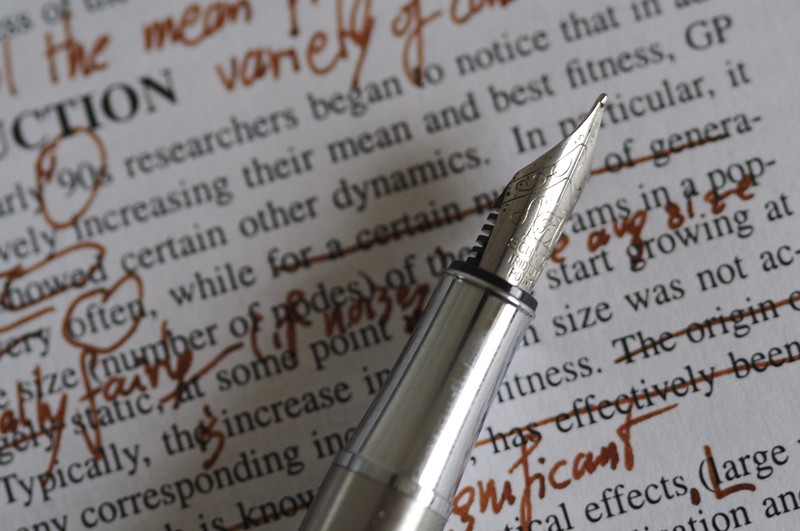
Note: I’m striking out text, with any replaced text or notes in red, because my version of this novel would be called ONE SHADE OF RED after all the red ink we spill on this thing. Also, I don’t know what happened to this post. A friend wants to use it as an editing example, so I’ve resurrected it and updated the piece a little. Enjoy.
Also: If you have a famous novel with a brilliantly awful first page that needs serious red ink, send me your nomination.
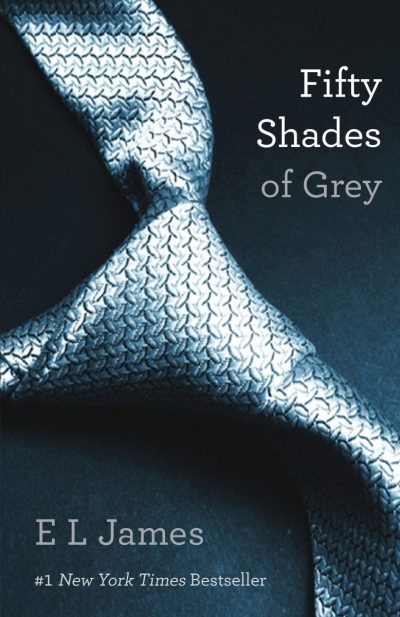
FIFTY SHADES OF GREY
I scowl with frustration at myself in the mirror. (This may be a world record: bam, in the first sentence, she breaks a cardinal rule of fiction writing: don’t tell readers what the hero or heroine looks like by having them stare into a mirror, gaze upon their reflection in a pond or, I don’t know, whip out their driver’s license and say, “Huh, five-foot-ten, a hundred and twenty pounds, red hair, green eyes and a few freckles. Howbout that?” Ugh. This is not exactly “Call me Ishmael.”)Damn my hair – it just won’t behave, and damn Katherine Kavanagh for being ill and subjecting me to this ordeal.(Unless the heroine’s hair is crucial to the plot — unless she starts out with unruly hair in Act 1, switches to a bob in Act 2 and shows how much she’s grown and changed by rocking a purple Mohawk in Act 3, the hair, it is Boring, and a Distraction. Also, nobody refers to friends and such by their full name. If she’s your bestie, you say “Katherine.”)I should be studying for my final exams, which are next week, yet here I am trying to brush my hair into submission. I must not sleep with it wet. I must not sleep with it wet.(Enough already with the hair. Seriously. The only two words with any kind of real conflict and potential are “final exams,” and unless she flunks those, and therefore gets kicked out of university and has to live under a bridge in a cardboard box, it does not matter for the story.)Reciting this mantra several times, I attempt, once more, to bring it under control with the brush.(More about the hair? MORE? Not necessary, not interesting and not entertaining, unless her hair is secretly a sentient being, organizing a plot to take over the world, one follicle at a time. I’m guessing Bruce Willis, being immune from such attacks, will foil this plot.)I roll my eyes in exasperation and gaze at the pale, brown-haired girl with blue eyes too big for her face staring back at me, and give up. (Back to the staring-at-the-mirror trick, which has to go. Find another way to describe the heroine.) My only option is to restrain my wayward hair in a ponytail and hope that I look semi-presentable.(Now we’re beating the Dead Hair Horse on its way to the glue factory.)
Kate is my roommate, and she has chosen today of all days to succumb to the flu. Therefore, she cannot attend the interview she’d arranged to do, with some mega-industrialist tycoon I’ve never heard of, for the student newspaper. (Awkward. First reference is Katherine Kavanaugh and now she’s Kate — just call her Kate both times, and let’s clean this whole thing up. Also, how many student newspapers score interviews with “mega-industrial tycoons” … who you’ve never heard of? If they’re really mega, then you have herd of them. Bill Gates, Steve Jobs and so forth. If they you haven’t heard of them, they aren’t mega at all. Edited text follows in red.)Kate is my roommate and she’s chosen today, of all days, to succumb to the flu. That means I’m stuck interviewing some industrial tycoon for the student newspaper.So I have been volunteered. (Redundant.) I have final exams to cram for, (already said that) one essay to finish, and I’m supposed to be working this afternoon, but no – today I have to drive a hundred and sixty-five miles to downtown Seattle in order to meet the enigmatic CEO of Grey Enterprises Holdings Inc. As an exceptional entrepreneur and major benefactor of our university, his time is extraordinarily precious – much more precious than mine – but he has granted Kate an interview. A real coup, she tells me.
Damn her extracurricular activities. (The last sentences were brought to you by the letter E: enigmatic, exceptional entrepreneur, extraordinarily, extracurricular. There are other modifiers that start with the letter E: extraneous, excruciating and ejector seat. I am looking for the handle, because it’s time to pull it.)
Kate is huddled on the couch in the living room.
“Ana, I’m sorry. It took me nine months to get this interview. It will take another six to reschedule, and we’ll both have graduated by then. As the editor, I can’t blow this off. Please,” Kate begs me in her rasping, sore–throat (compound modifier) voice. How does she do it? Even ill
(end of page 1)
Editing notes
Are you kidding me? ARE YOU KIDDING ME?
So this the first bit of a novel that sold a gazillion copies and rocked the literary world. It starts with an extended riff about wet hair and ponytails, as the author tells us how the heroine looks by having her look in a flipping mirror, goes back to the hair, uses every adjective and adverb in her dictionary that starts with the letter E and sets up the incredibly high stakes of whether or not a college student can tame her unruly hair and cram for her finals when she is forced — FORCED — to drive to Seattle and interview some billionaire for her friend.
God bless anybody who sells a ton of books or movie tickets. I adore books and movies, and the more people read books, and see good movies, the better.
HOWEVER: the first page of a book is a lot like the trailer for a movie. You start out with your best stuff, and it’s a rock-solid guarantee that the writing doesn’t get magically better ten pages or 100 pages later. The first page, and the first chapter, get polished and polished until they are a shiny diamond made of words.
Maybe you could argue this book is the one exception to that rule. From the reviews of this book, though, that’s not the case.
Why did it sell so well?
I believe, deep in my soul, that packaging matters more than the product.
The title of a book — or a movie, or a TV show — can save your bacon or kill you dead.
The cover of a book, or poster for a movie, is the next most important thing, because it’s what people see when they decide what to buy in Barnes and Noble or what to see on Friday night at those giant buildings where popcorn costs $9 a bucket.
You can’t pitch quality.
If you gave this a more typical title for the genre, and a more typical book cover, you’d probably end up with a title like A BUSINESS AFFAIR and some kind of Ryan Gosling looking guy wearing a suit on the cover with the heroine nearby, messing with her ponytail while she wears the highest of high heels and a business suit with a skirt that is just this side of immodest. Or the cover would feature a blindfold and a pair of handcuffs. That sort of thing. You know, something like this:
See? Here we go. The cover above isn’t just a good representation of what I’m talking about. I bet it’s a far, far better book. If you gave FIFTY SHADES OF GREY a more normal title like this, and more typical cover, I would bet you my house, my car and my first-born son that the book would not sell like hotcakes and get turned into movies.
The unusual title and cover isn’t a side issue. I believe it’s the entire reason this book went viral.
True story: guess what the author of THE GIRL WITH THE DRAGON TATTOO wanted as a title for his novel? Go ahead. Guess.
Here’s the answer: MEN WHO HATE WOMEN.
Raise your hand if you think that title would have set the world on fire and led to hit movies.
The title and cover — the packaging — are 90 percent of the battle.
The packaging matters more than the product.
FIFTY SHADES OF GREY is an interesting, literary title. The cover photo of a grey tie is also atypical of the genre and really stands out. The combined effect gives the book a literary veneer.
Some people might feel embarrassed getting on Flight 435 to Frankfurt and pulling out a paperback with A BUSINESS AFFAIR on the cover with a blindfold and handcuffs on the cover. And you can bet the male audience for such books is hard to find with a microscope.
Give it the gloss of lit-rah-sure, though, and that makes it okay for some people to read what they might never do: romance and erotica.
And hey, I respect the hell out of romance authors. Have learned a ton from them. So I’m not talking smack about the genre here–I’m specifically talking smack about the first page of this specific book. There are far, far better examples of romance out there. Amazing writers. Go support them.
FIFTY SHADES reminds me of the early Eric van Lustbader novels, like THE NINJA, which I think were hot sellers because they slipped in naughty bits to readers — mostly men — who expected, I don’t know, ninjas sneaking around at night and fighting. It was like a James Bond movie where they didn’t fade out when 007 kissed the girl. I can tell you 14-year-old boys around the globe had their minds blown. You can print this kind of stuff without getting arrested? I can buy it at the store and they don’t ask for ID? NO WAY.
And let’s give respect where it’s due: there’s an editor somewhere who came up with this title, and a cover designer who thought up the idea, got the right photo and nailed it.
Open up that brilliant cover, though, and you eventually get to the first page, which is a hot mess. And from the reviews, it doesn’t get better on page 2 or 152.
VERDICT
I truly thought, deep in my soul, that you couldn’t top the first page of THE FOUNTAINHEAD for a famous novel that is famously bad. But yes, we have a new champion.