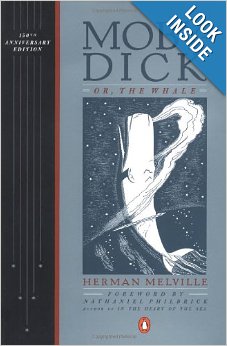
The Red Pen of Doom harpoons MOBY DICK by Herman Melville

MOBY DICK by Herman Melville

Now, this classic book is so ingrained in our culture that movies can get all deep and interesting simply by alluding to a metaphor–which is like a simile, only different–that refers to this doorstop of a book.

Like this: “Maybe I’m Ahab and he’s my white whale” uttered by Bruce Willis in DIE HARD 17: THE HAIR DYES HARDEST could change that movie from just another 120-minute shootout in a nursing home into a penetrating examination of the purpose or life, or lack thereof.

Does that make editing the first page of this thing any harder?

Not really. Bring it, Melville.

MOBY DICK

by Herman Melville

Call me Ishmael. (People have been riffing off it for so many years that those three words are invincible. Can’t touch this.) Some years ago — never mind how long precisely — having little or no money in my purse, and nothing particular to interest me on shore, I thought I would sail about a little and see the watery part of the world. (This second line is also good. It makes the narrator a smidge unreliable, which is always interesting, and gives him a motive that everybody can relate to: being poor and wanting to see the world.) It is a way I have of driving off the spleen and regulating the circulation. (On your third swing of the bat, Herman the Meville, you whiff. Nobody cares about other peoples’ spleens and such. Kiss those words goodbye.) Whenever I find myself growing grim about the mouth; whenever it is a damp, drizzly November in my soul;, whenever I find myself involuntarily pausing before coffin warehouses, and bringing up the rear of every funeral I meet; and especially whenever my hypos get such an upper hand of me, that it requires a strong moral principle to prevent me from deliberately stepping into the street, and methodically knocking people’s hats off- then, I account it high time to get to sea as soon as I can. (Whenever I read a ginormous sentence with five zillion semi-colons and commas, I reach for the red pen and turn it into a nice, short sentence with one comma.) This is my substitute for pistol and ball. With a philosophical flourish Cato throws himself upon his sword; I quietly take to the ship. (Another semi-colon, but this is the last one that gets to live.) There is nothing surprising in this. If they but knew it, almost all men in their degree, some time or other, cherish very nearly the same feelings towards the ocean with me.

There now is your insular city of the Manhattoes, belted round by wharves as Indian isles by coral reefs–commerce surrounds it with her surf. (Hate this sentence. It’s like our friend was talking to us about an interesting story, then started reciting beat poetry. Rewrite follows.) The city of Manhattoes is belted with docks and ships, like an Indian isle is encircled by coral reefs. Right and left, the streets take you waterward.

Verdict:

The fact this book is a classic doesn’t mean page one is perfect.

Herman the Melville is wordy on this page and he only gets wordier later on in this book, where he stops the action entirely to devote entire chapters to lectures about whale tails and such.

There’s a lot of fluff to kill, and I was pretty gentle with the word slaying. You could kill more.

Compared to most first pages, though, he does a good job of setting things up. Ishmael wants to see the world and that means sailing, because he’s not rich. So we’re in for an adventure.

How could we improve this? More foreshadowing. Maybe he mentions a friend who’s a sailor, the one who told him stories that got him interested in a life at sea, and this friend just served on a whaling ship that limped into port after getting attacked by a big whale. A ghostly white one. But his friend was drinking a lot of rum and tends to make up stories…

The Greatest Synopsis that Ever Lived

writing meme spiderman dear diary

Dear Agent Sir or Madam,

This is a follow-up to my querying letter about a million-word fictional novel trilogy. You can read that letter anywhere on the planet by firing up AOL and clicking on this World Wide Web thingy here: The Mother of All Query Letters.

Maybe you haven’t gotten to reading it yet, seeing how you’re busy selling my trilogy to Warner Brothers for one million dollars (I figure a dollar a word is fair). My niece Daisy has a library card and her nose in all kinds of books, not just Twilight, and when I told her about my fictional novel, she said I need to send every agent and editor in Manhattan a synopsis.

Now, “synopsis” sounded Latin and possibly dirty to me, so I asked whether that word involved sins, and Daisy said, “That’s a good way to look at it. List all the sins you commit in that book of yours.”

So here’s my list of the sinful things happening in each book of the trilogy, with each novel coming in at 333,333 and 1/3rd words apiece.

Book 1: I KNOW WHERE THE BODIES ARE BURIED, DARTH SAREK OF VULCAN

A grave-digger falls into a grave and hits his skull on a fat hunk of rock, then wakes up on an alien planet to find he’s six inches taller and half-ninja, half-Jedi, half-Vulcan.

First off, he’s bound for alien slavery on a pirate ship, and I believe slavery to be a sin, despite what Uncle Will says about the War of Northern Aggression.

Second, he kills bushels of aliens, and killing is a sin, though he does it to win his freedom from slavery, so I figure those sins cancel each other out.

Third, our hero does have relations outside of marriage with an alien princess or three, plus an android on a planet run by robots and an evil super-magneto computer made by Bill Gates himself after he bought up an entire Best Buy and started soldering stuff together.

Book 2: LOST IN SPACE AND TIME WITH A GREEN LASER SWORD AND A PURPLE ALIEN PRINCESS

The robot king and his super computer can plug you in, like that Matrix or that Tron video game they had at the 7-Eleven on third street until some pansy replaced it with Ms. Pac Man.

The robot king makes our hero think he’s waking up in that grave, and that nothing in the first book really happened, kinda like that season of Dallas before J.R. got shot and such, and let me tell you, I’d shoot that man myself with my grandpa’s Colt and proudly do whatever time a judge handed down with the bang of his mighty gavel.

Back to the story. After learning kung fu and how to bend more spoons than Yuri Geller, the hero busts out of the fake holodeck world of the robots and uses his laser sword to cut Bill Gates and his super-magneto computer clean in half. Murder is a sin, but he says his prayers and gets forgiveness from his maker while the aliens rejoice in their freedom and put him in charge of their army of spaceships and purple alien princesses.

Book 3: MASTER OF OUTER SPACE,INNER PEACE AND DESTROYER OF SUNS

There’s peace in the galaxy with the hero running things, so he studies his Jedi and his Vulcan to learn the secrets of immortality, raises generation after generation of his young ones with the purple alien princess who’s his queen, and teaches the purple alien army how to be kung fu ninjas — but a new threat arises.

See, suns are alive. That’s right — they’re born, they live, they evolve and they die, with new baby suns arising from the dusts of their supernova. And they see themselves as gods, seeing how they create all the elements in the universe and provide all the heat and light and such. They’re mad as tarnation and they’re not gonna take it one second longer.

I see this third book as a tale of redemption, seeing how the hero starts out committing all kinds of sins in books one and two. Now he’s married and living right, unlike my second cousin Nellie, who’s on her fourth divorce and odds are she’ll hit number seven before we wheel her into the Willapa Valley Nursing Home.

Back to this book: Our hero flies right up to the face of the biggest, maddest, meanest sun and finds a way to communicate, but the solar gods are hell-bent on war and destruction, and they start frying alien planets like eggs on a hot grill with a fine sheet of lard already melted on top.

As a last act of sacrifice at the age of 984, the hero mind-melds with the suns and hypnotizes them into calmness by bringing them into his memories and dreams, which lands himself into a coma for a spell until I figure out the next trilogy of 1 million words, which I figure has to involve the only thing bigger, badder and more amazing than killer suns: black holes with father issues not even Dr. Phil can solve.

So, that’s a full-on synopsis of the first trilogy, with book one attached as an encrypted WordStar document and also available on 5.25″ floppies. Though like I said in that querying letter, I’m running out of those floppies, so make it snappy.

Sincerely,

Sensei George Lucas King

P.S. This is my new pen name, guaranteeing my trilogy sits smack dab next to all those books by Stephen King while appealing to fans of Star Wars and all those kung fu movies, which I figure covers just about every man still breathing, then you got the alien princess love story thing for the women. To write me checks, you’ll need my full legal name, though I’d prefer cash on account of some trouble with the IRS that started in 1997.

The Mother of All Query Letters

Dear Agent Sir or Madam,

I am writing to you, or your agency, to acquire literary representation in Manhattan, Hollywood, London and wherever else such deals are made to publish books and turn them into movies.

Why? Because my 333,333 1/3rd-word fictional novel (Book One of a 1 million-word trilogy) is guaranteed to be bigger than Star Wars crossed with Fifty Shades of Gray with Oprah and Brad Pitt on top, like two cherries on a chocolate sundae instead of the single little cherry they give you at Dairy Queen over on 15th Avenue because those cherries, let me tell you, they taste like rubber mixed with corn syrup.

Now, I know the book world establishment is liable to pigeonhole books, and a person could say I KNOW WHERE THE BODIES ARE BURIED, DARTH SAREK OF VULCAN is a mystery about an ordinary gravedigger who’s secretly a half-ninja, half-Vulcan, half Jedi and only finds this out on account of him falling into a freshly dug grave on a Saturday night and waking up in a strange world where he’s six inches taller, has pointed ears and a sweet green laser sword.

And I suppose you could say it’s a romantic comedy set in a sci-fi action universe, since this hero gets more action than James Bond himself judging one of them Miss Universe contests, but that would be selling this story short. Who doesn’t want to see ninja Jedi adventuring through space and time with laser swords and starship battles? Also, instead of green alien women, I’ve got purple and orange ones.

It’s got fighting, cussing, dark deeds, giant space battles with starships way out in outer space and new life forms with their own languages and strange ways of fighting, cussing and doing dark deeds.

As for reviews and such, all five of my cousins, my momma and even Grandma Wilma, who hasn’t read a book since she stopped reading Archie’s Digest back in 1963, well, they all say this story sounds like a sure-fire winner, the kind they’d pay full price to see at the drive-in, long as the weather held up.

The full fictional novel is attached as an encrypted WordStar document. It’s also available on 5.25″ floppy disks, and I’m running out of those, so act now. I’ll give the winning agent the password to read it. Also, I’m fixing to finish the screenplay for the first two books before Christmas, so the best agent should also sell a lot of of movies.

Some agents want a synopsis, but reading the story is a lot better than reading about the story, especially the parts after the hero falls into that grave and wakes up.

My cousin has one of those internet phones and says agents want to know about my publishing credits. So listen: I’ve been a professional gravedigger for 23 years and have published 983 stories all over that world wide web on http://www.blogger.com, keeping my site set to private because I don’t want people stealing my ideas. See? That’s how VALUABLE they are.

The only question is this: are you gonna hop on this money train or are you gonna let it pass on by?

Sincerely,

Stefan Kingsley

P.S. This here is my pen name, guaranteeing my trilogy sits smack dab next to all those books by Stephen King, who I figure from looking at his photos is older than Roy Rogers’ uncle by now and fixing to retire or die, whichever comes first. To write me checks, you’ll need my full legal name, though I’d prefer cash on account of some trouble with the IRS that started in 1997.


Banned substances for writers

Click here to read the whole post at McSweeney’s here, because it is brilliant.

My personal favorites:

CAPOTEX — A vintage 1960s designer drug. Unlike most other banned literary substances, this drug is often used by fiction writers and non-fiction writers alike. Artificially increases prose style and sophistication. May cause speech patterns to be affected. Known to induce cutting, witty remarks in some test subjects. Long-term use can lead to literary irrelevance.

SPILLAGRA — Boosts literary testosterone levels. Known side effects include involvement with femme fatales, consumption of rye whiskey in dive bars, and over-reliance on colorful similes. If hard-boiled dialogue persists for over four hours, contact a doctor immediately.

ORWELLBUTRIN — Regulates and encourages the production of dystopamine in the brain. Developed as a means of social control, but now listed as a “doubleplus ungood” substance by the Ministry of Health. In rare cases, subjects may imagine that they can hear animals talking. Should only be taken after the clocks strike thirteen.

Writing secret: all you need is CURIOSITY and SURPRISE

The kitteh is surprised

Whether you write novellas about fierce mermaids, magazine stories for Cosmo (insert your own joke here) or speeches about the Austrian school of economics for the IMF — whatever sort of writer you are, two things matter most.

Not correct grammar and spelling. Those things are assumed.

Not pretty paragraphs and sentences that sing. That’s word gravy, while we’re talking about the main course.

What matters most: making your readers curious, then surprising them.

The kitteh is surprised
Surprise Kitteh is surprised.

This is why the inverted pyramid is a terrible structure for any writer. (Click with your mousity mouse to read Why the Inverted Pyramid must DIE.)

The inverted pyramid grabs a heavy rock and smashes the skull of curiosity. Then it takes that same bloody rock and crushes all hope for any surprises.

How does it achieve this epic level of failure? By giving you the answers before you even know the questions. The payoffs have no setups.

Ways to make your audience curious

Create setups by raising interesting questions (a) about real people where there are (b) high public stakes or (c) high private stakes and (d) serious conflict.

WHAT happened? (mystery)

Debates about the past are about facts, and assigning blame.

  • Who really killed JFK?
  • Did aliens really land at Area 51?
  • What caused the Great Depression?

WHY did it happen? (whydunit)

This is often more interesting than the question of who did it.THE BUTLER ALWAYS DOES IT, so tell us why instead.

How do you CHOOSE between two goods or two evils?

Debates about the present are value choices.

Choosing between good and evil is simple and cartoonish. That’s why its for kids. Truly tough choices are between two good or two evils. Does believing in true justice mean setting a killer free? That sort of stuff. These things are deep. They’ll exercise your head.

What WILL happen? (thriller)

  • Can we stop these evil cats from taking over the earth BEFORE a giant comet destroys it?
  • What might happen if you brought dinosaurs back to life?
  • Will 5.93 gazillion pounds of TNT make a dead whale disappear from a beach — or will something else happen instead?

WHO will get together — or split up? (romance)

  • Will Matthew McConaughy get together with Kate Hudson already or do we have to suffer through all 120 minutes of this stinker?
  • Why is Tommy Lee Jones in some movie with Meryl Streep about lovey-dovey nonsense?
  • What specific drugs were involved when Hollywood executives decided that Sarah Jessica Parker was some kind of sex symbol? (I’m cheating here and inserting a mystery question about the past into a romance setup, and I should be punished by the Storytelling Gods but, to be completely honest, and to use more commas, which is usually against my religion, I JUST DON’T CARE)

What should you do about the FUTURE?

Debates about the future involve costs versus benefits.

  • As a promising high school athlete, should you let your studies suffer to chase the dream of playing in Major League Baseball, when there’s a greater chance of being hit by a logging truck than being drafted?
  • Should we try to go back to the gold standard, to make Ron Paul all happy as he shuffles off into retirement, or does destroying the global economy kinda put a damper on that whole idea?
  • Next year, should you sell all your possessions to build a zombie-proof bunker in Montana for a zombpocalypse that will never come but is fun to think about — or should you focus on that whole “driving to work and paying the bills” thing?

Ways to surprise your audience

It’s unfair to have things happen for no reason, like Anne Hathaway getting smooshed by a truck in ONE DAY.

Also cheating: letting people off the hook via deus ex machina, which is fancy Latin for “the sidekick shows up at the last minute to shoot the bad guy, right before the hero dies” (every action movie known to man) or “it was all a dream!” (an entire season of DALLAS) or “let’s bring in something we never told you about, then run away” (every sci-fi movie you’ve ever seen on cable).

Surprises shatter expectations and stereotypes. Did you expect the scientist handling the landing of Curiosity on Mars to be a young man rocking a mohawk? No. You expected a stereotypical nerdy McNerd, and bam, that little surprise turned Mohawk NASA man into a national phenom.

A good surprise must reveal something:

  • a secret you hinted at before
  • how a person has changed after suffering and sacrificing
  • a subtle setup that they may have noticed, but will remember (PRESUMED INNOCENT does this better than Anything in the History of Stories)
  • how society has changed after suffering and sacrificing
  • a shocking decision (the hero gets what he wants but rejects it, an unhappy ending to a Hollywood movie OR a happy ending to a French existentialist movie, a romantic comedy that doesn’t feature an put-together and ambitious heroine with a loser man she fixes up)

Writers: Cross-training is essential

writing meme spiderman dear diary

Just like “playing professional football” isn’t one solitary skill, but a set of separate skills, you don’t study and practice “writing.”

There are dozens of separate skills involved.

  • Structure and storytelling, which is done best by the screenwriting peoples of Hollywood
  • Hooks and headlines (which you learn from ink-stained journalists and smooth-talking copywriters)
  • Taglines (Hollywood) and pitches (publicity peoples)
  • Speeches, opeds and persuasive writing (the rarely seen speechwriter, often riding fleet unicorns while fleeing from trolls)
  • Small-bore editing (grammar, copy editing and all that)
  • Dialogue (playwrights and novelists)
  • Big-bore editing (destroying a piece with your wicked red pen, then stitching it back together: better, faster, stronger)
  • Design and layout (book designers, cover artists, photographers, web designers)
  • The use and abuse of photos and imagery (photographers, journalists, photo-journalists
  • Publicity, sales and marketing

It’s a lot like the 53-whatever guys who play on a football team. Want to learn how to kick a field goal? Don’t ask the quarterback – bribe the kickers after teasing them about how clean their unis always are.

Need to become a better tackler? Talk to the linebackers. Want to run faster? Work out with the wide receivers and cornerbacks.

Because if you don’t cross-train, you’ll wind up looking silly. Like this.

Same thing with MMA fighters. They’re so well-rounded now, mixing striking with wrestling and ju-jitsu. Nobody who fights for money would think of spending all their time on one skill while ignoring the others, because they would get crushed into powder … and no longer pay the bills as a professional fighter. Delivering pizzas, maybe. Fighting, no. Unlike the bad old days of boxing, there isn’t a market for tomato cans that up-and-coming fighters match up with to pump up their record.

As a writer, I’ve learned the most from cross-training. Journalism and speechwriting are completely different, just like writing screenplays happens on a different planet from writing novels.

You can’t learn the other things while you play around in your favorite sandbox — but the skills you learn from hanging out in other writerly sandboxes has gargantuan payoffs.

Why critique groups MUST DIE

Every writer gets the notion — from college, from movies, from the Series of Tubes — that they should be in a critique group.

This notion is seven separate types of wrong.

It’s time for critique groups to go the way of the rotary phone — to make way for something better, faster and stronger.

Peoples of the interwebs: critique groups are obsolete

A critique group is useful for certain things:

(a) university professors who want students to break into groups and leave him alone for the next 45 minutes,

(b) writers who really, really like to read their work aloud,

(c) literary snobs who like to say silly pretentious things about the work of others, and

(d) happy writers who like to socialize with fellow writers and talk smack about the craft while drinking bourbon.

Sidenote: Yes, your particular critique group is wonderful, and you couldn’t live without it. No worries. I’m not driving to your house with the Anti-Critique Group Secret Police to disband it or anything. Also, your critique group’s amazing bylaws and secret handshakes mitigate all the typical disadvantages of plain old boring critique groups that are not nearly as awesome. 

Reason No. 1: Critique groups take far too much time

During college, sure, you’ve got time to sit in a group, read chapters aloud and debate what Susie really meant by having the protagonist drink a bottle of ketchup in Chapter 2.

Once you graduate from college, get a job, get married, buy a house and have little pookies, THERE IS NO TIME for this type of nonsense. Do I have three hours to drive to somebody’s house, listen to chapters read aloud, then talk about what I remember of those words and drive home? No. I have ten flipping minutes to write silly blog posts.

People who write for monies, full time, do not gather around a table to read their text aloud while fellow writers and editors listen carefully and ponder the words. It does not happen.

Reason No. 2: Editing as a group is dangerous and slow

Anything written by a committee will stink up the joint, right? Writing is a solitary act.

Editing is, too. You write a thing, then you give it to an editor.

Typically, there are different levels of editing: at a newspaper, you ship your text to the city editor, who gives it the first whack and focuses on the big picture. Later, the draft goes to the copy desk for a different type of editing, more of a polish and proofing.

Also, editing is best done on a keyboard, or with a red pen. Not out loud in a social group, where peer pressure and weird dynamics can screw up a draft in two seconds flat.

Reason No. 3: Critique groups can’t handle most things we write today

Short stories and novels. That’s what critique groups are really built to handle.

And they do a bad job on novels. Why? Because reading a novel in tiny chunks every week will (a) take forever and (b) turn the focus onto pretty words rather than structure and story. You need to see the entire airplane before you can say, with authority, whether it’ll fly or not. Peeking at tiny pieces of it all year doesn’t work.

Traditional critique groups are bullocks when it comes to editing blog posts, speeches, opeds, screenplays, newspaper stories, magazine features, obituaries and haikus. That’s right, haikus. YOU CAN’T HANDLE THEM.

Reason No. 4: Because I say so

That’s it.

I could put some bullets beneath here, if you want to make it official. Here you go:

  • Because
  • I
  • Say
  • So.

Let’s invent something new

Now, there is a place for some kind of thing that’s LIKE a critique group, except better, faster and stronger.

Everybody needs an editor. And the more important a thing is, the more you should hire a professional editor who actually does this stuff for a living. But for a whole bunch of things that we write — including silly blog posts — hiring a pro would be a waste of money and time.

So let’s invent a new Writing Monster that’s better, faster and stronger.

Better

The Writing Monster should be flexible, able to handle the editing of any kind of writing, whether it’s a little blog post, a speech, a short story or a screenplay.

It should also expose people to new ideas and new ways of looking at writing, and inspire us to rip the pages out of stupid pretentious books.

And it should expose us to different types of writers and editors, not just fellow writers who have the same exact skills and writerly prejudices.

Faster

The Writer Monster Thing should use this thing we call the Series of Tubes and travel at the speed of light rather than the Speed of Steve’s Subaru as you carpool to Jane’s house for the critique group and hope that she didn’t make that bean salad again.

Stronger

The Writing Monster should be strong and resilient, living in the cloud and forging connections with writers and editors anywhere, like the Borg’s hive mind collective.

BTW: Resistance is futile.

The Writing Monster will NOT die because Steve moved to Idaho or Jane discovered that she hates Tyler’s novel and, to be honest, his stinking guts.

Also, the Writing Monster will focus more on short, important things like concepts, pitches and structure. Things that take up less than a page. (Kristen the Lamb is onto something with her Concept Critique Group idea.)

The alternative is spending every week for the next year dissecting Steve’s 125,000-word epic about vampire elves with lightsabers riding dinosaurs and Jane’s memoir about growing up on a potato farm in Idaho.

The Red Pen of Doom destroys FREEDOM by Jonathan Franzen

FREEDOM

By Jonathan Franzen

The news about Walter Berglund wasn’t picked up locally – (add spaces here to match dash format in 2nd graf) he and Patty had moved away to Washington two years earlier and meant nothing to St. Paul now – but the urban gentry of Ramsey Hill did were not so loyal to their city as not to (if we can replace 10 words with one word, those 10 words are deader than Charlie Sheen’s acting career) read The New York Times, which ran According to a long, and very unflattering story in the Times, on how Walter had made quite a mess of his professional life out there in the nation’s capital. His old neighbors had some difficulty trouble reconciling the quotes about him in the Times (“arrogant,” “high-handed,” “ethically compromised”) with the generous, smiling, red-faced 3M employee they remembered pedaling his commuter bicycle (maybe bicycle geeks know or care, but humans do not get into bike vs. commuter bike, and I’m entirely unclear whether Walter was a U.S. Senator or a staffer or a lobbyist, and how he made the transition from bigshot in Congress or whatever to 3M employee on a bicycle, or whether he started as a nothing at 3M on a bike and went to D.C. or is now pedaling to work after screwing up big enough to be in the Times yet not go to federal prison) up Summit Avenue in February snow;. (let’s use a period, because semi-colons at the end of endless sentences are for professors and pretentious chowderheads) It seemed strange that Walter, who was greener than Greenpeace and whose own roots were rural, should be in trouble now for conniving with the coal industry and mistreating country people. Then again, there had always been something not quite right about the Berglunds.

Walter and Patty were the young pioneers of Ramsey Hill – the first college grads to buy a house on Barrier Street since the old heart of St. Paul had fallen fell on hard times three decades earlier. They paid nothing for their Victorian and then killed themselves for ten years renovating it. (contradicts last sentence of the first graf, since buying a beater house and working crazy hard to fix it says there’s something very right about the Berglunds) Early on, Some very determined person torched their garage and twice broke into their car before they got the garage rebuilt. Sunburned bikers descended on the vacant lot across the alley to guzzle drink Schlitz and grill knockwurst and rev engines at small hours until Patty went outside in (Drunken bikers would be afraid of some housewife? Um, no.)

(end of page 1)

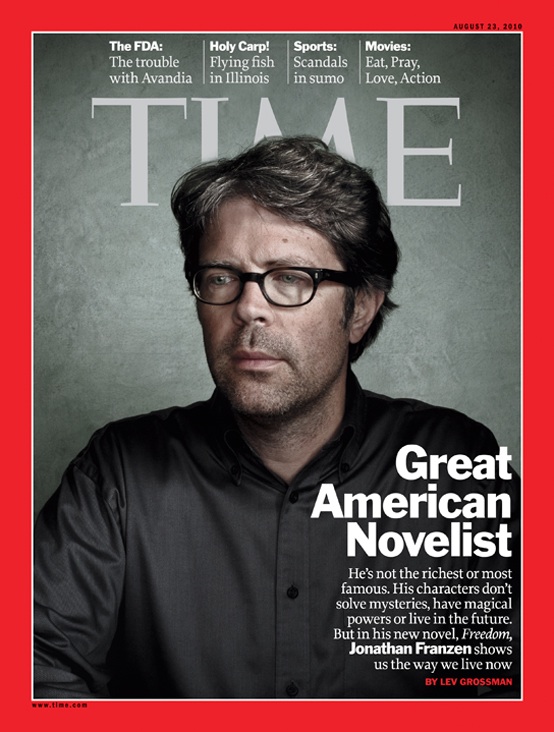
Time Magazine - Jonathan Franzen - Great American Novelist

Notes from the Red Pen of Doom

Yes, I know that critics went gaga over this book, and they loved THE CORRECTIONS, too.

I hate this first page. It rubs me wrong, and makes me feel like I’m about to read a 895-page doorstop of a book, something my sadistic Contemporary English Literature professor assigned me to read as punishment for my literary sins.

Here’s the deal: Franzen writes about families in the suburbs. Basically, the same topic that every sitcom has tackled for the last 50 years. Instead of making it funny, he makes it deep and depressing.

Is what Franzen writes – when he closes his eyes and composes after receiving inspiration directly from a muse that circles his head and descends, like a butterfly, or a silken bat, to kiss his unshaven cheeks with the kiss of creative genius – is it fun to read? No.

Don’t care about Walter and Patty as characters. I’d rather read about that biker gang guzzling Schlitz and grilling knockwurst while the talk smack and plan crimes that go epically wrong.

As with all literature – as Camryn Rhys or Elisa Logan would say, LIT-rah-SURE – the beginning is deep and mundane and depressing. It only gets worse from there. While the writing may be beautiful and amazing (though it is not beautiful or amazing on this first page yet) that’s not going to make me want to read more of the story. If I want to be depressed, I’d watch daytime TV.

The first page is all over the place. Also, he adores adjectives and adverbs, while I believe, deep in my dark heart, that all those modifiers simply mean Franzen should’ve picked stronger nouns and verbs in the first place.

It pains me that Franzen is half-Swedish and spent time in Germany as a student, because I am Swedish and lived in Germany as a child. But we are nothing alike, and I care nothing for this first page.

Which is too bad. Franzen has talent to burn. I bet if he wrote about the biker gang instead, it would be seven separate flavors of awesomesauce, and the Coen brothers would make a movie out of it.

Verdict: From this first page, you’d have to hand me stacks of purple euros to convince me that reading FREEDOM would be a good use of my limited time on this planet.

The Red Pen of Doom murders THE FOUNTAINHEAD by Ayn Rand

THE FOUNTAINHEAD

Cover of The Fountainhead

by Ayn Rand

Howard Roark laughed. (I approve of this. It asks a narrative question – who is this guy, and why did he laugh? – and I like short sentences anyway.)

He stood naked at the edge of a cliff. The lake lay far below him. A frozen explosion of granite burst in flight to the sky over motionless water. (Whoah, whoah, hold up. So far, it was all tight and Hemingway-esque. “The pants fit him. They felt good.” Now you suddenly switch to purple prose, with granite bursting in flight? I didn’t know that granite rocks flew, or exploded when they did decide to take wing. No.) The water seemed immovable, the stone flowing. The stone had the stillness of one brief moment in battle when thrust meets thrust and the currents are held in a pause more dynamic than motion. The stone glowed, wet with sunrays. (More purple prose. Hate it. Though I do smile at all the double-entendre action. Let’s try again.)

The lake below was only a thin steel ring that cut the rocks in half.  The rocks went on into the depth, unchanged. They began and ended in the sky. So that the world seemed suspended in space, an island floating on nothing, anchored to the feet of the man on the cliff. (What? I think Ayn Rand was smoking a bowl here.)

His body leaned back against the sky. It was a body of long straight lines and angles, each curve broken into planes. (Things are either curved, straight or angled. That pretty much covers it. Maybe the only other people in this book are Flat Stanley and the Blob.) He stood, rigid, his hands hanging at his sides, palms out. He felt his shoulder blades drawn tight together, the curve of his neck, and the weight of the blood in his hands. He felt the wind behind him, in the hollow of his spine. The wind waved his hair against the sky. His hair was neither blond nor red, but the exact color of ripe orange rind. (No man would ever describe his hair as “ripe orange rind.” He’d say, “I’m a red-head” or “I’m blond” or “I don’t know.”)

He laughed at the thing which had happened to him that morning (Oh, right. So funny!) and at the things which now lay ahead. (Yes — also hilarious. I laugh at that all the time. Maybe let’s use different ways to hint at backstory and do foreshadowing.)

He knew that the days ahead would be difficult. There were questions to be faced and a plan of action to be prepared. He knew that he should think about it. He knew also that he would not think, because everything was clear to him already, because the plan had been set long ago, and because he wanted to laugh. (Enough with the laughing about things that may or may not have happened, and difficult plans, and thinking about not thinking. We can go to this well once or twice, but not every sentence.)

He tried to consider it. But he forgot. (Or maybe we can jump into that well and stay there forever.) He was looking at the granite.

He did not laugh (Oh, we’re NOT laughing now?) as his eyes stopped in awareness of the earth around him. His face was like a law of nature— (You have got to be kidding me.)

End of Page 1

Notes from The Red Pen of Doom

I believe the readers of today – like me – don’t want (a) tons of purple prose, (b) paragraph after paragraph of character description or (c) 3.4 metric tons of purple prose that’s all character description and internal dialogue.

But there are bigger fish to fry here, both in the literary sense of Is This A Good Page One? and in the story sense.

Ayn Rand is a deity among conservatives, because her novels underpin what she calls the “philosophy” of objectivism, which says it’s quite unselfish to be selfish. This is obviously counter-intuitive and quite appealing in a juvenile kind of way, because hey, it’s now my moral duty to do whatever I want. The best way to take care of others is to only care about yourself. The surest path to aid the poor is to cut taxes for the rich. And so forth.

This philosophy intrudes upon the story. Roark, the hero of this novel, roughly has his way with Dominique, the heroine, when they first meet. She later describes it as rape. Dominique makes Sylvia Plath look mentally stable. To show her undying love for Roark, she marries … some rich man. Then she tries to destroy Roark, divorces that rich man to marry another rich dude, keeps on trying to destroy Roark, then finally divorces that other rich schmuck to marry Roark in the end, but only after Roark TRIES TO BLOW UP A BUILDING that he designed.

If you said “This is a book that makes a hero out of a selfish architect who’s a strong-willed, good-looking rapist and terrorist,” you’d kinda sorta be accurate. And yes, I read the entire book. Twice. I WROTE A PAPER ON IT.

So the first page does foreshadow a lot of things. Ayn Rand has “a frozen explosion of granite” in the second graf. She has a whole bunch of imagery and descriptions of Roark’s perfect body.

HOWEVER: If I hadn’t already read this book, I’d see this first page and think it was some kind of historical romance, with Roark’s kilt and dirk sitting over on that rock, his trusty horse waiting for him after he took a swim and rode off to rescue his favorite maiden, a red-haired beauty held captive by the twisted and disfigured Baron of Whateverthehell.

Otherwise, I don’t hate her writing per se. I merely despise it.

Usually, I can fix a line or a paragraph. Big chunks of this first page simply need to die. The best thing is to cut them out.

Does that whack about half of this first page? Yes.

Would that make it better? Yes.

There’s a weird mix of styles going on here. You get short, clipped sentences, tight and hard, with zero fatty modifiers. But then Ayn the Rand switches to long stretches of not only purple prose, but outright wackiness I expect from college sophomores writing flash fiction at three in the morning on the deadline day after hitting the bong FAR TOO HARD.

The Verdict:

There’s a reason 12 publishers rejected this novel before it found a home. Hate the first page. Hate the hero, and the heroine who tries to destroy Roark because she loves him so much. Hate the story. Hate the “philosophy.” It’s a tough call, whether THE FOUNTAINHEAD or OUTLANDER are more deserving of being thrown across the room. But I’m going with THE FOUNTAINHEAD.

Vonnegut, Einstein and a Grand Unified Theory of Writing

Kurt Vonnegut was the Man.

Go back and read his books. DO IT NOW.

Once you’ve read his books, and fully appreciate his literary genius, you can watch this low-definition video with horrible audio that still rocks because it has KURT FREAKING VONNEGUT.

I would have paid monies to have him as my professor. Now that I think about it, I did pay monies to have professors. Hmm. Though my journalism profs were top-notch. Props to you all.

Now, it’s not so complicated, is it?

Hero in a hole.

Boy meets girl.

Girl with a problem.

Albert Einstein — and thousands of other people far, far smarter than you or I put together, even on our good days when our fingers spark magic and the coffee we drink would do better on an IQ test than Michele Bachmann — spent many years trying to come up with a unified theory of everything.

See, the whole E=MC2 was only part of the answer. That’s the equation for energy. He wanted to do an equation that also explained gravity and whatnot. IT IS COMPLICATED. We will not get into it.

Albert Einstein
Albert Einstein was a muffin of stud with epic hair. I salute him. Image via Wikipedia

But writing isn’t rocket science. Not even close.

Oh, people get all mystical and complicated, and come up with their own jargon and rules. Yet these self-appointed writing gurus all disagree, and they specialize so much that they know more and more about less and less until they know absolutely everything about nothing.

You’ve got screenwriters and reporters, poets and novelists, playwrights (who spell their name wrong) and songwriters (spelling it right, good job), copywriters and non-fiction authors — all with their own rules and jargon, their own writing conferences and groups that hand out awards.

You’ve got endless shelves of books about the craft of writing, each expert giving their own special equations to maybe solve a piece of  of the puzzle.

Hear me now and believe me later in the week: We could unify this sucker, and we could do it without a lick of calculus or a single imaginary number. (Having -1 bottles of rieslings does nothing for me.)

So let’s do it. I have evil ideas, and have scribbled on the blackboard while cackling with glee.

But I’d like to hear what my brilliant writer friends say. How would you smash the walls that separate the different houses of writers?