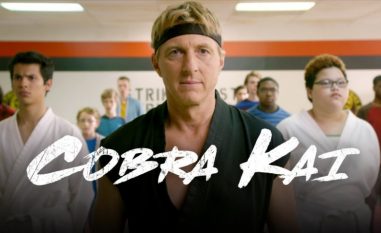
The last season of GAME OF THRONES went out in a fiery train wreck packed with dragons and stupidity–but here we have the opposite, a low-budget show on Netflix about dueling karate dojos.
Roughly 28 gazillion people are watching COBRA KAI, and they’re loving it. Shockingly, the critics are all over it, too.
Because unlike the Season that Must Not Be Named that Did the Night King and Mother of Dragons Wrong Wrong Wrong, the writing and plotting of COBRA KAI is carefully and horrifically good. (Warning: spoilers spoilers spoilers.)
Building on Season 1
In the first season, it’s really the story of Johnny’s redemption. He rises from the depths and finds a purpose again, and truly tries to reform Cobra Kai to give kids like Miguel some help. Not that Johnny becomes a complete goodie-goodie.
By comparison, Daniel struggles, and its a bit of a rich jerk. But he’s not a complete villain, either.
I kid you not, the series feels a bit like BREAKING BAD in that most major characters aren’t heroes or villains. They’re beautiful shades of gray.
Season 2 doesn’t try to continue the character arcs in the same direction, which would have been the easy narrative choice.
The showrunners and writers went bigger. They raised the stakes and added twists, reversals and revelations throughout the season that changed everything around again.
This season, Daniel is the underdog and Cobra Kai is the big, dominant dojo, the winners of the All-Valley Tournament.
Except it gets more interesting than that.
Setups, payoffs and echoes
Though the show is funny, it’s not a comedy.
Comedies poke fun at an institution–sitcoms go after marriage and family and suburban life, MASH took on the military, THE OFFICE hit corporate bureaucracy–and in a comedy, heroes can’t succeed except by accident.
COBRA KAI is a drama, with things happening for a reason. You could argue the last season of GOT was a melodrama, with things just kinda happening and fans immediately asking each other on Twitter and Reddit why why WHY?
For every payoff, there’s a setup. And the biggest scenes feature echoes of previous scenes.
A genius ending that sets up Season 3
There’s a lot packed into the final few episodes, and what the showrunners and writers did here is fun to take apart.
The beginning of the final episode has a sweet call-back to the original movie, playing Cruel Summer on the first day of school, then you get a slowed-down, sad version of the song at the end of the episode. Beautiful. How many rock songs can rock the xylophones? NOT MANY.
There are a lot of reasons for our characters to be moping around:
A giant brawl in school happens after Miguel’s new bad-girl girlfriend, Tory, hijacks the school PA system to say she knows what Sam (Daniel’s daughter) did–kissed Miguel at a party–and is coming for her.
Everybody fights everybody, tying up a lot of relationships. Hawks gets surprisingly beaten by his old friend Demetri, Tory cheats while fighting Sam, sending her to the hospital for cuts, while Robby fights Miguel, who gets kicked over a stairwell and is in the hospital with spinal injuries.
All of that leads to the apparent end of the romance between Johnny and Carmen (Miguel’s mother) and a “no more karate” edict from Daniel’s wife as they’re in the hospital room with their daughter.
It gets worse for Johnny, who loses control of his dojo to Kreese, after (a) giving Kreese a second-chance and (b) kicking him out of the dojo.
In a great scene that echoes imagery early in the season, he chucks his cell phone and the keys to the muscle car he repainted into a black-and-yellow Cobra theme. Giving up on his old life, right? Then the camera cuts to the cell phone in the sand, showing that his old flame (and Daniel’s former girlfriend) responded to his friend request.
Guesses on Season 3
I don’t believe the writers will truly let Johnny and Daniel give up on karate forever. But I doubt they make a return to it in the first episode or two.
Five bucks says Kreese’s new, purely evil Cobra Kai will force them to come back to teaching–and though I’m not counting on it, I could see the end of Season 3 featuring a real truce, if not a partnership, between Johnny and Daniel to team up and beat Kreese for the sake of their kids and the community.
Then again, they’ve surprised us episode after episode.
VERDICT
If you haven’t watched Season 2 yet, binge watch that sucker.
If you haven’t watched Season 1, watch that first.
No, I’m not a zombie, sparkling vampire or Jean Claude Van Damme-ish universal soldier.
I simply haven’t posted in forever, and have missed the readers of this silly blog, who’ve taught me a lot and are always, always witty and entertaining.
So: with a crazy busy session at work, my evil choice was (a) come home and write a blog post, (b) hang out with the wife and son, (c) do laundry, pay the bills and possibly sleep or (d) finish and edit a novel.
I chose everything but (a) and it was the right choice. And now I’m coming up for air.
To folks who are into these things I like to call “books,” here are a few things I learned finishing a new novel, which is the most fun you can legally have as a writer.
(1) Keep switching it up and taking risks
If you keep writing the same sort of story with the same sort of heroes (6-foot-4 and Hollywood handsome) and villains (posh British accent and disfigured somehow) in the same sort of scenarios (stolen MacGuffin could destroy the world!), then hey, it’ll get stale. Same thing with non-fiction, whether it’s newspaper and magazine pieces, speeches or whatever you’re into.
Mix it up. That’s how you grow and learn.
There are endless ways to structure and execute writing. You can steal from anywhere:
Stand-up comics are amazing at setups and payoffs, and can do them in the most ruthless shortage of words.
Poets make sure every line is a magical spell.
Narrative non-fiction is actually a secret treasure chest of great stories that totally work as fiction except they actually happened, and they use the same structural tools as narrative fiction, also known as fiction.
Playwrights spell their own names wrong, yet they’re the masters of dialogue.
Linked movies and serial shows show you how to plot mega-stories (22 movies by Marvel that all tie together!) and how great beginnings can go completely wrong (Season Eight of GAME OF THRONES).
Screenwriters are the absolute best at structure, which is the evil secret to anything of length. And everything has SOME length.
Even if you write stark Nordic mysteries or spy thrillers, romance authors and horror writers show you how to do emotions right, and nothing matters without emotion.
(2) Writers are helpful souls–take the help, and offer help whenever you can
I only started this blog after romance authors found my silly ad to sell the Epic Black Car.
And I learned an amazing amount from them. Am still learning.
For a journalist-turned-speechwriter, writing thrillers for fun, romance is the last place I expected to look.
Look in those unexpected places.
Ask questions.
Answer questions from folks starting out.
The other person who taught me an insane amount is my sister, Pam, who won a Nicholl Fellowship for screenwriting. You wouldn’t think screenwriting has anything to do with speechwriting or novels. But you’d be completely wrong. Screenwriters are the absolute best. They’re building skyscrapers that hold up to hurricanes. Meanwhile, other books on writing tell you to build a two-story house out of drywall, then you wonder why the thing falls down after the first rain.
Also: there are authors, writers and editors I met here from around the world, folks who are continually witty, talented and interesting. I want to give a shout out to two in particular — Alexandria and Joshua the Sharp — for their help this year. You two rock.
Keep on meeting people, on Twitter, the Gram, the Book of Face or whatever new thing Silicon Valley invented last week. You never know who’ll turn out to be amazing and will change your life, or whose life you might change. YOU NEVER KNOW.
(3) Take things apart to see how they work
If you read this silly blog (and hey, you’re doing that now), it’s clear just about every post involves taking something apart to see why it’s either (a) horrifically good or (b) beautifully bad.
That’s the interesting and fun part of stories, books, movies, music videos and speeches. How do they work and why?
What could you do to fix a flawed piece or improve something that’s already amazing?
Complaining about something is the easiest thing in the world. You can throw a Nicholas Spark novel across the room (go ahead, that’s kosher any day that ends in Y), walk out of a lame movie or end a show on Netflix after 5 minutes and say, “That sucks.”
Except there’s behind those words. Zero intellectual weight. Anybody can kvetch about something that stinks, or gush about artistic things that are seven separate flavors of awesomesauce.
It takes no talent to do those things.
Figuring out HOW things rock or stink–that’s the fun and difficult part.
Firing up Word is fine for writing anything short. For anything big–novels, screenplays and such–you need specialized tools.
Believe me. I’ve done it both ways, and trying to do something large and important on a word processor will drive you to drink.
Word processors don’t cut it
Writing a big project is like building a house. To keep on track and make sure the thing doesn’t fall down, you need (a) solid blueprints and (b) heavy equipment.
Short writing projects are like the little bits you can tackle in your garage, with the tools sitting around and the scrap wood in the far corner.
And sure, you can try to wrestle Word into doing heavy lifting by going wild with navigation options and headings. It’s sorta possible.
Sorta.
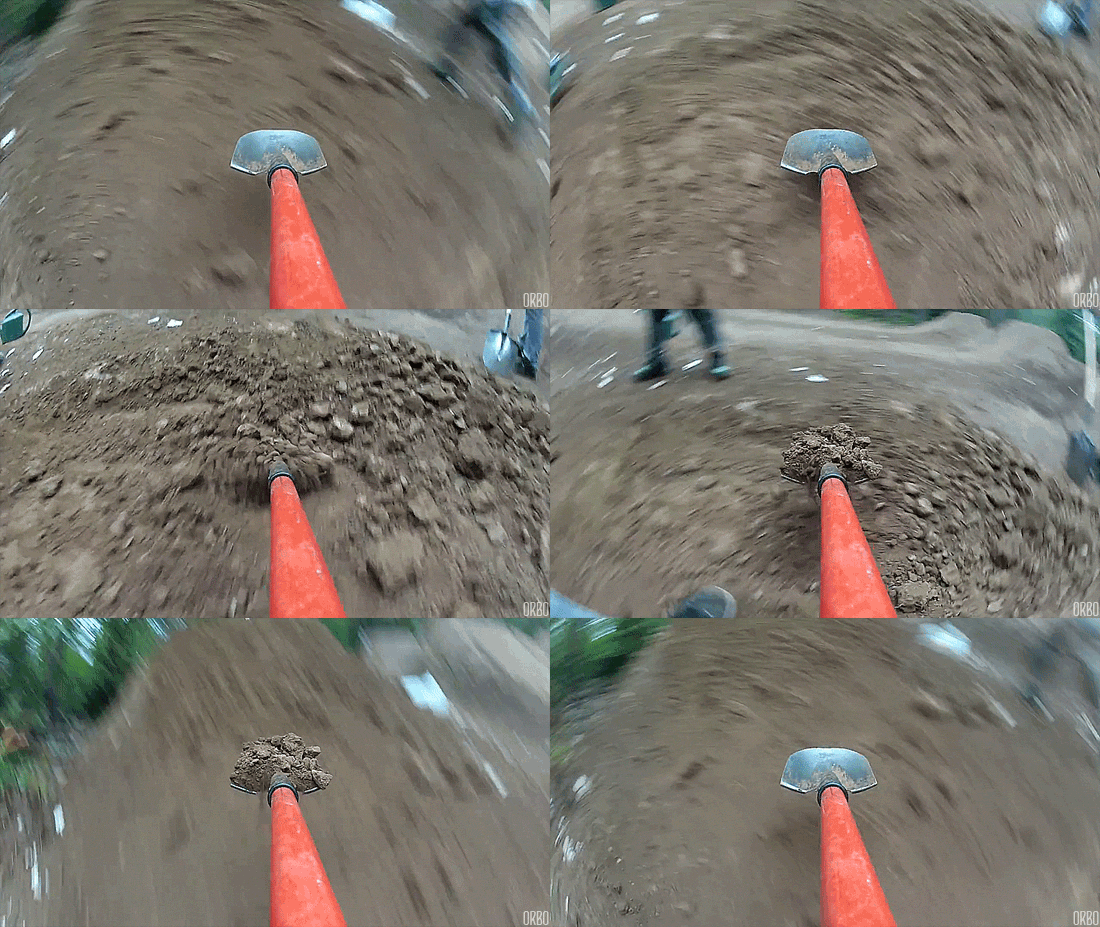
Yet no matter how hard you try to force Word into being able to handle a giant project, it’s like trying to excavate the foundation of your new house with a shovel instead of a bulldozer.
Even if you try to organize a single Word file that is organized enough to hold all three acts of a screenplay or all 100,000 words of your epic tale of when the elves rose up against the great tyrant, Santa the Claws, there’ll be all kinds of OTHER files hanging around.
A file about settings and another for characters. One for ideas and notes.
Another for loose text you cut out of a scene but might want to use elsewhere. You get the idea.
Switching between all those files is tough. Just getting a feel for things are is hard. How many words are all the chapters in Act 2 right now versus all of Act 1? Dunno. Get ready for a whole lot of highlighting and scrolling.
One tool to rule them all
I don’t care what you pick–Scrivener, yWriter, Manuskript, OneNote, Atomic Scribbler–as long as you test drive a bunch. For starving artists and writers out there, some of those choices are open source and free.
Try them all and pick one. You won’t go back.
There’s nothing like being able to see the whole project at a glance, then dive into different bits without digging around for which Word file or folder you put in all that stuff about pickpockets in Istanbul.
I just typed THE END on a novel written in Scrivener (yes! very excited about this one, and to beta readers, let’s chat). Am in the middle of transferring into Word for the final formatting and editing. Believe me, writing 80,000 words in Scrivener was a happy walk in the park compared to when I climbed that mountain using Word.
Haven’t used every single alternative, though I use OneNote at work and home and it’s both (a) pretty common and (b) pretty good.
A few lessons learned from my own silly mistakes
First, don’t get in a hurry to export your screenplay, Great American Novel or picture book about knitting hats for cats from Scrivener into Word.
You don’t want to export the whole thing right off because there’s an excellent, excellent chance you’ll have to import it all back in, which is a massive pain. Because once you look at it all in Word, you’ll spot six zillion structural things to fix that are a sweaty endeavor in a word processor and far, far easier in something like Scrivener.
And yes, I’ve made this mistake. As in last week.
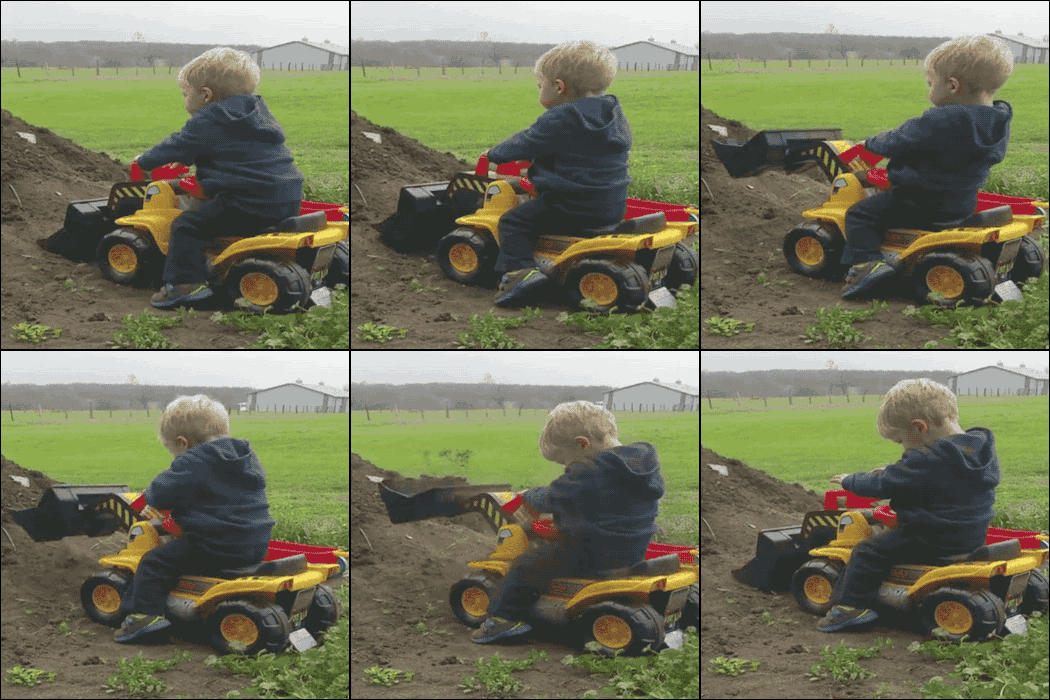
Heavy equipment, right? If you’ve got a choice between hundreds of hours with a shovel versus two hours with a bulldozer, pick the dozer.
The second thing is don’t ever export the entire project.
Seriously. Do it in pieces.
Sure, every program out there has some kind of magical option on the menu tree that saves your entire creation as a .docx, PDF or whatever. Resist temptation.
Put the first few scenes of your screenplay or novel into Word for that final editing and polishing. Meanwhile, keep on doing heavier work on the later stuff of Act 2 and 3.
Only export scenes or chapters into that Word file when they’re truly, truly ready.
The third thing is that paragraphs that seem short and sweet in something like Scrivener–especially if you have a big screen–turn ginormous when you pop them into Word on double-spaced pages.
Finally, get religious about making backups. OneNote, Scrivener and similar programs work their magic in mysterious ways, especially in how they save all those separate bits. It’s complicated. I believe quantum particles and gravitational waves are involved.
The way these beasts save their files is nothing like a Word doc, where you can see that solitary file and copy the thing to a thumbdrive or email it to yourself. OneNote in particular is tricky with saving. I’m still not sure where, exactly, it’s saving things half the time. Be careful out there.
But those are little tips and tricks. There are no giant tradeoffs, like a choice between a moped and a pickup truck. The switch to heavy writing equipment is always worth it. The only real question is what type and brand of literary bulldozer you should drive.
P.S. What heavy writing equipment do you use today–and what other ones have you dated or divorced?
If you’re a writer, you’ll need to use a MacGuffin now and then–and a MacGuffin generator is particularly important now, with upwards of a million writers cranking away every year on NaNoWriMo.
This is not a plot device. We’re talking about an item–and it doesn’t even have to really exist, or be seen–the hero and villain are fighting to obtain. Alfred Hitchcock was famous for using MacGuffins in his films. If the hero is on a quest, he needs to be questing for something. Really, it doesn’t matter what. It’s the journey that matters. Hitchcock has a nice way of getting into the topic.
You can see how movies and novels often revolve around a MacGuffin.
Indiana Jones always needs an item to find and fight over: an ark or a cup and so forth.
Spy movies need a microfilm containing the real names and identities of every undercover agent employed by the CIA, GRU or MI-6, with the good guys and bad guys both willing to do whatever it takes to find and destroy that MacGuffin, which the hero happens to pick up by accident in the luggage carousel at O’Hare.
Sci-fi novels need some kind of techno-babble MacGuffin, like a repulsive helix inverter, which can tweak your DNA or whatever and create an army of alien super soldiers.
Fantasy movies need a magical ring that turns you invisible but does nothing about your big hairy feet or the fact you’re the size of a smurf, or maybe an Enchanted Vorpal Sword of Infinite Sharpness that can lop off the head of the invincible Dragon of Instant Fiery Death that killed your father, uncle, grandfather, second cousin, first wife, baby sister and favorite horse.
Use it. Then visit her blog and show her some love. That’s how this thing works. Pay it forward.
Generator Number 2
Technically, this isn’t a generator. You don’t hit refresh on the browser to come up with another MacGuffin.
It’s more accurate to call this the Mother Lode of MacGuffins, with the entire history of the idea–plus with a massive list of the different flavors of MacGuffins with links that dive into each one. This site is a thing of beauty.
What is your favorite MacGuffin of all time? And which film, TV show or novel wins the prize for Silliest MacGuffin of All Time? (Note: It’s cheating to go with Star Trek, where every other movie or episode involves dilithium crystal nonsense and the warp core.)
Oh, it kills me to say this: we are doing it backwards.
Maybe you’re the exception to the rule. Perhaps you’re that rare writer who figured this out 10 years ago.
But I doubt it. Most of the writers that I know — novelists or journalists, speechwriters or screenwriters — go about it roughly the same way:
Step 1) Research, whether it’s six months of intense study or six minutes of looking at Wikipedia and playing Angry Birds“to let it all percolate.”
Step 2) Boil down the research into useful nuggets of meaty goodness.
Step 3) Use their secret recipe of writing methods to cook up their piece (outlining first or winging it, 3 x 5 index cards or spiral notebook, Word 2016 or Scrivener, one draft or six drafts, coffee or bourbon).
Step 4) Hand the draft to our editor, writing partner, spouse, co-worker or cousin Joey to get all coffee stained and edited.
Step 5) Spend five or fifty minutes thinking about how to present and sell the sucker for suitcases stuffed with twenties.
Those first four steps, they’re essential, right?
Here’s the thing: We writers are incredibly talented at screwing up Step 5.
Backward is bad
Step 5 is the monster lurking under our typewriters. (Yes, I know most of you use computers. Maybe I have a magic typewriter connected to the Series of Tubes.)
It’s the troll under the bridge, snarfing our lunch and saying, “Whatcha gonna do about it, tough guy?”
Now, boiling down a novel clocking in at 100,000 pages is rough. I have author friends who’d rather leap out of a perfectly good airplane, trusting in the bouncy power of their Nike Air Jordans, than write a three-page synopsis. Tagline? Logline? Forgetaboutit.
Doing Step 5 for anything, long or short, is tough.
Tough for screenwriters, who need to boil it down to an elevator pitch.
Tough for editors in newsrooms, who have to write headlines that fit into tiny nooks and corners of the newspaper layout.
Yet nothing else matters if we botch Step 5. Because nobody will see the fruits of our labors, the hard work that went into Steps 1 through 4, if we can’t condense the whole idea into a killer pitch and hook.
Reversing course
Instead of performing the labors of Hercules before even attempting the torture of Step 5, reverse course.
Start there.
Before you invest hours, days, weeks or months into research. Before you sweat bullets to put words on page after page.
Begin with the shortest and most important words.
The logline(or pitch, but in a sentence, not a paragraph) — “An alien monster stalks the trapped crew of a spaceship.”
The tagline – “In space, nobody can hear you scream.”
The headline – “Alien devours spaceship crew; heading for Earth?”
Test that out, not with friends and family, who are constrained by the need to live with you, and be liked by you.
Try that single sentence on people in line at Safeway or Starbucks, neighbors you barely know, visitors from out of town, tourists, people who won’t wound you forever if they make a face and tell you the idea is stupid.
And to get inspiration, use the series of tubes to check out “movie loglines” and “movie taglines” and “great headlines.” Or head to The Onion and read their headlines, which are seven separate flavors of awesomesauce.
Don’t do a thing until you have a logline, tagline and headline that sing.
Not one thing. Don’t spend six months writing a first draft or six minutes plotting the first chapter.
Go do it. Throw ideas around on a piece of paper or whatever — and not about whatever you’re working on. Dream up a few crazy ideas and write down loglines, taglines and headlines that are shorter than short. Then kill every word you can to make them shorter.
You’re going to notice a few things.
First, the hero doesn’t matter.
Second, the villain matters a whole bunch. If you remove the villain and threat, it kills the logline, tagline and headline. Because stories — even newspaper stories — are about conflict. No villain, no conflict. But if you take out the hero, it usually makes the logline a lot shorter and a lot better.
Here’s another example I’ve used before and will use again, because it is short and sweet and the logline for about six movies that have already been made: “Asteroid will destroy Earth.”
See? We don’t need Bruce Willis and Ben Affleck (Matt Damon‘s buddy, the one who dates & marries Jennifers) in there at all. Heroes just clutter things up.
Third, shorter is better. If you can get it down to three or four words, you are golden.
A new way to write
Let’s get practical. Here’s a new way to write anything.
New Step 1) Nail the logline, tagline and headline.
One sentence apiece, as few words as possible, and yes, it is cheating to have sentences that go on and on forever, sentences with six different commas and possibly semi-colons, which are a sin against the English language in the first place and should be taken out and shot.
New Step 2) Make it work as a paragraph.
Expand it a little, but not too much. Half a page, maximum.
New Step 3) Nail it as an outline on ONE PAGE, treating each side fairly.
Whether you’re writing an oped or an opera, a novel or a speech, figure out the biggest possible difference between the beginning and the end — and do it from both POV’s. The villain and the hero.
So: if it’s a romance where the heroine ends up as a great cook who’s happy and in a great relationship, what’s the greatest possible distance she can travel? On page 1, make her (a) the worst cook in the world, (b) unhappy and (c) alone. How can you take that up a notch? Make her a nun who loses her sense of smell (and therefore taste) in a car accident. I’m half kidding, but not really. You get the idea.
If the ending is crazy happy, the beginning better be insanely sad.
If the ending is full of sad, the beginning should be Happyville.
If the hero is a tough guy in the end, the best story shows him start out weak. Only after he suffers and sacrifices does he prevail (THE KARATE KID), and not necessarily by wining (ROCKY).
And you’ve got to make it a fair fight. Nobody thinks they’re a villain. The other side — whether it’s an speech about taxes or THE EMPIRE STRIKES BACK — has a point. If you don’t give it credence, your writing will be one-sided and weak. Cartoonish.
I used ALIEN before. What’s the story for the alien creatures? Maybe they’re a dying race. Maybe that crashed ship contains the last of their kind. The stakes just got a lot higher for the alien, right? You are our only hope, little facehugger. Get in that ship and lay some eggs.
Put yourself in the shoes of Darth Vader and the Emperor, who don’t see themselves as enslaving the galaxy. They’re helping people by establishing law and order. If nobody is in charge, it’s chaos and confusion. A strong empire means safety, security and economic growth. The rebels are violent terrorists who don’t appreciate what they have and will kill whoever it takes to gain power.
Now figure out your turning points. Put in your setups and payoffs. Make it work as an outline before you move on.
New Step 4) Research only what you need.
New Step 5) Write and have a professional editor bleed red ink on the pages until the draft is A SHINY DIAMOND MADE OF WORDS.
You’ll notice that what used to be an afterthought — Step 5 in the original way of writing — becomes the first three steps.
I did that on purpose.
Say you write a beautiful oped, 700 magnificent words about why the death penalty should be abolished or whatever. Now you’ve got to pick up the phone and pitch an editor at The Willapa Valley Shopper or The New York Times.
The first five seconds (aside from the “hello!” nonsense) will determine if they even look at the piece. Maybe six or seven words, if you talk fast. Part of that will be confidence, tone of voice and other things you can’t learn via a blog post.
Your pitch, though, will matter. A lot. A great speaker with a muddled pitch will lose out to a mumbler with a tremendous idea they can convey in four words. That’s what a logline, headline and tagline are really about, three different ways of explaining something in the fewest possible words.
Hollywood calls this five-second kind of thing “the elevator pitch.” There are websites that devote many, many words to it. Use the powers of the google and check them out. They are useful.
Bottom line: those four words matter more than all 700 words of the oped, all 3,000 of the keynote speech, all 15,000 of the screenplay or all 100,000 of your epic novel about elves with lightsabers riding dinosaurs.
Yes, I watch movies with subtitles, even if they’re in black-and-white, with people smoking French cigarettes while speaking French and watching things happen to other people in some scrappy, destitute part of Paris or, for variety, a tiny farming village in Normandy.
We are talking about a different sort of foreign film with subtitles.
Bonus No. 1: This film is 3 minutes long instead of three hours.
Bonus No. 2: There is hardly any talking, or any need to read the subtitles at all.
Bonus No. 3: Most importantly, this little film can teach us all great big lessons about storytelling and structure.
Also, unless you have no soul, it will make drops of water drip from your eyes and scurry down your cheeks.
Here. Watch the clip in high definition. Or low def, it that’s your thing. Whatever floats your boat.
Okay. All done?
Let’s take it apart and see what makes it tick.
Strong bones
This little film has strong bones. The structure is a roller coaster: things are bad (son is running away), things get even worse (son nearly dies, is paralyzed), then in the climax, things get resolved and the world is forever changed, at least for this family.
The father is not sympathetic at first, right? My first thought was bad casting. No. Good storytelling. The main narrative question is, “Will they get together?” This is a love story, which doesn’t have to be a rom-com with a high-powered professional woman who eventually gets together with a chubby, unemployed virgin who owns the Largest Comic Book Collection Known to Man, because for some reason, that’s what half the rom-coms are these days.
The other half of rom-coms star Matthew McConaughey.
Back to this little film: if they’re getting together in the end, they must be split apart in the beginning.
Another narrative question is, “How do these people suffer, change and grow?”
The father moves from stern, humorless taskmaster to loving and dedicated. He’s the hero of this little film, because it’s his actions that matter most. The normal thing would be for him to let the doctors do their work, right? But it’s his turn to rebel. He carries his son out of the hospital, out of the wheelchair and back into the world. Rehab isn’t going to be nurses and machines and doctors. It’s going to be father and son, learning to walk again.
And all that suffering and sacrifice pays off. The son also transforms. In the beginning, he’s rebellious and aloof. In the end, he’s loyal and connected to his family.
The mother is a flat character. She suffers, but she doesn’t change. That’s OK. Having two characters go through all this in three minutes is plenty.
Real stories beat Michael Bay explosions
This tiny film, which is a flipping COMMERCIAL, moved me far more than bazillion-dollar CGI blockbusters involving dinosaurs, vampires or robots that transform themselves into Chevies.
You can take those $294 million budgets full of special effects and a scripts credited to five different writers. (Pro-tip: the more screenwriters you throw in the kitchen, the crazier the thing that comes out of the oven.)
Give me a story with strong bones and a tiny budget.
Give me people I actually care about, because I don’t give a hoot about Shia LaBeuf and Megan Fox fighting robots or whether the awkward teenage girl gets together with the Sparkly British Vampire vs some kid who used to be a Power Ranger.
THE BIBLE:
And God came down from the heavens and He said unto the chicken, “Thou shalt cross the road.” And the chicken crossed the road and there was much rejoicing.
ARISTOTLE:
It is the nature of chickens to cross the road.
CAPTAIN JAMES T. KIRK:
To boldly go where no chicken has gone before.
FREUD:
The fact that you are at all concerned that the chicken crossed the road reveals your underlying sexual insecurity.
RALPH WALDO EMERSON:
The chicken did not cross the road. It transcended it.
BUDDHA:
Asking this question denies your own chicken nature.
MACHIAVELLI:
The point is that the chicken crossed the road. Who cares why? The end of crossing the road justifies whatever motive there was.
KARL MARX:
It was a historical inevitability.
BILL O’ REILLY:
To steal a job from a decent, hardworking American.
DR. SEUSS:
Did the chicken cross the road? Did he cross it with a toad? Yes! The chicken crossed the road. Why it crossed, I’ve not been told.
GRANDPA:
In my day, we didn’t ask why the chicken crossed the road. Someone told us that the chicken had crossed the road, and that was good enough for us.
New bonus answers:
BILL GATES:
I have just released the new Chicken 7, which will not only cross roads, but will also lay eggs, file your important documents, balance your checkbook and compete with Apple’s Smooth Eagle.
JERRY SEINFELD:
Why does anyone cross a road? I mean, why doesn’t anyone ever think to ask, “What the heck was this chicken doing walking around all over the place, anyway? What is wrong with that chicken?
And that’s slow. I type about 80 or 90. Faster, if I have coffee. Even quicker with headphones blasting, or on deadline.
Coffee plus headphones plus a deadline? Fuggetaboutit. That keyboard is gonna sing.
The thing is, all the speed in the world doesn’t really matter.
Here comes the math
Let’s say you write full-time, all day, every day. No day job to worry about, no cramming in writing at 4 in the morning when the kids are asleep or scribbling forty minutes a day on a yellow legal pad (are there other colors? why yes, there are, including PURPLE) as you ride the train from New Jersey to the NYC.
Say you’re not that fast. Fifty words a minute.
Fifty words per minute =
3,000 words per hour
24,000 words per eight-hour day
120,000 words per week
That’s a ton of words. An incredible amount.
Let’s do a little more math to see how much we should be cranking out, if we’re not surfing the net, Twittering our lives away and checking out Facebook photos all day.
Here come the word counts:
200 words = letter to the editor
500 words = five-minute speech
600 words = news story
800 words = oped
1,000 words = 10-minute speech
Up to 3,000 words = profile or magazine piece
Up to 8,000 words = short story
3,000 words = 30-minute keynote speech
15,000 words = screenplay
20,000 to 60,000 words = novella
60,000 to 120,000+ words = novel
Of course, people don’t type every second of the workday.
Let’s say half your day is eaten by meetings, research and other things, and you only write four hours a day, or 20 hours a week. Even then, we’re talking about 60,000 words.
That’s most of a novel, four screenplays, 20 keynote speeches or 100 opeds.
In a single week.
Nobody writes that much. NOBODY.
Not even Stephen King, back when he was fueled by industrial amounts of caffeine, nicotine and other substances.
In fact, writers of all sorts are happy to produce between 500 and 2,000 good, usable words a day.
I know novelists who are happy to produce one good novel per year. If you divide 100,000 words by 52 weeks, you get a smidge less than 2,000 words per week and, I kid you not, less than 300 words per day.
I know reporters who crank out two stories a day, five days a week and columnists who do one or two opeds a week.
There are pro speechwriters, brilliant people I’ve known for years, who take two solid weeks to nail down a 30-minute keynote speech (3,000 words).
Before the invention of word processors, writing gods like Hemingway would pound on their Underwoods and count every word, quitting for the day when they hit 1,000–or even 500–that day.
But let’s be generous and say 2,000 words a day is a good day.
Where are the missing words? Why are all sorts of pro writers–reporters, novelists, poets, speechwriters–producing about 20 percent of what the math says?
Suspect No. 1: It’s not really eight hours or even four hours
This looks like the obvious culprit, because it’s the only person sneaking away from the crime scene with a guilty look and blood on the bottom of their shoes.
Reporters have to cover stories, get quotes from sources and meet with editors.
Novelists need to do research, talk to their agent, go on book tours and so forth.
Every writer, reporter and novelist has to do research, travel and attend meetings. Nobody is chained to the desk the entire workday, pounding on the keyboard like a typist. They need to eat of the food sometimes, and drink of the wine, and have a life.
HOWEVER: A lack of hours isn’t what’s wrong here.
Let’s say even more of the day is toast. Research. Phone calls. E-mail. Lunch with some big important person. Twittering to your buddies.
Fine, let’s go all the way down and say six of your eight hours are toast, and there are only TWO HOURS of actual banging on the keyboard.
3,000 words per hour X 2 hours = 6,000 words a day.
And yet the most writers typically can hit, day after day, is 2,000 words.
Where are the missing words?
Also, I know writers who spend six hours a day in meetings, doing research, returning e-mail and all that — and they still bang on the keyboard at least four to eight hours a day because they’re working crazy hours. A lot of writers work weekends, too. Writing is often a daily habit.
Yet 2,000 words per day seems like a kind of universal wall for writers of all stripes. Why?
Suspect No. 2: We type slower than narcoleptic turtles
This suspect doesn’t even get handcuffed and taken down to the station for a chat.
I used 50 words a minute because it’s the average typing speed of the general population.
Serious and professional writers are typically a lot faster, unless they’re hunting and pecking on an Underwood because that’s what they’ve always done since they first got published in 1926. There aren’t that many authors in that category.
If you dictate your stuff with Naturally Speaking or whatever, it’s more like 100 words a minute.
But let’s be generous again and pretend we all type really, really slow.
25 words a minute = 1,500 words an hour.
Even if we say Suspect No. 1 (Miss Most Hours of the Day Get Wasted) and Suspect No. 2 (Mr. Types Slowly) shacked up in a cheap motel and conspired to murder the creativity of all writers, it doesn’t get us down to 2,000 words a day.
Four hours at the keyboard at 30 words per minute is still 6,000 words a day. Two hours is 3,000 words, which is closer, but not plausible. Professional writers aren’t much slower than average typists–they’re a lot faster.
We need a better theory of the crime.
Suspect No. 3: Writing requires deep, deep thinking
Ah, this one is good. It’s lurking in the shadows.
It’s evil. Hard to refute.
How can you say that writing is shallow and easy?
How can you deny the art required, the creativity?
This isn’t an assembly line. It’s not a factory where we churn out widgets. Writers create something original, whether it’s a 500-word story for the newspaper or a 100,000-word novel.
Except I know better. Because I’ve been watching.
Going off my own experience wouldn’t be proof of squat. Maybe I’m an anomaly. Maybe I type 80+ words per minute (true) and separate writing from editing (also true).
But I know writers of all sorts. Reporters, speechwriters, novelists, you name it, and just about everybody who writes for money bangs on the keyboard at least four hours a day, and they’re all faster than 50 words a minute. That’s 3,000 words per hour.
Even going with four hours a day of actual writing, we should be at 12,000 words a day. Except we’re not.
Suspect No. 4: We’re creating while destroying
This is our killer. I’ve seen him at work.
I’ve helped other writers catch the evil scumbag, convict him and send him upstate so he can’t do any more damage.
We are typing away on the keyboard, and we’re not doing it at 10 words per minute. We are writing fast. It’s just that we destroy those words just as fast.
Why do we writers destroy more than we create?
Not because the words aren’t pretty. Sentence by sentence, they’re fine.
It’s because the structure is wrong.
I’ve looked at bad drafts that hit the roundfile. The sentences were pretty. It was the structure that failed.
We spend so much time trying to fix these things because we nobody teaches us structure.
Oh, they taught me the inverted pyramid in journalism school, which is the best possible blueprint for a story if you want to give away the ending right away and put people in a coma the longer they read.
Creative writing professors teach us characterization and the three types of conflict in creative writing.
Rhetoric professors give us logical fallacies and different types of arguments in speech and debate.
Journalism profs teach us hard and soft headlines and the different types of ledes.
Yet that’s not really structure. It’s tiny bits and pieces.
Building a house one room at a time, without blueprints
They way most of us write is like trying to build a house one room at a time. Winging it, without any blueprints.
Pour the foundation for the front door and foyer.
Frame it. Wire it for electricity. Drywall it. Paint it.
Now dig the foundation for the kitchen and build that.
Where should the living room go? OK, we did that, but forgot to put in stairs to the second floor, so we’ve got to tear it all down and start over.
That’s how I used to write. It’s how most writers I know do it.
You start at the beginning and work your way through it, trying to fix any problems with structure along the way.
My old friend and mentor, Robin, was guilty of this. He’d spend a week on an oped, which is only 800 words. He was a brilliant man, one of the smartest I’ve ever known, and a good example of why mixing research, writing and editing into a single process slowed everything down to a snail’s pace. He’d create and destroy thousands and thousands of words before he had 800 on a final draft.
Doing research, writing and editing all at once is no way to run a railroad. It’s building a house without blueprints, blindly hoping the beginning will magically connect with the middle and an end you haven’t figure out yet.
I’ve had houses designed and built. If a contractor tried to build a house the way we writers work, it wouldn’t take six months to finish it. It’d take six years, or forever.
So this is our killer, our time-suck, our nemesis.
Question is, how do you DO structure — and how do we, as writers, learn to draw good blueprints, so we stop spending 80 percent of our time at the keyboard destroying what we created?
A classic post from my old blog, updated a bit. For new folks, enjoy.
Let it be known: we men must rethink our natural manly instinct that romance novelists are something to avoid, like SEX AND THE CITY 2, which is indeed worthy of scorn, and woe unto any man whose girlfriend or wife coerced them into wasting two hours of their life to see that stupid thing. No bribe is sufficient.
Published romance novelists are not only talented and funny, but many can write circles around the 6.57 gazillion reporters, writers and novelists I know.
These women are more talented than most folks writing about elves and spaceships, or elves riding spaceships, because there is so much freaking competition with romance novels.
Are there bad romance novels out there? Sure, just like any genre. But with so many books and writers, it’s like throwing 10,000 authors into the Thunderdome, tossing in a single chainsaw and refusing to unlock the door until there’s only one woman left. That woman is going to kick tail. She will be a writing goddess.
And the message is good. Romance novels don’t want men to be to be office drones, worried about TPS reports, or moody, over-educated basket cases you read about in literary novels.
Romance novels want men of action and charm, packing swords if not guns, and sometimes guns and swords. Any man can learn this from googling “romance novel covers.” IT IS AN EDUCATION.
Fabio and a sword is all you need. Shirts are optional.I hadn’t read romance novels, or even checked covers until now. Yet now that my eyes are open, we men should band together to pool our resources to give romance novels serious tax subsidies, because romance authors and readers are a secret army doing a $16.5 billion public relations campaign for men everywhere.
And, yes, the genre is bigger than that. It’s a big push for love of all stripes, which is a good thing. Life isn’t about having the biggest pile of dead presidents. It’s about family and who you love. As a husband and father, I get that.
So, romance novelists and readers, I am holding a mug of Belgium beer which I raise your direction.
I take great pleasure in dissecting the first page of Popular Novels Which Actually Stink, or finding first pages that absolutely sing and figuring out why they’re so glorious.
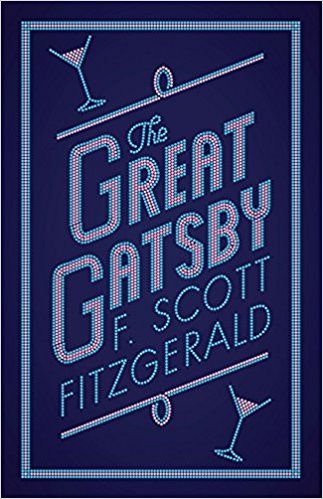
By request, today we’re taking on page one of a classic of lit-RAH-sure: THE GREAT GATSBY by F. Scott Fitzgerald.
Sidenote: There are 5,832 various editions and such, so you’re page one may end on a different sentence and such. I tried to stop at the end of a paragraph, though as this is an older book, back when paragraphs lasted longer than most CBS sitcoms, this is kinda hard.
THE GREAT GATSBY
In my younger and more vulnerable years, (missing a comma here) my father gave me some advice that I’ve been turning over in my mind ever since.
“Whenever you feel like criticizing any one,” he told me, “just remember that all the people in this world haven’t had the advantages that you’ve had.”
He didn’t say any more, (this feels like odd, unplanned repetition of the “any one” in the previous graf, so strike “any”) but we’ve always been unusually communicative in a reserved way, and I understood that he meant a great deal more than that. In consequence, I’m inclined to reserve all judgments, a habit that has opened up many curious natures to me and also made me the victim of not a few veteran bores. (Listen, we’re on the third graf already, and I’m not inclined to reserve all judgment, seeing how you’re coming off like a veteran bore.) The abnormal mind is quick to detect and attach itself to this quality when it appears in a normal person, and so it came about that in college I was unjustly accused of being a politician, because I wasbecame privy to the secret griefs of wild, unknown men. Most of the confidences were unsought — frequently I have feigned sleep, preoccupation, or a hostile levity when I realized by some unmistakable sign that an intimate revelation was quivering on the horizon.; for the intimate revelations(“intimate relations” twice in this sentence, so close together, doesn’t work at all)of young men, or at leastThe terms in which they express them, (comma deleted) are usually plagiaristic and marred by obvious suppressions. Reserving judgments is a matter of infinite hope. I am still a little afraid of missing something if I forget that, as my father snobbishly suggested, and I snobbishly repeat, (here we get repetition with a purpose for once and it does work) a sense of the fundamental decencies is parcelled out unequally at birth. (This is an awkward mouthful)
THOUGHTS: This is 100 percent interior monologue, which isn’t required by law to be boring. Though it sure leans that way.
Maybe it sets the mood.
However: If you’re basing a tragic hero’s entire motivation for making a ton of money to become a rich snob to impress a girl he loved and lost, and you’re hell-bent on starting page one with interior monologue about backstory, MAKE IT ABOUT THE GIRL.
Not the narrator. Not the narrator’s dad.
Not boring people who tell the narrator secrets while he pretends to sleep.
Make it all about the girl and Gatsby.
A huge part of the novel is throwing fancy parties to impress each other, right? I’m going off my memory from doing my own term papers on this thing. Never saw the movies. And when I do a first page, I try NOT to cheat by reading plot summaries and such, even if I’ve read the book.
Put a gun to my head and I’d delete this first page and start with the real inciting incident, which should be Gatsby and the narrator meeting the girl at a party way back when, so you can echo that later.
Or make it about about a small betrayal, from college or back during the war, to foreshadow the bigger betrayals and tragedies to come.
VERDICT: Doesn’t make me want to read more, which I wouldn’t unless the English 101 prof gave me no choice.
Sorry, F. Scott F.–can’t lie and say I liked this. Nuke the first page and go with a better hook.




 The Red Pen of Doom