So this convicted drunk driver has to blow into a tube before his car starts, and he’s drunk. Shocking. What’s this genius do?
He looks for a sober buddy to puff that tube for him so he can drive off.
The nearest buddy happens to be a raccoon rummaging through his garbage. Grabs the raccoon, somehow gets the animal to blow on the tube and yes, the car starts, with the animal now unconscious. Maybe he squeezed it too hard.
So he’s driving along when the raccoon wakes up to gets his revenge, scratching and clawing our drunken genius, who crashes into a fence.
This story has all the classic hallmarks of weird news: drunken idiots (almost always men), motor vehicles and dangerous wild animals. The only way to improve it would be to add firearms.
Sadly, the San Diego Police report that this is an internet hoax.
HOWEVER: The way it spread so fast shows that the bones of this story are strong. All the elements you need are there, and there’s no fat to trim. It’s an urban legend that’s evolved into a perfect little story.
As the race for the White House gears up, you are being bombarded with stories, 30-second ads, attack tweets and Instagram videos.
Back in the 1970s, the average person got hit with 500 messages a day: ads in the paper to buy Fords, radio spots for Richard Nixon, promos for the latest ABBA album and billboards for Coke.
Today, the average person is buried with 5,000 messages a day.
So how do you tell the difference between propaganda vs. journalism and rhetoric?
Let’s talk about why this works, as a story, and how it could be even better. Because I’m not adding value by simply sticking funny or heartwarming videos in your feed. We have to dissect them and learn a little. SCHOOL IS IN SESSION.
Why this works and how to make it better:
1) The mangled start doesn’t matter–yet fixing it would’ve made it even more viral
This video works even if you read the story on Huffingtonpost or wherever, and know all the story beats, before you watch the thing. That’s how good the story is.
HOWEVER: Starting out a video with text screens like this is almost always a mistake. Cramming all the text in the beginning slows it down and I bet a good percentage of people bail in those first few seconds instead of sticking with it, which is a mistake.
How to fix it: Start with video of the dog chained up. We don’t need any text to understand the problem, to get that setup. Then if you really have to, add a little voice narration. I’d kill the text screen entirely.
2) Our narrator takes risks and is a hero
The narrator keeps the focus entirely on Rusty the Dog, but he shows real heroism, taking time–and risks.
He spends time to get to know this dog, repeatedly risks getting bit and confronts the owner, saying he’s not leaving without the dog. That took guts.
And all the while, he knows his family can’t adopt the dog, that he’d have to find another home for it.
Everything the narrator does is unselfish, and while he doesn’t focus on it, or take credit, this makes the story better.
3) The biggest possible gaps
Conflict and surprise comes from the biggest possible gaps between expectation and result.
You expect the chained up, aggressive dog to bite his hand.
You expect the owner to laugh at him when he says he’s not leaving without the dog.
You expect the narrator to adopt the dog himself, not search for a home.
And you expect the dog to be timid and afraid when finally free, not friendly and joyous.
This is a little story, a tiny snippet of life. But it made me feel more than most of the action movies that I’d happily paid money to watch and wouldn’t see again.
I’d see this again. I’d smile to see a follow-up, to find out how Rusty is doing.
And I’d want to shake the narrator’s hand for taking some risks, and doing the right thing, for an old dog most people would avoid and forget.
Why is this so funny and perfect? Let’s take it apart and see why it sings.
1) The sheriff deputy is from central casting.
If there’s a factory where Hollywood makes police officers from small towns, Lt. Higgins is the man they use as the mold.
Even without the hat and the uniform, Higgins would look and sound like an officer of the law. It’s in his bones.
Also, his accent and the cadence of his speech is mesmerizing. I could not, and would not, improve it. And his name is perfect.
2) Telling details about the crime and the suspect.
Show somebody the surveillance video without any narration from Lt. Higgins and they’d be all, “Yeah, it’s some kid in a hoodie. Good luck figuring out who.”
Lt. Higgins doesn’t see grainy film and a kid in a hoodie.
He sees a six-foot-tall suspect in a camo hoodie, a man with a distinctive lanky gait.
If we gave Lt. Higgins more screen time, I bet he could dissect every frame of this surveillance tape. And we’d be educated while entertained.
3) Son, I’m gonna have a cheeseburger here, with fries and a coke
The beginning is good. The middle is interesting.
But the last two-thirds is the climax, and that’s what makes this little bit of YouTube footage into viral gold.
This is what slayed me: “Look at me son, I’m talking to you. The sheriff likes Stelly’s restaurant, and so do I. The food is good, and the folks are friendly. We’re gonna identify you, arrest you and put you in a small cell. After that, I’m gonna have a cheeseburger here, with fries and a coke, and leave a nice tip for the waitress. Meanwhile, your next meal will be served in a small door through a cell door.”
Then Lt. Higgins gets all CSI, talking about his detectives “harvesting DNA from the rock you used” and the perfect bootprint on the door.
The kicker: Lt. Higgins doesn’t need all that science evidence, because the suspect’s friends, they don’t like him much and will go for the reward money. Oh, that stings.
Verdict: Lt. Higgins should have his work duties changed so he records Crime Stopper videos all across America.
On the way up, a man and his family said, “You’re almost there. But don’t go on the ice. We slipped and it was nearly fatal.”
This would be why all the people on the ice field in this photo are roped up and wearing crampons. It’s the way to Camp Muir and the summit. You don’t walk out there in shorts and hiking boots.
Loved this. Our own Hound of the Baskervilles gets faked out every time I pretend to throw the ball and palm it. Where’s the ball? The ball? I CAN’T FIND THE BALL!
So I try not to write about personal things, because a good blog is not a bad version of Dear Diary.
HOWEVER: It’s my birthday and I’ll blog if I want to. (Believe this is a song from the ’50s. Could be wrong. Not gonna check.)
Though I rarely drink now, my wife gave me two bottles of fine bourbon this morning: Knob Creek and Buffalo Trace.
A while bag, I toured the Buffalo Trace distillery while in Kentucky’s capitol, and they spent hours educating all about bourbon, which is rather complicated and interesting.
Also, the governor made us Kentucky Colonels.
I kid you not. Not really a military thing. Honorary advisory role from way back. Colonel Sanders wasn’t an officer who fought in World War II, then decided to open fried chicken restaurants. He was a Kentucky Colonel.
So yeah, those of us who went on this trip still joke around and call each other Colonel, though none of us have gone to the annual reunions.
The interesting part about the tour wasn’t just the ABC’s of bourbon and how each barrel was worth $25,000.
At lunch, they gave us pulled pork sandwiches and little taster cups. Columns were ingredients: rye whiskey, bourbon, vodka and so forth. Rows were age, with six months on the bottom row, a year, two years then the expensive stuff on the top row aged something like seven years or more.
Here’s the thing: didn’t matter if you loved whiskey and hated vodka. Every single thing in that bottom row, the six-months old, tasted like cheap moonshine. Rocket fuel. It was terrible, no matter what ingredients they used.
The next row was better. Third row was great.
Weirdly, the top row, the expensive stuff, wasn’t universally wonderful. Vodka doesn’t really taste like anything, so it was fine, but other cups weren’t smooth like the middle rows. Some of them tasted seriously off. Spicy, heavy, more concentrated. You’ve probably run into this if you’ve ever had an expensive bottle of wine. Uncorking it after thirty or sixty years is rolling the dice. Could be amazing. Could be sour and terrible. Either way, it’ll cost you as much as a used Honda Civic.
On the same line of thought, I’d always thought the Z3 was the best-looking car ever since Remington Steele drove one in GOLDENEYE: SEAN BEAN DIES AGAIN. (Love the Swedish subtitles on this video. Perfect.)
Last week, I spotted a Z3 at our friend’s house with a FOR SALE sign. Beautiful car, low miles.
She gave me keys to drive it. A dream, right?
Hated it. A fine car, just way too small, my head would poke out of the top of the soft-top. I felt cramped, like an astronaut shoved into a space capsule. I honestly feel far more comfortable in the Epic Black Car Part II: The Sequel, which sounds weird to say–I’d rather drive that instead of a Z3? But yeah, I would.
Sometimes, expensive is just expensive, and something one-third the price is twice as good.
If you haven’t seen his other videos, they’re all worthwhile. He does a beautiful impression of Morgan Freeman narrating, and the writing for each video is spot-on.
How much stuff is in your garage or basement, taking up space?
I feel your pain. Once you put something in a plastic bin and shove it in your garage, there’s a 95 percent change you’ll never open it. You could move across the country three times, loading and unloading those same plastic bins into U-Hauls, and never crack open the seal.
This is wrong. And it doesn’t have to be this way.
Though my first social media love remains Twitter, and my affair with WordPress lives on, the useful thing about Facebook is you can connect with local people who’ll pay you monies to TAKE JUNK YOU DON’T USE.
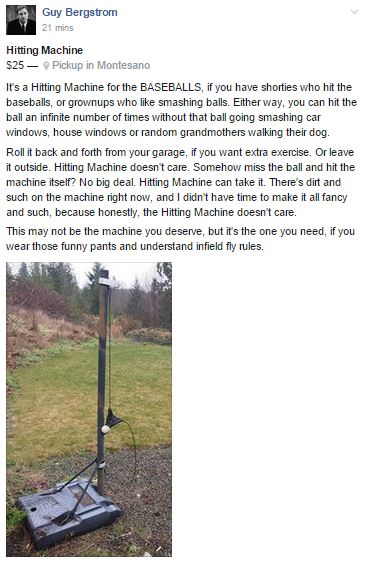
Here are three ads I put on Facebook today for my local group, East Grays Harbor Swap and Shop, or as I like to call it, EGHSS, which you pronounce kinda like “eggs” except slower and in a Danish accent.







 The Red Pen of Doom