Now that the Avengers have assembled into a giant machine that prints dollar bills, the X-Men are getting rebooted and Batman/Superman are teaming up to create billions more for an entirely different set of studio executives who live across the street from the Marvel folks, there’s something we need to discuss.
Because there’s a common problem with all of these movies–except for Batman, and we’ll get to that.
The Invincible Hero problem.
I’ve seen all three movies involving Thor and his hammer, and yes, the hammer has some crazy Norse name, and even though I’m a Swede nobody knows how to really pronounce the thing. IT’S A HAMMER.
Those movies are fun, and great, but tell me this: how do you hurt Thor, or kill him?
Because I don’t have a clue.
So there’s hundreds of millions of dollars in CGI explosions happening, and Iron Man grabbing Thor to fly him into trees and a cliff and such, but all amazing special effects that cost more than my house and your house and every dollar we’ll ever make in our lifetime, well, they don’t really move me, because I’m never worried about Thor being injured or killed.
You can throw the man around, blow him up, stab him with Loki’s sneaky dagger, punch him with the Hulk, and none of that really matters. The only proven way to hurt Thor is to remove Natalie Portman from the picture.
The first Thor movie was better than the sequel because for a good chunk of it Thor didn’t have his powers. He was just a man who could get hurt, lose a fight or even die, and it was his willingness to sacrifice himself and die that made Odin restore his powers.
See, when a hero is invincible, you don’t worry about them. And when you don’t worry about them, you stop caring about bullets and thugs and whatever else the villain is throwing around.
Superman is the worst offender. When you look at heroes on the screen like Wolverine and Captain America, they don’t seem to get hurt, since both guys regenerate and such. But they’re powers aren’t crazy like the boy from Krypton, who can (a) run faster than a speeding bullet, (b) fly, including going into space without needing to breathe, (c) shoot heat rays from his eyes when they’re not (d) busy taking x-rays of your bones, (e) ice anything with frost breath, (f) move so fast he GOES BACK IN TIME and (g) 17 other powers I don’t have time to list.
When you’re so powerful and invincible that tank shells bounce off your skin (Superman, Hulk) or armored suit (Iron Man), it’s hard to ramp things up without jumping the shark. Should we have Hulk get hit by a comet, or throw Superman into a black hole to see what happens? Also, no barber could cut Superman’s hair or trim his beard, right? He’d look like the lost fourth member of ZZ Top.
Batman is a better, more interesting hero because he’s simply a man. You know his bones can break, that the villain can truly hurt or kill him. It matters.
Hollywood could fix this problem, if it cared to, by setting up in each of these bazillion-dollar stories not just how cool the hero is and what amazing things he or she can do.
Tell us, up front in Act 1, what the hero can’t do. Show us a few weaknesses and how they can get hurt or even killed. Because then in Act 2 and 3, we’ll care a lot more about those CGI explosions and bullets as part of the story instead of eye candy that doesn’t really affect the story.
Hear me now and believe me later in the week: OBLIVION is an interesting and beautiful movie that could have been classic.
Why did it flop?
Let’s look at the prime suspects:
5) Tom Cruise fatigue
This is an easy target. Cruise has gone from “Biggest Movie Star on the Planet” to “Incredibly Excited Actor Jumping on Oprah’s Couch” to “Scientologist Who Gets Divorced a Lot.”
As a huge fan of Lee Child’s Reacher novels, I have to say that Reacher is something like 6’5, 250, blond and quietly sarcastic, while Cruise is short, light, dark-haired and loudly cocky.
HOWEVER: I will give the man his due, because Cruise did a fine job of acting in this movie. The average sci-fi apocalypse movie would have a hot new 20-something actor mumble his way through the thing looking stoned while trying to seem macho. Cruise was an upgrade from the typical New Action Hunk.
You could’ve put Matt Damon, Ryan Gosling or George Clooney in this sucker and it wouldn’t solve the problem. Cruise gets a pass.
4) Double mumbo-jumbo
Screenwriter Blake Snyder (may he rest in peace) says in SAVE THE CAT that audiences will buy one crazy piece of magic or sci-fi. They’ll buy a giant robot assassins with heavy Austrian accents or they’ll buy witches with real magic powers–but they won’t suspend disbelief to see a movie featuring magical witches battling a robot assassin.
Audiences might buy sci-fi techno stuff mixed in with a little magic if you distract them with lightsabers and don’t try to over-explain the magical stuff. But if you start talking like an idiot about the magic being caused by science, say something insane like “midi-chloridians,” they will turn on you, and hate you for ruining things forever.
OBLIVION throws all kinds of stuff in here: an apocalypse, an alien invasion, evil robot drones, massive human cloning, frozen astronauts who are 85 years old or whatever plus and a serious fetish for spiffy helicopter-things.
All of this, however, is under the happy umbrella of technology. Even the craziest stuff seems plausible given the setting of the movie. Also: Cruise should spend his salary from this movie to make a working replica of his helicopter-jet thing, which I’m gonna call the Tom-mobile.
3) Insanely confusing plot
This is a good suspect. While the movie technically avoid the double mumbo-jumbo trap because it’s all science, there are enough plot threads to weave a throw rug.
We’ve got dream sequences in black-and-white, Morgan Freeman channeling Morpheus by way of Mad Max, some Minority Report flavorings and a dozen other subplots thrown into the blender.
Even so, the director holds it together. You understand it. So the confusing parts of the plot aren’t what keeps this movie from being an instant classic.
2) Happy endings are for suckers
The ending is happy, which fanboys never like. Tom Cruise Clone #1 and the dying Morgan Freeman blow themselves up in the mothership of the aliens, saving the world, and later we see Tom Cruise Clone # 2 finding his wife and baby daughter.
Reunited and it feels so good. Except it doesn’t feel great.
1) The villain
There are three parts to a villain, which I’m making that up right now.
Let’s call it Guy’s First Law of Villainy, which states villains must be motivated, fascinating and scary.
Motivated: If your villain is simply doing bad things for no reason, it’s nonsensical.
This is a huge problem with OBLIVION, since these aliens invading Earth go through all kinds of trouble to (a) find Earth in the first place, (b) travel a bazillion light years to get to our precious rock orbiting the sun, (c) wage a long and brutal war to gain control of the planet so they can … (d) suck up all the water in our oceans to create nuclear fusion or whatever.
Hold up.
Water is no big flipping deal. Hydrogen is the most common element in the universe. Oxygen isn’t exactly rare. You can find water on asteroids, comets and planets. There’s some moon orbiting Jupiter or Saturn that we think is a giant ball of water with a frozen crust of ice on top.
I don’t buy aliens going through massive amounts of trouble to steal our water. Sci-fi needs to make sense, because sci-fi fans are smart people who care about this stuff. So this is a huge problem.
Fascinating and scary:
If you’re going to have an alien invasion movie, don’t forget the aliens.
OBLIVION has no aliens. I kid you not.
It has all kinds of drones, which look like angry flying cousins of Pac Man, yet tiny little drones aren’t scary of fascinating. Give us big, threatening bad guys, not cute little ones.
Who is the ultimate villain of the movie? A big faceless computer.
That’s not fascinating or scary. At all.
To make this movie work, we needed amazing aliens, the kind that are incredibly fun to watch. ALIEN got this right, as did ALIENS.
PROMETHEUS forgot about this rule, and therefore wasted the gross domestic product of Paraguay on Michael Fassbender and special effects for no good reason.
This is the reason OBLIVION failed as an alien invasion classic: no aliens. You can’t expect audiences to go wild for a boring, faceless computer as the bad guy.
It’s the same trap that doomed THE MATRIX sequels. We never saw Neo battle the ultimate bad guy in charge of the machines. He died playing anti-virus cleaner for the machine lords, which put the B in Boring.
BREAKING BAD wasn’t great because of brilliant cinematography, writing and acting, though Bryan Cranston deserves an Oscar or three instead of an Emmy.
It wasn’t great because of the gritty subject matter. In fact, it was successful in spite of the topic of meth dealers, which made many people not even give the show a chance.
Let’s dive deep, and dig hard, into what really made this show so different and so flipping good.
Heisenberg’s hat.
5) A complete story
In the normal world, 99.9 percent of TV shows cling to life from week to week. The creators and actors are happy if the pilot gets funded and made, then nibble on a diet of fingernails to see if a network picks up the first season.
Then they live in fear of not getting a second season. If they get a second season, they stay up all night worrying about some network executive moving their show to a night and time that guarantees doom, or keeping their show in the same slot only to have it slayed in the rating by some hot new thing from CBS or HBO.
Successful shows have different problems. Lead actors who were nobodies can suddenly do no wrong and start demanding the GDP of Spain per episode, or bail from the silly little show that turned them into a star to make a go at movies.
The ending of a series is often sudden. There’s no time to wrap up the series with a true finale.
Even when a series has time for a planned ending, you often get something muddled and maudlin, like a retrospective. Or the writers do something artistic and ambiguous (SOPRANOS facepalm) or go all the way and pull a LOST, causing us to curse their names for eternity.
4) Real character arcs
If you look at the pilot and the last episode of most TV shows, the characters are broadly painted archetypes who have barely changed, if at all. Unless they left the show.
Think of the average sitcom. There’s some kind of goofy situation involving (a) your average suburban family or (b) some institution the sitcom pokes fun at, whether it’s military hospitals during the Korean war, a hospital in Seattle full of dreamy surgeons, a hospital in Chicago or a hospital somewhere else. There are antics and jokes and some kind of moral lesson. Then everything gets fixed.
Same thing with dramas, which don’t always involve hospital ER’s. No. They also feature police, prosecutors and FBI profilers. With your average drama series, there’s a formula: bad guys do something bad, good guys arrive at the crime scene, bad guys lead them on a chase, good guys catch them.
Events change. Things happen. But characters don’t really change. You could watch these shows in any order.
BREAKING BAD is quite different. It let us see how different characters suffered and changed in reaction to the deepest adversity.
Gus, Hank, Mike, Jesse, Skylar, every major character suffers and changes. Gus alone would be worth his own spinoff prequel, as would Mike.
3) Chekhov’s gun
The way Vince Gilligan and his writing room use setups and payoffs is beyond beautiful. And here’s the kicker: they didn’t sit down and make a master plan.
They improvised.
Not once or twice at key moments. All the time.
Gilligan and his writers are true believers in Chekhov’s gun, the storytelling law that if you show your audience a gun in Act 1, that gun better go off before curtains fall on Act 3.
When they showed us a bearded Walt with a machine gun in his trunk in a flash forward at the beginning of Season 5, they didn’t know what Walt would do with that machine gun in the finale, only that it would get used.
They also improvised entire characters, such as walk-ons like Gus, who turned into keystones for the series. That wasn’t planned.
Uncle Jack and the Nazi’s? Not planned.
They improvised like crazy, and often used flash-backs and flash-forwards to do it. Which is the opposite of most shows, movies and books, which use flask-backs and flash-forwards for boring exposition.
2) The Hero
Walt is an interesting hero because he’s different and flawed.
Most heroes are too perfect. They’re untouchable tough guys who never lose a fight, brilliant scientists who can catch serial killers with a scrap of DNA off a cigarette butt or charming goofs with hearts of gold.
Sure, you get some anti-heroes, but are you really surprised by a cynical lone-wolf hero with an allergy to razors, a haunted past and trouble with the bottle?
Walt started out as an average dad in the suburbs, middle-aged and beaten-down. He’s not a hero, not even to his wife and kids. He’s nobody.
What made people root for Walt was his drive to change. He could’ve taken the easy way out, gone to hospice and died. Fighting inoperable lung cancer was a brave choice, regardless of how he got the money.
Unlike typical heroes, Walt couldn’t win fights with his fists. He had to use his brains.
1) The Villain
Who’s the villain of BREAKING BAD?
Because that’s the real secret, the number one reason this show was so great.
There’s no shortage of suspects.
Mike, Tuco, Skylar, Jesse, Todd, Lydia, Uncle Jack–there’s a case to be made for all of those characters being the ultimate villain of the show.
The top two might be Gus and Hank.
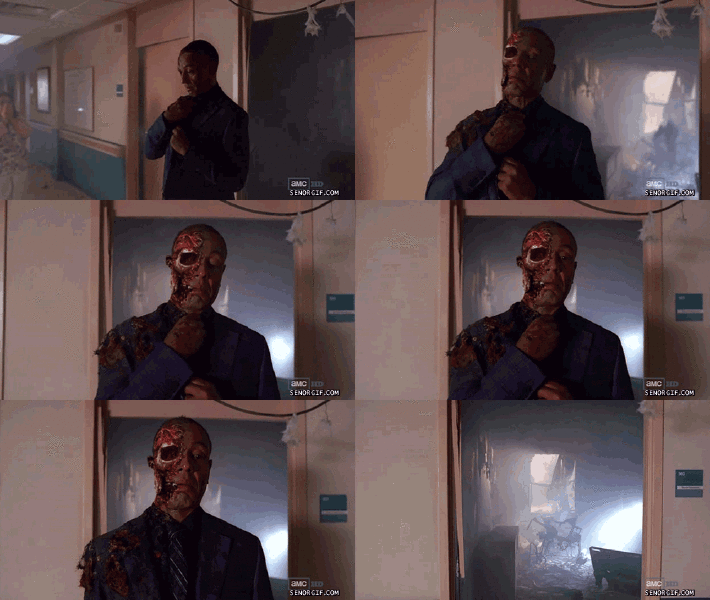
Gus was an incredible adversary. He seemed invincible right up to the point Hector made his crazy eyebrow face and started dinging that bell.
Hank was an antagonist from the other end, betrayed by his own brother-in-law. Walt chose to break the law, and while Hank made bad jokes, he was a pretty pure force for good on a show filled with people wearing black hats.
Gus and Hank, though, aren’t the real villain.
Walt is. He was the danger, the one who knocks.
He’s the hero and villain, which is why this was such a great show. BREAKING BAD is a tragedy, with hubris bringing the downfall of Walt, who admitted as much in his last conversation with Skylar.
“I did it for me. I liked it. I was good at it. And I was really–I was alive.”
Can you think of another TV show, movie or series of books that took a tragedy this far, this long? I can’t. There’s a possible case for all six STAR WARS movies depicting the rise, fall and redemption of Darth Vader, but that angle of the story is thrown together and sloppy, like something bolted onto a pile of droid parts by drunken Ewoks.
Other shows, movies and books suffer for lack of a single villain. Instead, they give audiences stories about (a) Villains of the Week who you know are doomed, (b) a multitude of villains, especially if this is a series of movies based on comic books, with one villain in the first movie, two in the second and three villains in the third movie before the reboot or (c) no real villain at all, with the show–usually a sitcom–about the crazy antics of a family, group of friends or office.
BREAKING BAD is about the struggle for Walt’s soul, the pull of good and evil, love and revenge, going out fully alive no matter how many dead bodies pile up versus fading away with a whimper.
That struggle happens right up until the end. There are no easy outs, no simple answers. And that’s why this show will be remembered and cherished.
THE BREAKFAST CLUB is a classic coming-of-age movie, which involves a jock, a prom princess, a geek, a stoner and a freak. THE AVENGERS is the same, except the kids are all grown up, have fancier toys and bigger issues, as this beautiful mashup makes clear.
BREAKING BAD is the best thing on the Glowing Tube, by far — that’s the consensus of all kinds of critics and smart peoples on this rock circling the sun. The thing has its own subreddit, just like Batman and catsstandingup — that’s how big it is.
Who could’ve predicted the actor who played Hal on Malcolm in the Middle would transform into this amazing character, Walter White?
And this mashup here, of Walter White singing the old Sinatra — well, it doesn’t get any better than this.
I tip my hat to actor Bryan Cranston and the whole BREAKING BAD team. Amazing work on an amazing series.
This man named Vadzim Khudabets edits movie trailers for a living. So he took 99 movies trailers and stitched them all together into this masterpiece of summer movie awesomesauce.
Summer means big, dumb summer movies, typically involving (a) cops and convicts shooting each other and making things explode, (b) cartoons from the ’80s being turned into $253 million wastes of good CGI and (c) members of AARP like Bruce Willis, Arnold Schwarzenegger and Sylvester Stallone trying to prove they can still hang with the young Jason Stathams of the world.
However: There are some big, dumb summer movies that rise above the mediocre pack of Michael Bay wannabes and G.I. Joe retreads.
PACIFIC RIM is a beautiful B-movie. It’s not gonna win a single Oscar and it doesn’t try for that. What it aims for is simple, pure entertainment, and it does that job well.
Here’s the trailer.
The director of PACIFIC RIM is Guillermo del Toro, who directed HELLBOY and THE HOBBIT — basically, the man can direct anything he wants. He’s a movie-making muffin of stud who did PAN’S LABYRINTH, which is literary, beautiful and one of the most unique movies you’ll ever see.
PACIFIC RIM works because it goes big without getting ridiculous, and entertains without trying too hard. It’s the rare kind of movie where you leave the theater and wouldn’t mind seeing the thing again tomorrow, or even today. There’s so much to see and marvel at, and it’s a testament to Guillermo del Toro skill at storytelling.
So go see the thing. I bet you it’s two hour shorter and five times as entertaining as any random Michael Bay explosion-fest.
Bonus clips below. Enjoy.
An epic supercut of Godzilla smashing things.
Featurette about the monsters in PACIFIC RIM
Featurette about the humans and their giant robots
Hollywood will waste $3 million on six different screenwriters to screw up a script for a $238 million CGI explosion-fest like TRANSFORMERS 16: OPTIMUS PRIME RESCUES MEGAN FOX FROM THE NURSING HOME.
I can sit through something like that — if you pay me — and it won’t move me one bit.
But here’s 3 minutes of film, something that didn’t cost a dime to produce, that will make you laugh and weep and maybe even stop to think about life for a second.
Also: I love Tim’s tagline for his restaurant. “Where breakfast, lunch and hugs are served.”
As a non-fan of the Superman, I can honestly say this: MAN OF STEEL is far, far better than expected.
It’s like Zack Snyder took the only good parts of PROMETHEUS (cool spaceships and outfits!), stuffed it into a blender with INDEPENDENCE DAY (aliens are coming to blow up the planet!) and added with a dash of Wolverine (hairy shirtless tough guy wanders planet, doing random good deeds).
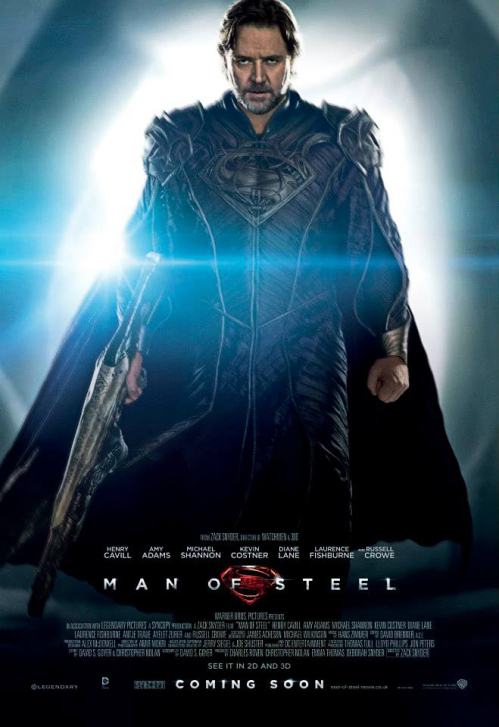
Russell Crowe is surprisingly awesome in MAN OF STEEL. Who knew?
I mean all that in a good way.
HOWEVER: The world doesn’t need another review of Soupman’s latest reboot. What the world needs is a real discussion of a real problem that Superman and other heroes can’t seem to shake.
They’re invincible. And that, friends, is crazy boring.
Iconic heroes made of flesh and blood already have a serious problem, since everybody sitting in the seats, munching on $9 popcorn, knows they’re icons. We know the producers of James Bond movies would never wake up one day and say, “I know — let’s kill off Bond and start some other kind of film, maybe with a 200-year-old sparkling vampire who’s into whiny teeangers.”
Hollywood wants franchises, and you don’t kill off the foundation of billion-dollar juggernauts. Ironman will never die. Batman, Sherlock Holmes, Spock, Kirk (new young Kirk, not Shatner, who they did kill off), Wonder Woman — hey, they’re all safe.
But they’re not invincible. They can and do suffer. They can bleed and die. We know that.
Superman is never really in trouble. Stuff happens to him on screen and you shrug, because hey, that’s Superman.
It’s not the same with Batman, who’s been stabbed, knocked out, set on fire and generally abused. One of the great things about the Dark Knight trilogy is how much Batman really does suffer, sacrifice and grow.
MAN OF STEEL does a good job, and it’s a fun movie. The problem is the character of Superman, who’s a lot like Neo after the end of THE MATRIX, when Keanu Reeves can do anything.
Where do you go from there? Turns out you wander around and get lost for two movies that got progressively worse until something perfect turned into something meh. Which is sad. THE MATRIX was brilliant … right up until Neo went all Superman on us.
Here’s an ironclad rule of storytelling that I’m inventing right now: The villain has to be more powerful than the hero. Always.
Not equally powerful. Not less powerful. The villain has to be superior.
Otherwise, we’re sitting in a dark room watching Chuck Norris swivel around on his cowboy boots as he kicks 59 random henchmen in the face. Does it look pretty? Sure. Is it dramatic and exciting and good story? No. We know Chuck — or Jason Statham, or whoever — is better, and that our hero is gonna win.
When your hero is invincible, like Superman and Neo, the villain can’t be more powerful. It’s impossible.
Think about every Boring Action Movie you’ve ever seen: the villain is less powerful and scary than the hero, which is why he needs an army of thugs to protect him from the big bad scary hero, who starts out the story as an amazing tough guy and ends the story … as an amazing tough guy. Most of the bad Bond movies are like this.
Same thing with every Failed Comic Book Movie, like the lame Hulk films. The Angry Green Thing is basically invincible. Bullets bounce off him. Tank rounds go clang off his green skin. How can you worry about the guy getting in trouble, or having a tough time with a bad guy? This is why comic book movies tend to have hordes of villains. That’s compensating for the weakness of each villain, and it doesn’t work.
Two little movies we all remember reverse this beautifully. The villains in ROCKY and THE KARATE KID seem invincible to us, don’t they? Apollo Creed is the heavyweight champion of the world. He’s crazy strong, insanely fast, in incredible shape and everybody with a functioning brain cell in their noggin would bet the farm on him, not the slow, plodding loser they lined up for a publicity stunt of a fight. Johnny also seems like a teenage nightmare, a giant bully who pummels Daniel-san relentlessly.
Rocky and Daniel-san start out as serious underdogs, and they get their butts kicked in all sorts of ways throughout the movie. It’s only at the very end that they eke out a little moral victory. But we don’t care. That little moral victory is more important to us, the audience, than all the beat-downs administered by the tough guy in your average action movie.
Bigger isn’t better. It’s the distance traveled from the beginning to the end. And when you start out cranking it up all the way to 11, and end at 11, you’re not really taking us anywhere.
There are fanboys who quibble with director J.J. Abrams for making a fun summer movie instead of a serious Star Trek film, as if we’re talking about Shakespeare here instead of Klingons and Khan and photon torpedoes.
These grumpy critics complain about too much action and “fun” and not enough hard science and long conversations about dilithium crystals or whatever.
I say, get over yourselves.
I also say this: J.J. Abrams and his writers are clearly having fun, and it shows. It showed in the first STAR TREK and it shows in STAR TREK INTO DARKNESS.
As a speaker, or an actor, you want to feel the emotion you want the audience to feel. When you watch a Christopher Nolan film, whether it’s about Batman or Guy Pearce not being able to remember who killed his wife, the feeling is quite different: serious and somber and haunted.
Emotions matter. Audiences want to feel something, and in the summer — when Hollywood isn’t trying to win Oscars with Serious Films with Very Serious Actors looking Seriously Sad while they wear period costumes from the 1940s or 1840s — people sitting in those theater seats are paying good money to have fun.
So if you want a slow, somber STAR TREK film about science and all that, fire up STAR TREK: THE MOTION PICTURE and wake me up when it’s over, because that thing should be sold as a sleep aid.
We’re here to dissect STAR TREK INTO DARKNESS and say why it works, as a story. It works wonderfully because J.J. Abrams and his writers care about setups and payoffs, reversals and revelations, Easter Eggs and echoes.
I want to talk about the setups and payoffs, because they’re fundamental, and J.J. Abrams and his people get them right.
Warning: this thing is chock full of spoilers. Don’t read it if you haven’t seen the movie.
Setups and payoffs
If you care anything about storytelling, hey, the setups and payoffs in this film are gorgeous.
Everything ties into everything else. There are no orphaned payoffs, no setups that lead nowhere.
In fact, most setups pay off at least three different times.
Two key examples:
The first time we see Benedict Cumberpatch as Khan, he’s (1) offering to heal a Starfleet officer’s daughter, and he does it with a sample of his own blood. That blood later (2) resurrects a tribble after Bones injects it with some of those same blood cells and (3) brings back to life a certain somebody who (4) saves the Enterprise and crew by entering a radioactive chamber to restart the warp core and such, which echoes (5) some other famous scene in STAR TREK II: CORINTHIAN LEATHER DOES NOT REALLY EXIST, BUT RICARDO MONTALBAN IS STILL AWESOME.
The 72 long-range photon torpedoes loaded onto the Enterprise are an even better setup that pays off at least 10 times.
Ready? Khan escaping to a Klingon planet causes (1) Admiral Marcus to give Kirk the experimental, long-range torpdoes, which (2) make Scotty resign because he’s not allowed to scan the experimental torpedoes, meaning they might take the Enterprise out of warp and blow them up, while (3) the torpedoes let Carol Marcus sneak aboard the Enterprise as a science officer in the first place leading to (4) the revelation that Carol is the daughter of Admiral Marcus, (5) Scotty resigning makes him loose on Earth and free to go investigate what evil thing Admiral Marcus is building out at sector 24-11-whatever, (6) Sulu’s threat about surrender or get torpedoed makes Khan surrender because (7) the torpedoes contain his frozen crew of fellow super-humans, which causes him to (8) team up with Kirk to sneak aboard the ship of Admiral Marcus who’s busy shooting holes in the Enterprise until (9) Carol bargains with her father not to destroy the Enterprise because she’s on it, so he simply beams her aboard his scary dreadnaught until (10) Khan takes it over and demands that Spock lower the shields on the Enterprise so he can beam this torpedoes and crew over, which Spock does since (10) he and Bones already removed the frozen crew and set those 72 torpedoes to explode.
I’m probably forgetting three other payoffs from that one setup involving the best MacGuffin in my memory.
Most films or novels have trouble making their lone plot device make any kind of story sense. J.J. Abrams and his writers don’t have any trouble at all. They tie every major plot point together, and every character, with one thing. Brilliant.
Bonus clip: Leonard Nimoy and William Shatner in their best scene.




 The Red Pen of Doom