It’s two in the morning. Everybody sane is asleep.
But a secret society of British editors was busy sneaking onto my blog, reading my love letter to all who wield the Red Pen of Doom to pay the mortgage.
I know this because a man in a black hood crept inside my secret lair, entered the bigger turret and whispered in my ear, “Me and my mates are dead chuffed.”
He wore a pendant around his neck that looked a lot like a sharp red pen, dripping blood. Also, he smelled like good tea.
I dig the British, and the Australians, so it’s a happy accident that a bunch of Brits and Aussies and New Zealanders read this blog.
The brilliant and beautiful British editors must have told their friends in Canada, who were also up early for some reason, and hitting my silly blog at an ungodly hour despite the fact that I know Canada is only five hours behind Eastern Standard Time, being up north with the sun either shining all but two hours in the summer and that same daystar hiding out for all but two hours in the dead of dark, dark winter.
It was hilarious to read their comments on Twitter, where I asked to join the Society for Editors and Proofreaders (SfEP), perhaps as Fetcher of Coffee — or maybe Puncher of All Who Need to Be Punched.
They said sure. Join our group.
So I might. Even their acronym looks cool, and I belong to the Swedish Institute of Learned Men Without Beards Who Truly and Absolutely Hate Acronyms, Poets and Mimes (SILMWBWTA).
Editors and proofreaders of the United Kingdom, I salute you. Start making two lists: coffee preferences and people who need instant nose jobs.
And just because I can, four of my favorite videos related to all things British, with the exception of Bond movie clips. 007 deserves his own post later.
Every novelist, journalist and aspiring writer I know is all over social media. They’ve got a blog and a Twitter account, or a Tumblr and a Facebook page.
Or they have all four, plus three things that are so bleeding edge, I haven’t heard of them yet.
HOWEVER: you could spend all day banging out blog posts and tweets and Facebook updates. It could suck up all your free time. And you might not get that much out of it.
I see people doing it wrong all the time, and it kills me.
So let’s get some things straight:
It’s not about how many friends you have on Facebook.
It’s not about how many hits you get on your blog.
It’s not about how many people follow you on Twitter.
If you want to make more money writing for a living — or quit your day job to write full-time — then you need to look inside the media toolbox and see each type of social media for what it is: a tool.
Not a magic bullet. Not a sure-fire path to fame and fortune.
You also need to realize that social media can’t be your entire media plan. And no, you are not the exception, Internet Boy.
Here’s a quick-and-dirty look at each tool:
Twitter
This whole Twitter thing is for meeting people.
The social barrier is incredibly low, because tweets are by definition super-short.
Nobody is going to send you a rambling five-page email about their feelings. There’s a lot of freedom in 140 characters.
Want to BS with other writers? Look up the right hashtag for the kind of writing you do. I bet #poems will get you in touch with poets around the world.
Movies, romance, thrillers, journalism, whatever you’re into, you can find people with the same interests on Twitter, and it’s non-threatening.
It’s like a big bar that’s always open where the drinks are always free and the people are friendly, because they’re drunk. I said THE DRINKS ARE FREE.
Facebook
The Book of Face is nothing like Twitter, nothing at all. It’s a closed system.
If Twitter is a big bar where anybody can talk to anybody, then Facebook is a giant hotel with 500 million rooms where you’ve got to know the right hotel room number, knock on the door and have the person behind the peephole look at you and say OK before they open the door and let you in the private party.
Facebook is for friends and family.
It’s for people you’ve had dinner with, or would have dinner with, and want to share baby photos and wedding photos and private things you don’t want to share with the world.
Maybe you think a Facebook fan page is the best thing ever, and you swear by it, and it’s the reason why you went from reporter at The Willapa Valley Shopper to editor of Vanity Fair.
I don’t recommend it. Facebook’s niche is friends and family. There are better tools.
Also: don’t play Farmville, or Bejeweled, or whatever on Facebook, for doing so a Sin, and the Flying Spaghetti Monster DOES NOT FORGET.
He doesn’t forgive, either. Not his thing.
Blogs
Blogs are a bit like Twitter, in that everybody can see them. It’s not a private party like Facebook.
With a blog, you can write a helluva lot longer than 140 characters and put in silly photos of zombies and movie clips about hair bands from the 1980s. IT IS GLORIOUS.
Blogs are where the people you meet on Twitter can come to hang out. You can have literary flame wars in the comment sections about whether the Spork should be sent along with Snooki and the Situation on a one-way mission to Mars.
Different tools for different jobs
Think about those three tools — Twitter, Facebook and blogs — compared to a face-to-face meeting, a phone call and an e-mail.
Asking for a face-to-face meeting with an important and powerful stranger is the highest possible hurdle, right? A six-foot brick wall to climb over.
A cold call is chain-link fence. A little easier.
E-mailing that same VIP is three-foot wall.
Posting a comment on their blog is a little hop over decorative plants.
Tweeting is like hopping over a crack in the sidewalk. It’s nothing. Go give Yoko Ono a tweet. DO IT NOW.
It’s not about getting hits
Social media is not a games of Tetris, where you’re trying to get the high score.
Having 500,000 hits to your blog or 20,000 followers on Twitter doesn’t do anything, by itself.
Social media is about meeting people and learning things. It’s about a dialogue, not a monologue.
Fame and fortune still comes from old-fashioned mass media.
Do people like Charlie Sheen start Twitter accounts and instantly get 6.8 bazillion followers? Yes.
And there is a reason for that. That reason is simple: he was already a famous movie and TV star.
Also, he is an infamously insane train wreck, which is hard not to watch.
Want to reach a mass audience? Use the mass media
If you want national success, you need to reach a national audience.
To sell a million movie tickets, or novels, you’ve got to reach tens of millions of people with the mass media — and if you’re lucky, advertising. National success means trying to reach 330 million people. International success means reaching out to all 7 billion on this rock.
You can’t do that with Facebook and Twitter and a blog. Not everybody uses it. The only real way to reach a mass audiences is by using the mass media. TV. Newspapers. Radio.
A big chunk of the population only gets their news and entertainment from the idiot box. A different chunk only listens to the radio. A smaller bit rely on newspapers and magazines.
If you’re not on all of those channels, you don’t exist to those different audiences.
Social media isn’t a magic bullet
Old-fashioned mass media still has the biggest bullets and the biggest guns.
Is this heresy to the fanatics of the web? Yes. Too bad, so sad, tell your dad. Journalists and public relations pros will tell you this is the truth. Suck it up, internet boy. Sometimes, you have to get up from behind the keyboard and talk to real reporters, live and in person.
Someday, you have to go on a radio show. Eventually, you need to get on TV shows — not once, repeatedly — to reach all those people who only watch TV, even if you’re just trying to reach a local or statewide audience.
Say you’re a playwright in Seattle trying to make your debut play a success. Are you gonna sell out the season by having a blog and a Facebook fan page and tweeting twice a day? No.
Don’t waste your time dreaming that lightning will strike via the internets.
Get on the local TV stations, on radio, in the newspapers, on local blogs that are already popular. Your own blog and whatnot is gravy. It’s not a serious media plan.
Take solace from the fact that with 5.84 bazillion people trying to do via the series of tubes, there’s less competition for serious, hard-working people who know how to work the mass media. By “work” I don’t mean “annoy.” You need to do it right.
It isn’t easy. It isn’t simple. But it’s a lot more effective for reaching a mass audience than hoping hits on your blog will turn into magic, like lead into gold.
There are gold mines out there. That’s where you should take your pick and your axe and your mighty pen to look for the shiny yellow stuff. Because that’s where it lives.
I don’t care what you’re writing: whether it’s spy thrillers, speeches, newspaper stories or romances about men in kilts, the only thing that matters to the reader is the journey you take them on.
How far – and how fast – is that ride? Where does it start and where does it end?
The roller coaster you take readers on is far, far more important than how pretty you’ve painted things with words.
Oh, there are people who write so beautifully that they can make a trip to Safeway sound more interesting than the latest Michael Bay explosion of robots and cleavage. And yes, there are people who are bestsellers despite the wordsmithing skills of a middling sixth-grader whose main hobby is eating paste.
Those bestsellers are millionaires because story – structure, really — beats pretty words.
Ronald Reagan wasn’t considered the Great Communicator because of his verbal skills. Go back and listen to his Berlin Wall speech, considered a great one. He’s got all sorts of verbal tics and delivery problems. He wasn’t that smooth of a speaker. Reagan’s genius was in being a great storyteller.
The same thing is true of great reporters. It’s not the quality of the prose that makes us hand out Pulitzers and buy Bob Woodward’s books. What he’s truly good at is getting people to give him juicy things to write about, so he can tell a great story, with twists and turns and shockers.
Bad writing is all bad in the same way.
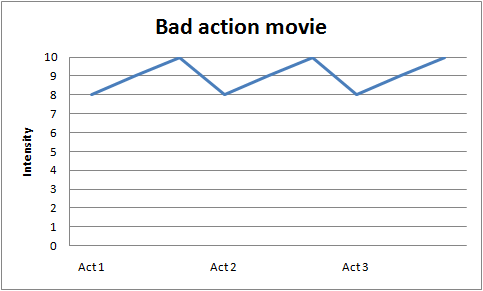
People want a thrilling ride? The Michael Bay School of Storytelling says OK, let’s blow their minds with the most intense story ever. Except when everything is dialed up to 11, the audience goes numb.
Here’s the script for every TRANSFORMER movie ever made. Act 1: Robots fighting! People running! Explosions! Act 2: Robots fighting! People running! Explosions! Act 3: Robots fighting! People running! Explosions!
You see the same problems with bad action movies starring Chuck Norris, Stallone and Schwarzenegger. If it’s exciting to watch the hero take on five bad guys on top of a roof, then it must be twice as awesome to have him dismember 10 thugs with a chainsaw in Act 2 and three times as cool to torch 20 thugs with a flamethrower in Act 3. Except it’s not.
It’s not much different with the typical Boring and Pretentious Literary Novel, which starts out wallowing in misery and angst in Act 1, moves on to more misery and angst in Act 2 and ends with, just for variety, an extra dose of misery and angst for Act 3.
Technically, the insanely rich hero does go on a journey. He goes to the country club. He goes to dinner. He goes to a polo game where he sneaks a rendezvous with his mistress, who he secretly despises.
The other kind of Boring and Pretentious Literary Novel features a noble poor person, who suffers even more than the rich schmuck, and yes, he also technically goes on a journey, though going from one cardboard box in a bad section of Skid Row three blocks down to a rattier cardboard box WITH HOLES IN IT in an even sketchier part of Skid Row isn’t much of a trip for the audience.
A story like this isn’t a thrilling roller coaster. It’s a slow slog on the Train of Misery.
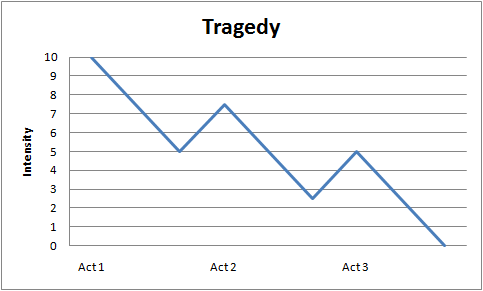
This is why tragedies work. Inherently, they are a fast and exciting ride, because you start at the very top, with a king or president or otherwise Important Person Who Has It All.
Then, because they can’t resist temptation, or otherwise succumb to hubris and stupidity, they plummet from the top to the bottom. Not that they don’t fight back. They try. They pull out of the slide a couple times, and you think they might make it until their inner demons get the best of them.
That is exciting. You’re letting the audience peek into a different, secret world – the Land of the Rich and Famous – and bringing one of the exalted few down to earth. Who doesn’t want to watch that, or read that?
Reporters make a living doing this. Greek playwrights were doing it 2.94 bazillion years ago. Novelists and screenwriters are still doing tragedies, and will be doing them until the sun turns into a red giant and fries the earth.
The reverse story, Underdog, is so simple and well-known that I won’t make a silly chart for it, because I have faith in you.
I believe, deep in my soul, that you have seen ROCKY once or twice, and watched THE KARATE KID many times, because that movie still rocks to this day despite the lame remake starring Will Smith’s kid, which didn’t involve karate at all, because IT WAS IN CHINA and was about kung fu, not karate. Though I do love Jackie Chan.
Unlike the Bad Action Movie, the hero in an Underdog plot doesn’t start out as some insanely skilled and handsome muffin of stud who, if armed with a folding toothbrush, can take on 43 bad guys. Driving tanks.
Rocky starts out as a washed up boxer, a loser. Ralph Macchio starts out as a skinny kid who gets his butt kicked by local bullies 25 hours a day.
Rocky and Ralph go on real journeys, from rock bottom to the top. Ralph goes from getting beat up by the bullies to beating the leader of the bullies in an honorable way, and having his foe shake his hand. He gains their respect. He suffers and sacrifices in order to change and grow. Also, Mr. Miyagi is the Man.
ROCKY has a more interesting plot, and the script won a freaking Oscar because of it. I kid you not: Sylvester Stallone, Mr. B Movie, started out by winning an Oscar for screenwriting. That is the only thing in the world he has in common with Matt Damon.
The end of Rocky isn’t your typical action movie, which features the hero (a) impaling the Villain of the Week, (b) throwing the Villain of the Week into a bottomless pit or (c) watching the Villain of the Week get impaled after he falls down the bottomless pit.
Rocky ends without a victory at all. He doesn’t beat Apollo Creed, despite all his sweat and blood.
He battles Apollo to basically a draw, and for him, that’s a huge moral victory. He has grown. He has changed. And when he gets the girl, it’s not perfunctory movie nonsense, the typical, “Oh yeah, it’s the end, so the hero needs to kiss the girl after he says some clever one-liner.” You care about this schlub getting the girl, even if you didn’t care one bit for TANGO AND CASH.
Sidenote: I did enjoy DEMOLITION MAN, mostly because Sandra Bullock was awesomesauce, Wesley Snipes was believably insane and they made it so after the apocalypse or whatever, every restaurant was Taco Bell.
To whoever wrote that script, I salute you.
The lesson here: no matter what you write, figure out the ending, and that determines the beginning.
If you have a down ending, you need an up beginning. Otherwise, you’re not taking the audience on any kind of ride.
If you have an up ending, you better have a down beginning. The lower, the better.
ROCKY and THE KARATE KID are minor examples.
Let’s go big. The billion-dollar stories follow this formula: STAR WARS, the Harry Potter movies and THE LORD OF THE RINGS are the three biggest stories on this planet, spanning many movies, countless spin-off books and enough merchandise to sink the continent of Australia.
George Lucas and J.K. Rowling have more money than God — end of debate.
All three of those stories start down. Way down. The evil emperor is gaining power. Harry Potter is an orphan because Voldemort killed his parents, and now he’s coming for Harry the Potter — and meanwhile, this big glowing eye on top of a volcano controls all sorts of trolls and scary dudes in hoods who ride black horses of the apocalypse. Our only hope is a tiny man with hairy bare feet and a magic ring whose mighty magic power seems to only turn him invisible and really grumpy.
Sidenote: while in Maui, I read the preface to the introduction to the liner notes for LORD OF THE RINGS, and around page 83, after the index of Elvish words and an anthropological study of Hobbit culture, I was still waiting for the actual story to begin. I did not throw the book across the room, because there were no men in kilts in it that I could detect, but I did lay it down gently and look hard for a hollowed-out pineapple full of alcohols.
Now, I’m not saying all stories are either comedies (up ending) or tragedies (down ending). That’s simplifying things way too much.
For example, dramas and sitcoms are the most common things on TV, right? And they are completely the opposite of what you expect, when you drill down into the story structure of dramas and sitcoms.
Hear me now and believe me later in the week: dramas are not tragedies. Dramas end up.
LAW AND ORDER is probably the most famous drama, since at least five cable channels play nothing other than reruns of LAW AND ORDER, LAW AND ORDER: CSI, LAW AND ORDER: LA, LAW AND ORDER: SPECIAL VICTIMS UNIT, LAW AND ORDER: SOME FIELD IN NEBRASKA and, best of all, LAW AND ORDER: BRITAIN, which I threw in here at the end as a sneaky segue allowing me to play The Best Video On the Planet.
Yes, dramas are about horrible things like murder and rape and war.
Except what they’re really about are heroic people who swim in the muck and chaos caused by idiots and greed. Dramas really say, “Despite how bad things are, there are people who’ll try to make things right.”
That doesn’t mean they succeed every time. About one out of twenty times, LAW AND ORDER lets the bad guy get away with it, and yes, it seems like one out of three times, but if you’re reading this, you’re a writer, and bad at math, and you’re not going to go back and watch all 4,398 episodes to do a tally. So I could make stuff up all day.
Comedies don’t always have down endings, per se – but they are NOT happy.
Comedies are about how absurd, hopeless and screwed up things are.
Specifically, comedies target an institution.
Sitcoms usually go after marriage and family life, usually middle-class suburban families.
M*A*S*H was an indictment of war.
ANIMAL HOUSE lampooned frats and college life.
Comedies have mixed endings. It’s OK for the hero to get what he’s after – but only in an absurd way. His best efforts to achieve his goal always backfire. Things don’t happen like they should. It’s screwball.
The other kind of mixed ending is ironic. The hero gets what he wants, but decides he doesn’t truly want it. He finds the king’s treasure after slaying the dragon and decides he doesn’t want all that money, that he’d rather go back home and be a simple farmer. That sort of thing. ROCKY is a bit of an ironic ending. He doesn’t win the fight. He wins other things: self-respect, a future, a girlfriend. Then in the sequels it gets all conventional and boring, though Mister T, for a brief moment in time, before he sold out and joined the A-Team, was a scary, scary man.
Bonus material for story nerds and intellectual types
There is another type of ending, Random Nonsense, which is more common in indie films with subtitles. Think black and white. Think French existentialism.
Here’s an example: the hero is a downtrodden detective, investigating a killer far smarter than he will ever be. His only son hates him, his boss wants to fire him and wife just left him, though he starts up a flirtatious thing with a girl who works at his local café. Just as he starts catching some breaks – he’s walking the café girl home from their first date when he spots the killer running from an alley, the scene of his latest crime – he’s hit by a drunk driver. The End.
Random Nonsense has a message, too, just like tragedies are about hubris, dramas are about the human spirit overcoming adversity and comedies are about how absurd life is. Random Nonsense is trying to make a point about existentialism and chaos, that we don’t really control events. Things just happen.
This may make for deep conversations in your Philosophy 301 class, and you may feel all intellectual talking about what the movie really meant at 3 a.m. at Denny’s while you eat sides of fries and drink bottomless cups of coffee while smoking cigarettes bummed from your roommate, the sociology major. Sociology!
But it makes for a terrible story. There’s no roller coaster. That’s why the audience for these kinds of stories fits on a postage stamp.
I don’t care who you are — you need an editor. And you always will.
In fact, the more successful you are as a writer, the more editing you’ll need.
Here’s why:
The time crunch.
You’ll never have as much time as you did when you were struggling to break in.
A journalism student can get away with writing and polishing a major story for weeks or months.
Once you get a job as a reporter at The Willapa Valley Shopper, the first step on your path to The New York Times, you’ve got to crank out two stories a day, every day.
I used to write three or four stories before 10 a.m. every deadline day at papers of news. You get used to it. But it’s a shock at first. The time crunch is real. Which leads to problem No. 2.
The sophomore slump
Think about famous debut novelists who had a tremendous first book, and when you hopped inside your automobile and raced to Borders — back when Borders existed, and sold these things we called “books” — to buy their second novel on release day, it made you weep like a Charlie Sheen who’s run fresh out of tequila and tiger blood because that second book sucked like Electrolux.
Why does this happen?
Because debut novelists spend years polishing that first novel until it shines like a diamond made of words.
And when a debut novelist finally makes it, and has a three-book contract with Random House to crank out a book a year, it’s a struggle. They aren’t used to writing that good that fast.
You only need editing three times: when you start out, when you’re middling and when you’re a busy pro
Some people who write for a living — and didn’t spend time at newspapers or magazines getting edited every day — sometimes think success means they’re infallible. Their words are perfect, becausee otherwise why wouldn’t they be famous? Or they are richer than God and simply don’t care.
And even great writers sometimes just write long. They’re in a rush. They have to crank out the product and move on to the next thing.
Stephen King, who I adore, writes beautiful little short stories and novellas while cranking out novels that clock in at 800 or 1,000 pages.
I could close my eyes, reach onto my bookshelf in my secret lair and grab five King novels that weigh more than most second-graders. Some of these novels are fine being that long. Others are overloaded semis with a sleek sports car of a novel lurking inside and waiting to burst out.
Even literary snobs now admit that King’s novels — even the giant ones — are good. But you could chop 400 or 500 pages from any of his monstrously overlong novels and make them even better.
Think about J.K. Rowling, and how with every paycheck and movie deal, the next book in the Harry Potter series doubled in size, until Boeing had to invent a new freight version of the 747 just to deliver the last novel so we could find out why Hermione winds up with What’s-His-Face, the redheaded doofus sidekick, instead of Harry, her true love.
Get the right editor
Most people get the wrong kind of editor.
You don’t need an editor for nancypants nonsense like dangling modifiers and misplaced commas. That’s a proof-reader, not an editor. Any semi-literate fool can proof-read a document. Microsoft Word can take a whack at that.
The editor you need is (a) a professional who (b) edits or writes for a living in (c) the specific type of writing you want to do FOR MONIES.
Any old professional will NOT do
A roomful of reporters and editors at a newspaper is a good example. They all write and edit for a living, and 99 percent of them want to write the Great American Novel — but 99 percent of the time, they fail.
Because it’s not their specialty.
Hear me now and believe me later in the week: Writing short non-fiction newspaper stories is far, far different than writing 400-page novels. The structure reporters use for news stories — the inverted pyramid — is exactly backwards for fiction.
Now, there are exceptions. Opinion page editors and columnists could make the transition to speechwriters, and vice-versa. The structures and techniques for persuasion on the page are quite similar to the ones used in speech and rhetoric.
But if you want to make a switch, the fact that you already write for monies doesn’t guarantee anything.
It’s like professional sports. The fact that you play shooting guard for the Bulls doesn’t mean can play left field for the White Sox.
That’s exactly what Michael Jordan tried to do. This is the greatest basketball player of all time. He’d won enough NBA championships. He’d climbed every basketball mountain. He was one of the best athletes on the planet.
So when he decided to try playing major league baseball, it wasn’t a silly dream.
And he did it right. He didn’t try to muscle his way onto the White Sox starting lineup by having lunch with the owner. He trained with baseball coaches and played for the minor league Birmingham Barons, batting .202 with 3 home runs, 51 runs-batted-in and 30 stolen bases.
Batting .202 isn’t good enough. Jordan went back to basketball.
When you try to cross-over, you’ve got to be just as careful and serious and hard-working as if you’re trying to break in for the first time.
Your editor needs to do it for monies
If you really want to pay the mortgage writing full time, you’ve got to go all in with an editor who wields their Red Pen of Doom for monies, too.
Not your husband or wife or best friend. Not a coworker or a buddy who writes something sort of close to what you’re doing, even if they do it full time.
It’s an achy breaky big mistakey to use a non-pro as your editor. Friends and family may be great readers of books but horrible at editing. Either way, you’ll take what they say far too personally.
Dreams will be crushed. Friendships will fray. Marriages will sour. DO NOT DO THIS.
Even if you’re friends with somebody who writes or edits for a living, and they say sure, they’ll edit you as a favor, that might be OK for one small piece. A short story. Your first shot at a stump speech. But not anything of length. And not as a habit. When you start cashing checks for what you write, stop being a freeloader. Set your friend free.
Better yet, don’t lean on the friend too much in the first place. Because they’re your friend. They won’t tell you if you truly stink up the joint.
Your editor must be in your specific field
It’d be silly to use a professional writer or editor in a different field.
They won’t know the conventions and quirks of another type of writing. They’ll make you feel confident that your text is perfect when it has some formatting flaw or deadly structural boo-boo that neither one of you spotted, because your buddy writes screenplays and you’re doing a novel about elves with lightsabers who ride dragons.
Find an editor who does exactly what you want to do, whether that’s writing novels, newspaper stories, magazine features, non-fiction books or speechwriting for the politicians.
Now, the natural response to this is, “Professional editors cost money, and I am a poor, starving writer with six kids who lives in a cardboard shack and feeds my family Top Ramen, raw, like popcorn, because we can’t afford a pot to boil the stuff in, so there’s no way I can pay some fancy editor to bleed on my words, words that I carefully put on this paper towel in my own blood because Bic pens and Underwood typewriters and Toshiba laptops are out of my budget, unless I spend my every weekend robbing the local 7-Eleven, which for some reason hates AP style and won’t go with Seven-11.”
To this I say: suck it up.
Professional editors don’t cost THAT much. Scrape together $100 or $200 and have a pro look at the first chunk of whatever you’re writing. Believe me, they don’t need to read all 400 pages to know what your strengths and weaknesses are. Though it’s a lie that you can figure that out after five pages. It only takes one page, to be honest.
If you were trying to cut hair for a living, it’d cost you more than a couple hundred bucks to get a license. A writing conference plus three days in a hotel can run you $1k, and that’s if you NEVER EAT ANYTHING and completely abstain from bourbon. So suck it up and find somebody good to look at your first bit, long before you write the entire shebang.
Because a great editor is priceless.
Plug: Theresa the Stevens, who reads this silly blog and makes witty comments, is a professional editor and former literary agent who also edits for publishers.
Theresa the Stevens is also kind, because she does a special deal where she wields her wicked pen on the first 75 pages of a novel PLUS the synopsis PLUS the query letter.
Think about how long it takes a human being to write and rewrite and rewrite a novel and synopsis and query letter. Hundreds of hours. Bazillions. Think about paying yourself minimum wage for those hours.
Then close your eyes and imagine there’s a glowing mystical being who, for the price of the complete first and second seasons of The Jersey Shore on DVD, could save yourself hundreds of more hours of pain while making you (a) seem incredibly brilliant and (b) have ten times the shot of not only getting the thing published, but making decent money at it.
Is that worth a couple hundred bucks?
Cowboy up. If you really want to write for a living, and not toy with it as a hobby, find yourself the best professional editor possible. And pay them in something other than thank you’s and cups of coffee.
And those words help sell 5.842 gazillion miles of barbed wire back in the late 1800s, when the West was still wild and there weren’t handy trees or stones to make fences.
Light as air, strong as whiskey, cheap as dirt – I’ll remember that for days. Forever, maybe.
It’s honed down to perfection. Nine words, and not a one is wasted.
A little strand of steel with a twist and BOOM, you are golden. Photo by Guy Bergstrom.
In the five seconds it takes to hear those words, or read them, you’re sold.
Writers struggle with those first five seconds.
What’s the best way for a reporter to convince the city editor put a story on A1 instead of buried next to the obituaries on B15?
How can you sum up a 100,000 novel in a single page – or a single sentence?
When a magazine editor is buried with pitches, how does yours stand out from the slush pile?
What should a screenwriter say about his script while riding in an elevator for 30 seconds with Steven Spielberg?
Science shows us secrets
Here comes the science: people make up their mind about you – or your writing – in the first five seconds.
Viscerally. Unconsciously.
Their little reptile brains see your face or your words and make a split decision.
Later on, our oversized frontal lobes justify that snap judgment.
It’s not a rational thing. I’ve seen the science. Go read BLINK by Malcolm Gladwell. (Go on, read it. I’ll be over here, drinking Belgian ale.)
Different researchers testing for different things found the same result.
The first five seconds of a job interview determines whether you get it
The first five ticks of the clock during a professor’s first lecture of the semester, with the sound turned off, can be used to predict exactly how students will rate that professor.
A quick glance – less than – at two candidate mug shots will predict who will win the race. This works with adults or five-year-olds. Mug shots. No names. No parties. The shape of the face.
This last result fascinated me. Researchers had people glance at those mugs, then rate the candidates on attractiveness, intelligence, competence and whatnot.
They thought attractiveness would matter.Nope. They thought race and sex and age would matter. Nope.
Competence was the only thing related to the eventual winner.
This makes sense. If somebody’s attacking your village, you don’t pick Nerdy McNerdy as the leader of the defense. Brains without brawn won’t work.
You don’t pick Miss America to lead the troops into battle, either, because she’ll simply be nice to look at while you all get slaughterd.
And you don’t pick Mr. Neanderthal, tough but stupid.
Who do you want? Somebody who looks competent – tough but smart. A Clint Eastwood, somebody who looked like he knew what the hell he was doing.
Hold it out and squint
Alright, you’re already thinking of the Greatest Squinty Eyed Tough Guy in Movies, so remember this rule: Hold it out and squint.
Hold out your first page of your text and squint.
Is it a sea of gray?
Is there a photo or graphic? Are all the paragraphs the same length? Do you have any subheads or anything to break up the text?
Now, this doesn’t work for certain things. You can’t have photos and whatnot in screenplays or manuscripts.
Later on, though, it will make or break you.
When you go to rent a movie (yes, I know Blockbuster is dead to you and it’s all Netflix now, so pretend you’re clicking away with Mr. Mouse), you make decisions in far less than five seconds. You glance at the front cover and move on.
Same thing with books. Glance and move. Glance and move.
Maybe you pick a book up and read the text. What makes you pick it up? Images first. Maybe a good title. Glance and move.
That’s why the Squint Test is so important.
Think about movie posters with too much going on. When you squint, you don’t know what’s what.They’ve got the star and the co-star and seven different sidekicks in there, plus the villain and two random thugs. It’s a mess.
Less is more. Simple works best.
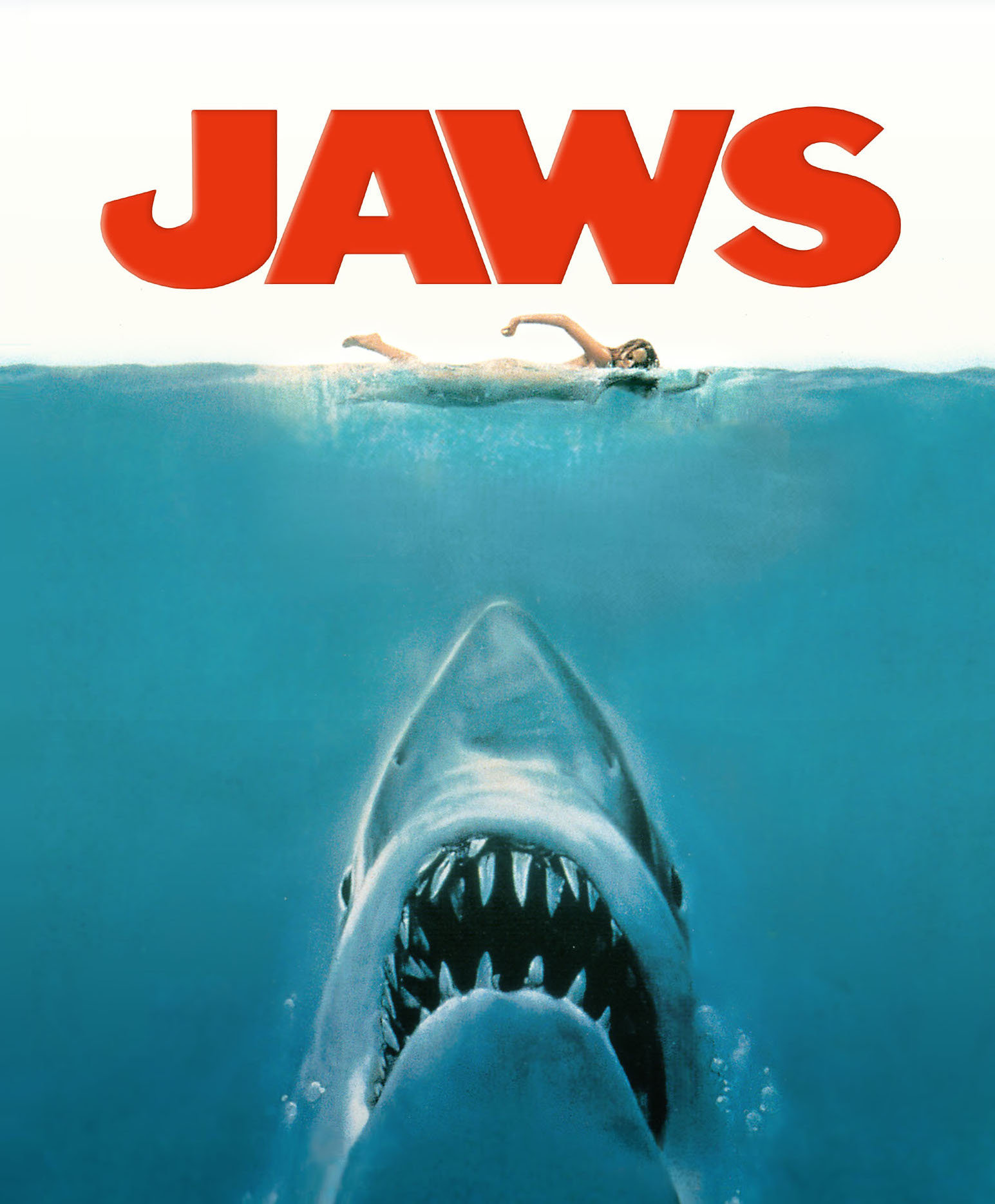
The poster for JAWS is perfect: a pretty young woman swimming along and a giant invincible shark roaring out of the depths of the ocean. It doesn’t get any more primal than that. We need the shark and a pretty girl. That’s it.
The JAWS movie poster is classic, and will always be classic, because it is simple and brutal and seven separate types of awesome. Steven the Spielberg, stick with this movie thing — you have talent.
Putting this knowledge to evil use
Our conscious brains aren’t really running the show. We’re like a mouse riding on top of an elephant, sometimes biting the elephants ear to go left or right.
How can we writers use that knowledge?
Tap into the reptile part of our brains. Go for the gut.
Blake Snyder hit this idea with his Hammer of Truth in SAVE THE CAT when he demolished the conventional wisdom of genres.
JAWS isn’t a horror movie. ALIEN isn’t a sci-fi movie. FATAL ATTRACTION isn’t a domestic drama. All three are the same story, the same primal threat: there’s a monster in the house. You can’t get away. Either you fight it and kill it, or it eats you.
Hollywood screenwriters are masters of the first five seconds. Fire up the google and check out “loglines” to see how they sum up a movie in a sentence. They make writers of novels look like silly chatterboxes. Think you’re being hip with a one-page synopsis instead of five pages? Hollywood laughs at a full page of text. One sentence, buddy.
Can you do it in a sentence?
How about nine words?
Copywriters are also world-class at those first five seconds. Visit copyblogger and soak up their wisdom. DO IT NOW.
The best five-second pitches — whether it’s a headline for a newspaper story, a poster for a movie or a pitch for a novel — tap into those primal needs and instincts that Blake Snyder talks about.
Survival vs. death. Love vs. loss.
You know what the stakes are. Instantly. Not 30 seconds into it. Not 15 seconds after learning about the when and where and who. You see what’s at stake, right away.
Here are four words: COMET WILL DESTROY EARTH.
That’s a newspaper story everybody will read. Everybody. It’s a movie people saw twice (ARMAGEDDON and DEEP IMPACT).
Part of the secret seems to what’s missing: the hero. You don’t hear a damn thing about the hero after you’ve boiled it all down, do you? Screw the hero. Heroes are plain vanilla and boring. The best ones, the ones that hook us, talk about the bad guy: the alien, the shark, the comet. Hmm. Maybe there’s a reason for that. But that’s a post for another day.




 The Red Pen of Doom