Hard and Complex versus Impossible and Bizarre

This is about why Flappy Bird was such a surprise hit, Taylor Swift’s newest mega-video is meh and why your favorite movies, novels and video games work when others fail.

Here’s why: audiences want something interesting, and entertaining, which means different and surprising. Yet there’s a fuzzy line between Hard and Impossible and a deadly chasm between Complex and Bizarre.

It’s like thinking, “chocolate chip cookies are yummy, so why not chocolate chip cookies with almonds, M & M’s, pecans, Oreo sprinkles, peanut butter and a Snicker’s Bar on top?”

Watch the big Taylor Swift video, BAD BLOOD, then we’ll chat.

Now, this has high production values and great costumes, and I’m sure Michael Bay watched it on an endless loop all weekend. Yet it’s not elegantly complex and entertaining. It’s a hot mess, the music video equivalent of THE EXPENDABLES, with so many random stars thrown in for cameos that I have no idea who’s who. Does it look cool? Sure. Do we care one bit? No. Not even half a bit, or a quarter bit.

Compare that to the simplicity and beauty of Iggy Azalea’s BLACK WIDOW, which is a masterpiece, paying homage to KILL BILL and flat nailing it.

Continue reading “Hard and Complex versus Impossible and Bizarre”

Six smart steps after #NaNoWriMo

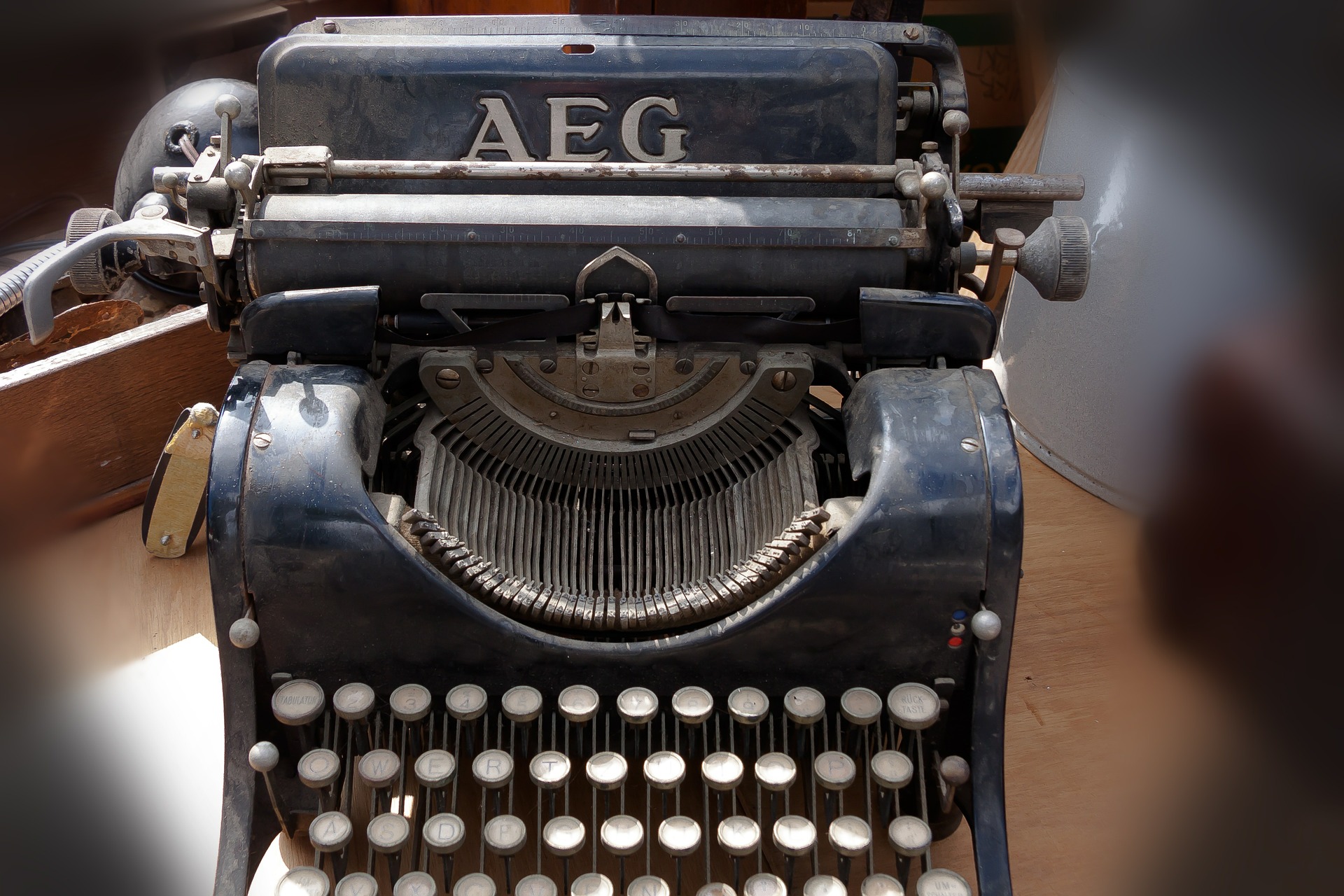
typewriter-465387_1920

Don’t bother with sending your novel around for beta readers to chew on, editors to edit and proofers to proof. You’ve got 50,000 golden words, right? THEY MUST BE SEEN AND PUBLISHED, TOMORROW, and you’ve already told the dealership to order a black BMW because the advance will be huge.

Forget sending queries to literary agents. Call them on the telephones, right now, or get their cell number and try dinner time, because they’ll be home.

If your novel is truly great, bypass those gatekeepers and fly to the Isle of Manhattan to hail a cab for the offices of Random House with the only copy of your manuscript in your locked briefcase. Make sure there are copyright notices all over the thing and a confidentiality agreement drafted by your attorney before anybody gets a peek, lest they steal it.

Do you have your plane ticket yet? Go get one, right now.

Okay, those folks should be busy on Travelocity while literary agents and editors are hiring a team of former Special Forces soldiers to greet them in the bowels of JFK’s parking garage.

Everybody else, let’s talk turkey, post-Turkey Day.

You may have 50,000 words and a spiffy badge, 34,000 words and a feeling of failure, 13,000 words and a newfound hatred of literature or 3,923 words and a pile of index cards that say things like, “The scene where Emily discovers that she hates her husband and wants to become a nun. Then he makes her ham and eggs. The eggs are soggy but the ham is delicious.”

Related: Six easy ways to improve NaNoWriMo and Do not look upon your #NaNoWriMo word count and despair, for there is hope

So what’s next? Six smart steps, that’s what:

1) Put your novel in a drawer.

Yeah, I know it’s probably a Word doc. Stick that thing in a virtual drawer. Don’t touch it, not even to fix that scene where Emily is at work and the serial killer is in the copier room, expertly printing his manifesto on both sides and making the machine staple that sucker in the upper left corner before he kills the CFO with an industrial three-hole punch.

Now go read five great books in your genre. Paperbacks. Popular stuff, nothing a professor would assign for a term paper. Not sure what genre your novel is? Find out. Want a shortcut? Read this: Everything they taught us about stories was WRONG

Writing a romance or a thriller? Read these: Why every man MUST read a romance – and every woman a thriller and Out of fairness, I destroy my favorite genre: thrillers

2) Take the first page of those five great books in your genre and study them. Just the first page.

Now take your manuscript (mss if you’re a hipster) and print the first page. Only the first page.

Compare them all. Different authors have different styles, sure, but you shouldn’t be writing in second person, or first person plural, if all five of the bestsellers in your chosen genre of memoirs are say, first person. Just a guess. For giggles: Top 9 reasons to write in first-person plural

If you want a quick look at taking a red pen to the first pages of famous novels to rip them up, in a good way, check out these:

3) Step back from the writing of scenes and chapters and boil your story down.

Can you explain it to a random stranger at Starbucks in four sentences? How about one sentence?

Get it down to four words. Yeah, I’m serious. Writers, we are doing it BACKWARDS and Writers: can you do it in FOUR WORDS? and Writing secret: Light as air, strong as whiskey, cheap as dirt

4) Get your novel edited, and not by your mom, husband or best friend.

Because I truly believe this: The evil secret to ALL WRITING – editing is everything

Tempted to join a traditional critique group instead? Don’t. Not the kind where you meet once a month, or once a week, and everybody reads a chapter. I’m serious: Why critique groups MUST DIE

5) Read up. A lot.

Read about the business of books, whether it’s traditional publishing, indie or zipping your manuscript to servers at Amazon to start selling it tomorrow.

Read great fiction in all sorts of genres while your manuscript simmers in the oven of that drawer. Learn about writing a query and synopsis, a little marketing and public relations and social media.

A few quick starters before you hit Barnes and Noble for hefty, book-like substances:

6) After a month, go back and crack open that NaNaWriMo manuscript again.

Listen to your editors. Use what you’ve learned about storytelling and from reading great books in your genre. Fix the ending. Fix the beginning. Kill off every character you can and combine their roles. 

Keep on working on it while you dream up the next novel, which should not be a sequel. Different characters, different setting.

Does the new idea feel like work, or would you happily burn a day off to crank out chapters? Toss ideas that feel like drudgery and hold fast to concepts that make you excited. Because this should not feel like punching a clock in a Ford factory or going to meetings in a cubicle farm about your TPS reports.

Writing it should make your heart beat faster while you smile. You may even cackle the evil cackle of glee. All those are Good Things, and should be encouraged.

Also: The thing about writers and editors is this: they’re friendly, and as long as you’re not a jerk, they’ll chat with you on Twitter and help you out a little. Great people. I LOVES THEM.

Also-also: If you want to know anything, check out The Writer’s Knowledge Base for a massive collection of articles and posts on every topic a writer could want. It’s like a mega-powered and secret google for writers and editors. Plus it’s free. This thing is a public service. Use it, and tell the folks who run it thanks. Send them tips when you spot great posts or stories and some good karma.

Because there’s a lot of good karma among the folks who love books. This isn’t a zero-sum game where somebody has to lose for somebody else to win. People who love books and writing also love fellow writers and editors. We’re brothers and sisters in arms, battling word counts and deadlines and plot bunnies. It shouldn’t be stressful. Because this is fun stuff, the making up of stories to entertain each other.

Top 9 reasons to write in first-person plural

old typewriter, typewriter, antique keyboard, the way people used to access Word and the Series of Tubes before they existed

Why nine? Because Top 10 lists are popular, and therefore Boring.

But listen closely, for the case is strong for writing in the first-person plural, which we thought at first was second-person plural, and if we thought about it, which we should, first is better than second.

Also, research via the google proved that languages other than English include other amazing options. Just think of a novel written in fifth person past participle without a single letter E in the text. Think of it. Then think of a book cover with black text on a black background with black accents.

That artist from the ’60s who merely painted a canvas black will get sick with jealousy, and does he even know what presumptive mood is? Unlikely. But he’d talk our ear off about acrylic versus watercolor.

And now the list: Top 9 reasons to write in first-person plural

No. 9 — We create an immediate bond with our audience. We hear our voice, and we like it.

The only way to bond more quickly is if we put instant coffee in the microwave, going back in time.

No. 8 — First person is for narcissistic nancypants, polluting each page of text with “I,” “I,” “I,” and, for variety, strings of “me” and “my.”

It’s not about you, first-person singular. It’s about us, plural. Don’t we know that now?

No. 7 — The first-person plural has roots in the Greek chorus, a sturdy trunk from Ayn Rand’s Anthem and green, modern leaves with Joshua Ferris and his Then We Came to the End, which has to be doubly good because it also has “We” in the title.

No. 6 — It’s not “the royal he,” “the royal she” or “the royal I,” is it? No, no, no.

Take it from House Windsor: it’s the royal we. Accept no substitutes.

No. 5 — Third-person is common, bourgeois, and blasé. How many novels are written in third person, and do we ever read all of them?

There are too many, and the quality varies so much. That’s a sign and an omen, our astrology tells us.

No. 4 — First-person plural creates an emotional distance from the readers, which is sometimes necessary.

It’s like having wealthy relatives we don’t enjoy. We don’t have this problem, but if we did, we wouldn’t wish to spend time with them, but we wouldn’t want to get disinherited, either.

Plus, that exquisite distance creates a sense of foreboding and mystery.

If they can never know us, and believe we have no feelings, then we are, indeed, unknowable and omnipresent, literary gods. Or half-Vulcans with Underwoods and a hankering for Jeffrey Eugenides. We’re not sure yet.

No. 3 — A singular narrator can be mistaken, unreliable, reliably unreliabe, obtuse, acute but not cute, scalene or perpendicular.

But we are many, irrefutable, infalliable, translucent, effervescent, a closed plane of certainty and confidence.

We are legion, and it is Good.

No. 2 — Great literature is truly poetry, and great poetry uses first-person plural, such as Emily Dickison and her wonderful, “We send the wave to find the wave,/ An errand so divine.”

Do we want to be great or pedestrian? We choose great.

No. 1 — While second-person point of view was employed by Albert Camus, giving it the sheen of respect, and Jay McInerney found success with Bright Lights, Big City, we cannot ignore the massive volume of pulp fiction detective novels cheapening this choice.

Every such novel began in this sort of crude fashion: “You walk into your office and she’s already sitting behind your desk, drinking your Jim Beam and playing with your .38 special. But she’s got ruby red lips, trouble with the mob, and legs that just won’t quit, so you don’t do the smart thing and turn around to leave. No. You hang up your trenchcoat, take out your notebook, and listen to her sweet, sweet lies.”

Do not look upon your #NaNoWriMo word count and despair, for there is hope

writing meme spiderman dear diary

Say it’s your first time writing a novel, and you’re a smidge behind. On the 15th of November, you should’ve hit 25,000 words.

Do not despair.

Also: For those who’ve burned vacation time, dumped their significant others and sent the kids to boarding school, because you’re going to hit 50k if it kills you, I say this: dance not the dance of victory, because 50k isn’t actually a novel. It’s a novella. You want to hit 80k or 90k to be safe.

However: None of this really matters. At all.

Related post: Six easy ways to improve #NaNoWriMo

For your first draft, word counts mean nothing

I don’t care if you’ve gotten stuck at 12,000 words or you’re already finished with your 194,000 epic involving the king of the orcs and the vampire mermaid who loves him.

Anybody new to writing a novel, of whatever genre, should ignore the word count demons in this first draft.

Say it with me: It’s a first draft and the word count meants nothing.

The word count means nothing.

One more time: I’ve got 99 problems and a word count ain’t one.

Continue reading “Do not look upon your #NaNoWriMo word count and despair, for there is hope”

Six easy ways to improve NaNoWriMo

writing meme spiderman dear diary

Writer peeps tell me they’re doing NaNoWriMo, which is Esperanto for “I’m trying to write a novel in a single month, and I’m 10k behind already, so I’ve quit my job and divorced my husband. I vaguely remember that we had some kids. Ready for a sprint?”

God bless all who sign up for this. I believe a novel is the toughest thing a writer can tackle, and the most rewarding.

It’s just that 30 days is a bit insane, and I say that as somebody who writes insanely fast. Related post: Why are all writers lazy bums?

If a friend of mine said they were doing NaNoWriMo, I’d want them to have a good experience and not pull their hair out because they missed two days of writing at that wedding and now they need to write 3,000 words a day and IT’S NOT HAPPENING.

It’s great that there’s a national month encouraging folks to write a novel. I just don’t want new writers to bang their head against the wall and feel like a failure if it doesn’t happen. You’re not a failure. The math is stacked against you for NaNoWriMo.

So here is what I would say to that friend wrestling with word counts and freaking out, or to anyone considering doing NaNoWriMo next year.

1) Spend all of October training for this literary marathon

For writers, a novel is like running a marathon. You don’t pop up off the couch on Nov. 1 and bust out 26.1 miles. You’ve got to train and build up to it.

Ignore the veteran pantsers and their crazy “I never outline” ways. Anybody writing a novel for the first time on Nov. 1 should spend October doing this:

  • Read SAVE THE CAT by Blake Snyder and STORY by Robert McKee
  • Figure out what primal story, per Blake the Snyder, you’re going to write—that’s your genre
  • Watch movies (hey, this homework stuff is tough) or read your favorite books in that genre, and see how those movies and books do setups and payoffs, reversals and revelations
  • Map out a three-act story, using Blake’s spiffy Beat Sheet, and if you want to get technical, he breaks Act 2 in half, so you’re really looking at four Acts
  • Figure out your story on that one-page Beat Sheet, and do whatever research you need for the Writing of Many Words

2) The goal is actually more than 50,000 words

You might say, “Hey, mister, fifty thousand words is a lot to write in a month. Don’t make this any harder.”

Sure, 50k is a lot. We’re talking about 1,667 words per day, every day. Except 50k is a novella, not a novel.

It’s more like half a novel.

Google it. Go on, I’ll wait.

Okay, not really. I’m over there, watching funny cat videos.

So: Literary agents, publishers and book peoples have all these standards for word counts when it comes to novels of different genres, and if you’re going to run a literary marathon, let’s make sure you hit 26.1 miles, not 14 miles and call it a marathon.

Chuck Sambuchino is an editor, author and expert on what agents and publishers want in different genres. Here’s a TL;DR version of his post about word counts for novels: “Between 80,000 and 89,999 words is a good range you should be aiming for. This is a 100% safe range for literary, mainstream, women’s, romance, mystery, suspense, thriller and horror. Anything in this word count won’t scare off any agent anywhere.”

Therefore: you’re really shooting for 80 to 90k. Which leads us to Number 3.

3) Make it NaNoDecemberO to stay sane and married

Trying to hit 50k in 30 days is hard. The math, it doesn’t add up.

I know full-time authors who write one book per year. Maybe two. If they wrote 50,000 words a month, they’d be cranking out six to ten books per year.

Which doesn’t happen.

Not even Stephen King puts out six books a year, and he (a) writes faster than anybody, (b) has decades of experience writing fiction and (c) has the money to spend all day doing nothing else, if he wants.

People doing NaNoWriMo typically are not independently wealthy, retired or able to call on decades of fiction writing experience. I bet most folks have full-time jobs and kids and life. So asking them to write at least 1,667 words a day is asking a lot.

Especially when the real finish line is really 80,000 or 90,000 words.

  • 80k words in 30 days is 2,667 words per day
  • 90k in 30 is 3k a day
  • People expect three bullets, except I don’t have another set of numbers on this point, so here’s the start of an infinite set, just for you: 1 2 4 8 16 32 64 128 256 512 1024 2048

That’s crazy talk. Old school authors like Hemingway would count their words, words printed on these things called typewriters, doing it by hand with a pencil. And they’d call it a day when they hit 500 words, going off to drink bourbon and watch bullfights, because 500 words a day is roughly three books a year.

Let’s make it NaNoDecemberO and give you two months to write a full novel instead of a novella.

  • 80k words in 60 days is 1,334 words per day
  • If you go long at 90k, that’s still only 1,500 words a day, less of a workload than NaNoWriMo’s 1,667
  • That’s right: write fewer words per day and actually have a full novel instead of a novella

Therefore: go ahead and turn it into NaNoDecemberO.

It’s okay. The NaNoWriMo police won’t come to your door and take away your keyboard. You’ll get more sleep and your friends and family will thank you for doing something incredibly hard in 60 days instead of 30.

4) No matter what, don’t set a goal of more than 2k a day

You might think, “Hey, I’ve got a free Sunday coming up, and I’ll spend six hours writing, 2k an hour, so that’s 10 to 16k, easy.” Might happen. Probably not.

It doesn’t matter what kind of writing you do or whether you write an hour a day in the morning or all day as your job. Reporters, screenwriters and authors all seem to hit the wall at 2k a day.

Though you can edit all day. Hmm. Interesting. Write 2k, then edit like a madman. There may be something to that.

HOWEVER: Let’s say you can go all out and hit 3k a day, every day. You’re going to miss days. Weddings, anniversaries, holidays, soccer practice, late nights at work. It’ll happen. If you need 3k a day, and miss a day, now you have to make up for it with 6k tomorrow. Ugh. Even spreading that out over a week would be tough.

Don’t be a literary tough guy and set yourself up for painful falls. It’s a marathon, not a sprint. 2k a day or less is smart.

5) Don’t do it alone

Writers are friendly and helpful. Ask. There’s no such thing as a dumb question.

And find some people to trade chapters with and such. You don’t want vague happy nonsense like “it was great” or vague critical nonsense about how they hated chapter 2 and don’t know why.

Find a few fellow writers who need critique partners. Everybody needs beta readers.

Or omega readers. 🙂

Yes, that’s an inside joke. And a good one. I’d throw down a double-sized happy face, if I knew how.

6) Let’s turn January into NaNoEditMo

The secret to all writing is editing—and the longer a piece of writing is, the more editing love it needs.

Don’t bother with critique groups where people read chapters aloud. Are you really going to read 80,000 words to the group? Might take six days. Not gonna do it. Wouldn’t be prudent.

There are all sorts of books, blogs, web sites and secret societies when it comes to editing fiction. Dive into it. Learn all about editing, and practice on things you steal from the Interwebs or pull down from your shelf.

Because you can’t edit yourself. Not at first. It takes experience bleeding on the pages of others before you can turn your own pages red.

The way to learn is from horrifically beautiful writing and amazingly bad prose. Mediocre stuff doesn’t teach you how to edit.

One thing will pop out fast: story and structure matter more, over the long term, than the quality of the writing. You’ll probably enjoy entertaining trash in the genre you’re writing far more than literary novels where every sentence is a poem, and this is true if the genre novels are insane stuff about a zombie pirate in love with a robot ninja from the future.

Also: Yes, somebody has probably written that exact book. Bonus points if anybody can point me to the cover of that novel. I’ll do a blog about this zombie-pirate/robot-ninja shebang.

Also-also: NaNoScriptMo would actually be fun and practical. A screenplay is about 15,000 words and that’s 500 words a day. Hemingway would approve. Then he’d drink a whiskey and watch a bullfight.

I threw it on the ground — why people stop reading books

writing meme spiderman dear diary

Like you, dear reader, I devour books. I eat them for breakfast, munch on them for lunch and blast through an endless buffet of books in bed, waiting for the Sandman — because books, they are THE BEST.

However: there are books, even famous best-sellers and literary masterpieces that eager graduate students dissect for their dissertations, that are simply unreadable. You start them, you want to be blown away by them and instead, you toss them through the air to test their aerodynamics.

Goodreads asked their peoples about books they started, and wanted to love, but simply couldn’t finish.

Some books at the top of their Couldn’t Finish List include:

  • FIFTY SHADES OF GREY, which is complete trash, and not in a good way. Here’s my take on the first page of that stinker: The Red Pen of Doom impales FIFTY SHADES OF GREY
  • THE GIRL WITH THE DRAGON TATTOO, written by a fellow Swede, and I wanted to love this book, I really did, but couldn’t get past page 30-whatever. 
  • ATLAS SHRUGGED by Ayn Rand, who couldn’t write her way out of a wet paper bag if you handed her a sharpened pencil. I took a red pen to the first page of her most famous book here: The Red Pen of Doom murders THE FOUNTAINHEAD by Ayn Rand
  • CATCH-22, which I’ve read a zillion times and love. Maybe I’m crazy.
  • THE LORD OF THE RINGS, an immense and dense tome that I started to read and despite being (a) on a beach in Maui and (b) chock full of mai tai’s, I couldn’t (c) get past the 60-page introduction to the prologue or whatever because it was massive amounts of academic text lecturing me about the sociology of hobbits and elves, with no story whatsoever, and it put the B in Boring.

So I agree with Goodreads about throwing most of these books on the ground.

Here’s the story with all kinds of comments.

Writers: can you do it in FOUR WORDS?

That’s the acid test for every writer: four words.

If somebody in line with you for the Largest Latte Known to Man asks what you’re working on, can you explain it in four words?

How about eight words?

Because if you can’t, you’re not really done.

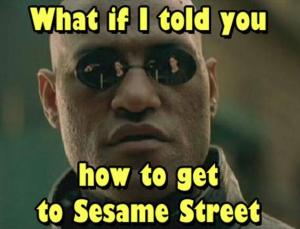
What if I told you ... how to get to Sesame Street?

And I don’t care that you’ve spent the last seven years locked away in a French monastery, slaving away 25 hours a day, eight days a week to perfect (a) The Great American Novel, Even Though It Was Written in France, (b) the movie script that will turn Hollywood on its ear and stop it from spending $250 million apiece on Michael Bay explosion-fests involving robots that transform into cars or whatever  or (c) a punk-rock masterpiece with song after song with lyrics so beautiful, and rebelliously ugly, that anyone who listens to it quits working for The Man and buys an electric Fender so they can learn the only three chords you need to know to become AN INSANE ROCK GOD.

So let’s get down to it. If you haven’t already, read these posts to get all educated and such, even though it is technically cheating — because today, there is a quiz.

Writing secret: Light as air, strong as whiskey, cheap as dirt

Writers, we are doing it BACKWARDS

Writing secret: all you need is CURIOSITY and SURPRISE

THE MOTHER OF ALL LOGLINE QUIZZES

Loglines, which, if you weren’t paying attention, are short little summaries of movies and books and such.

There are two ways to score this quiz, the first involving length and the second quality.

Four words or less gets you an A, five words is a B and so forth.

Quality is subject, but even if your logline is insanely brilliant, anything over eight words gets a big fat F, and F that glows in the dark and follows you around for a week like a bad cold or a moldy metaphor, which is like a simile, but different.

Sidenote: If you are a Literary Muffin of Stud, go ahead and share your brilliant answers in the comments. Then we’ll talk smack.

Sidenote on the side of that sidenote: If you are a shy lurker, as 99.9 percent of writers are, print this and scribble your answers, then share your brilliant answers somewhere, with somebody. Because it’s time you stopped being a shy lurker writer type. YOUR HEAD WILL NOT EXPLODE. Maybe you’ll even make a friend over the Series of Tubes and such, fall in love, get married and move to a former dairy farm in Vermont or whatever. These things have happened.

Quiz Part 1) Write a logline for your favorite movie, but turn the villain into the hero without changing the story.

Example

STAR WARS:  Wise ruler fights to stop murderous rebels, who keep blowing up invaluable public property.

Shot the length rule to bits there. Let’s shorten it to five words.

STAR WARS: Wrinkled leader battles murderous rebels.

There we go. I like it. Could have nailed four words if we smited “wrinkled,” but I don’t care.

Bonus, because we hit five words and give ourselves an A++ and such: Palpatine’s Greatest Hits, Vol. 1.

Quiz Part 2) Take your current project — movie, novel, performance art piece involving a dance number that expresses your feelings about unemployment — and write a logline making fun of it.

Go ahead. Have at it.

It’s more fun than you’d expect.

Quiz Part 3) Write five fresh loglines by twisting or rewriting stupid books and movies that had promise, then took all that promise and blew it to pieces with The 12-gauge of Utter Stupidity.

Examples

MATRIX REVOLUTIONS: Man wins war against robot enslavers.

Six words. It’s a better plot, because not Keanu “Whoah” Reeves doesn’t sacrifice his life to play virus cleaner for the robots, therefore protecting the status quo and ensuring a cycle of endless war and nuttiness. His death actually changes things with this logline. But six words is still too long.

MATRIX REVOLUTIONS: Man frees mankind from robots.

Five words. Too many “mans” in there. Where’s Trinity and such? But it’s better.

ONE SHOT: Tom Cruise is a foot too short to play Reacher.

Yes, I am a bad man. The trailer still looks awful. Couldn’t they find some short actors to play the thugs who Tom Cruise beats up? It looks like junior high bullies hassling a second-grader for his lunch money.

ONE DAY: Man meets girl, loses girl, gets girl back.

That’s the standard plot for every romantic comedy ever, but it’s also 1,398 times better than the actual plot of ONE DAY where man meets girl, man loses girl, man loses girl again, man finally marries girl, girl gets RANDOMLY PANCAKED BY A TRUCK, man is sad, roll credits.

TRANSFORMERS 3: DARK SIDE OF THE MOON OR WHATEVER: Magic robots leave Earth, because why would magic robots need our lame technology and such anyway? Also, Megan Fox buys a pair of pants.

I’m cheating again, though it is fun. Alright, TRANSFORMERS 3: Robot war obliterates Earth.

Much better. Also, it’s right up the alley of Michael Bay, who loves nothing more than blowing up stuff anyway.

The Red Pen of Doom destroys FREEDOM by Jonathan Franzen

FREEDOM

By Jonathan Franzen

The news about Walter Berglund wasn’t picked up locally – (add spaces here to match dash format in 2nd graf) he and Patty had moved away to Washington two years earlier and meant nothing to St. Paul now – but the urban gentry of Ramsey Hill did were not so loyal to their city as not to (if we can replace 10 words with one word, those 10 words are deader than Charlie Sheen’s acting career) read The New York Times, which ran According to a long, and very unflattering story in the Times, on how Walter had made quite a mess of his professional life out there in the nation’s capital. His old neighbors had some difficulty trouble reconciling the quotes about him in the Times (“arrogant,” “high-handed,” “ethically compromised”) with the generous, smiling, red-faced 3M employee they remembered pedaling his commuter bicycle (maybe bicycle geeks know or care, but humans do not get into bike vs. commuter bike, and I’m entirely unclear whether Walter was a U.S. Senator or a staffer or a lobbyist, and how he made the transition from bigshot in Congress or whatever to 3M employee on a bicycle, or whether he started as a nothing at 3M on a bike and went to D.C. or is now pedaling to work after screwing up big enough to be in the Times yet not go to federal prison) up Summit Avenue in February snow;. (let’s use a period, because semi-colons at the end of endless sentences are for professors and pretentious chowderheads) It seemed strange that Walter, who was greener than Greenpeace and whose own roots were rural, should be in trouble now for conniving with the coal industry and mistreating country people. Then again, there had always been something not quite right about the Berglunds.

Walter and Patty were the young pioneers of Ramsey Hill – the first college grads to buy a house on Barrier Street since the old heart of St. Paul had fallen fell on hard times three decades earlier. They paid nothing for their Victorian and then killed themselves for ten years renovating it. (contradicts last sentence of the first graf, since buying a beater house and working crazy hard to fix it says there’s something very right about the Berglunds) Early on, Some very determined person torched their garage and twice broke into their car before they got the garage rebuilt. Sunburned bikers descended on the vacant lot across the alley to guzzle drink Schlitz and grill knockwurst and rev engines at small hours until Patty went outside in (Drunken bikers would be afraid of some housewife? Um, no.)

(end of page 1)

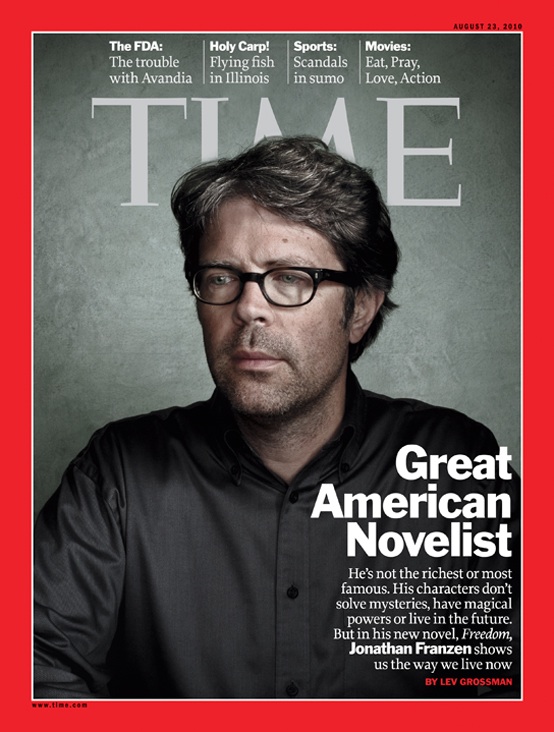
Time Magazine - Jonathan Franzen - Great American Novelist

Notes from the Red Pen of Doom

Yes, I know that critics went gaga over this book, and they loved THE CORRECTIONS, too.

I hate this first page. It rubs me wrong, and makes me feel like I’m about to read a 895-page doorstop of a book, something my sadistic Contemporary English Literature professor assigned me to read as punishment for my literary sins.

Here’s the deal: Franzen writes about families in the suburbs. Basically, the same topic that every sitcom has tackled for the last 50 years. Instead of making it funny, he makes it deep and depressing.

Is what Franzen writes – when he closes his eyes and composes after receiving inspiration directly from a muse that circles his head and descends, like a butterfly, or a silken bat, to kiss his unshaven cheeks with the kiss of creative genius – is it fun to read? No.

Don’t care about Walter and Patty as characters. I’d rather read about that biker gang guzzling Schlitz and grilling knockwurst while the talk smack and plan crimes that go epically wrong.

As with all literature – as Camryn Rhys or Elisa Logan would say, LIT-rah-SURE – the beginning is deep and mundane and depressing. It only gets worse from there. While the writing may be beautiful and amazing (though it is not beautiful or amazing on this first page yet) that’s not going to make me want to read more of the story. If I want to be depressed, I’d watch daytime TV.

The first page is all over the place. Also, he adores adjectives and adverbs, while I believe, deep in my dark heart, that all those modifiers simply mean Franzen should’ve picked stronger nouns and verbs in the first place.

It pains me that Franzen is half-Swedish and spent time in Germany as a student, because I am Swedish and lived in Germany as a child. But we are nothing alike, and I care nothing for this first page.

Which is too bad. Franzen has talent to burn. I bet if he wrote about the biker gang instead, it would be seven separate flavors of awesomesauce, and the Coen brothers would make a movie out of it.

Verdict: From this first page, you’d have to hand me stacks of purple euros to convince me that reading FREEDOM would be a good use of my limited time on this planet.

The Red Pen of Doom murders THE FOUNTAINHEAD by Ayn Rand

THE FOUNTAINHEAD

Cover of The Fountainhead

by Ayn Rand

Howard Roark laughed. (I approve of this. It asks a narrative question – who is this guy, and why did he laugh? – and I like short sentences anyway.)

He stood naked at the edge of a cliff. The lake lay far below him. A frozen explosion of granite burst in flight to the sky over motionless water. (Whoah, whoah, hold up. So far, it was all tight and Hemingway-esque. “The pants fit him. They felt good.” Now you suddenly switch to purple prose, with granite bursting in flight? I didn’t know that granite rocks flew, or exploded when they did decide to take wing. No.) The water seemed immovable, the stone flowing. The stone had the stillness of one brief moment in battle when thrust meets thrust and the currents are held in a pause more dynamic than motion. The stone glowed, wet with sunrays. (More purple prose. Hate it. Though I do smile at all the double-entendre action. Let’s try again.)

The lake below was only a thin steel ring that cut the rocks in half.  The rocks went on into the depth, unchanged. They began and ended in the sky. So that the world seemed suspended in space, an island floating on nothing, anchored to the feet of the man on the cliff. (What? I think Ayn Rand was smoking a bowl here.)

His body leaned back against the sky. It was a body of long straight lines and angles, each curve broken into planes. (Things are either curved, straight or angled. That pretty much covers it. Maybe the only other people in this book are Flat Stanley and the Blob.) He stood, rigid, his hands hanging at his sides, palms out. He felt his shoulder blades drawn tight together, the curve of his neck, and the weight of the blood in his hands. He felt the wind behind him, in the hollow of his spine. The wind waved his hair against the sky. His hair was neither blond nor red, but the exact color of ripe orange rind. (No man would ever describe his hair as “ripe orange rind.” He’d say, “I’m a red-head” or “I’m blond” or “I don’t know.”)

He laughed at the thing which had happened to him that morning (Oh, right. So funny!) and at the things which now lay ahead. (Yes — also hilarious. I laugh at that all the time. Maybe let’s use different ways to hint at backstory and do foreshadowing.)

He knew that the days ahead would be difficult. There were questions to be faced and a plan of action to be prepared. He knew that he should think about it. He knew also that he would not think, because everything was clear to him already, because the plan had been set long ago, and because he wanted to laugh. (Enough with the laughing about things that may or may not have happened, and difficult plans, and thinking about not thinking. We can go to this well once or twice, but not every sentence.)

He tried to consider it. But he forgot. (Or maybe we can jump into that well and stay there forever.) He was looking at the granite.

He did not laugh (Oh, we’re NOT laughing now?) as his eyes stopped in awareness of the earth around him. His face was like a law of nature— (You have got to be kidding me.)

End of Page 1

Notes from The Red Pen of Doom

I believe the readers of today – like me – don’t want (a) tons of purple prose, (b) paragraph after paragraph of character description or (c) 3.4 metric tons of purple prose that’s all character description and internal dialogue.

But there are bigger fish to fry here, both in the literary sense of Is This A Good Page One? and in the story sense.

Ayn Rand is a deity among conservatives, because her novels underpin what she calls the “philosophy” of objectivism, which says it’s quite unselfish to be selfish. This is obviously counter-intuitive and quite appealing in a juvenile kind of way, because hey, it’s now my moral duty to do whatever I want. The best way to take care of others is to only care about yourself. The surest path to aid the poor is to cut taxes for the rich. And so forth.

This philosophy intrudes upon the story. Roark, the hero of this novel, roughly has his way with Dominique, the heroine, when they first meet. She later describes it as rape. Dominique makes Sylvia Plath look mentally stable. To show her undying love for Roark, she marries … some rich man. Then she tries to destroy Roark, divorces that rich man to marry another rich dude, keeps on trying to destroy Roark, then finally divorces that other rich schmuck to marry Roark in the end, but only after Roark TRIES TO BLOW UP A BUILDING that he designed.

If you said “This is a book that makes a hero out of a selfish architect who’s a strong-willed, good-looking rapist and terrorist,” you’d kinda sorta be accurate. And yes, I read the entire book. Twice. I WROTE A PAPER ON IT.

So the first page does foreshadow a lot of things. Ayn Rand has “a frozen explosion of granite” in the second graf. She has a whole bunch of imagery and descriptions of Roark’s perfect body.

HOWEVER: If I hadn’t already read this book, I’d see this first page and think it was some kind of historical romance, with Roark’s kilt and dirk sitting over on that rock, his trusty horse waiting for him after he took a swim and rode off to rescue his favorite maiden, a red-haired beauty held captive by the twisted and disfigured Baron of Whateverthehell.

Otherwise, I don’t hate her writing per se. I merely despise it.

Usually, I can fix a line or a paragraph. Big chunks of this first page simply need to die. The best thing is to cut them out.

Does that whack about half of this first page? Yes.

Would that make it better? Yes.

There’s a weird mix of styles going on here. You get short, clipped sentences, tight and hard, with zero fatty modifiers. But then Ayn the Rand switches to long stretches of not only purple prose, but outright wackiness I expect from college sophomores writing flash fiction at three in the morning on the deadline day after hitting the bong FAR TOO HARD.

The Verdict:

There’s a reason 12 publishers rejected this novel before it found a home. Hate the first page. Hate the hero, and the heroine who tries to destroy Roark because she loves him so much. Hate the story. Hate the “philosophy.” It’s a tough call, whether THE FOUNTAINHEAD or OUTLANDER are more deserving of being thrown across the room. But I’m going with THE FOUNTAINHEAD.

The Red Pen of Doom guts THE NOTEBOOK

THE NOTEBOOK

(The title makes sense, since the story turns on an actual notebook.)

by Nicholas Sparks

Chapter One: Miracles

Who am I? And how,I wonder, will this story end?

The sun has come up and I am sitting by a window that is foggy with the breath of a life gone by. (Melodramatic and clunky.) I’m a sight this morning: two shirts, heavy pants, a scarf wrapped twice around my neck and tucked into a thick sweater knitted by my daughter thirty birthdays ago. The thermostat in my room is set as high as it will go, and a smaller space heater sits directly behind me, clicking and groaning and spewing hot air like a fairytale dragon — and still my body shivers with a cold that will never go away, a cold that has been eighty years in the making. Eighty years. , I think sometimes, and dDespite my own acceptance of my age, it still amazes me that I haven’t been warm since George Bush was president. I wonder if this iIs this how it is for everyone my age?

My life? It isn’t easy to explain. It has Not been the rip-roaring spectacular I fancied it would be, but neither have I burrowed around with the gophers. I suppose it has most resembled a blue-chip stock:

(end of page 1)

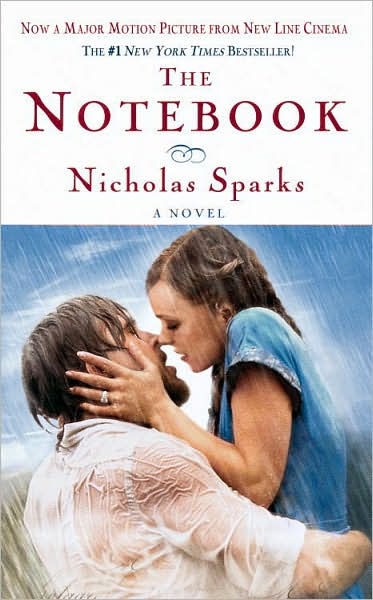
the notebook by nicholas sparks
THE NOTEBOOK by Nicholas Sparks. A book that belongs next to Hemingway. A movie that should have won many, many more Oscars, yes? Nicholas Sparks was ROBBED.

Notes from the Red Pen of Doom

The biggest problem isn’t the line editing, though it’s clunky. While clearly first-person P.O.V., he keeps inserting needless attributions like “I wonder” and “I think.” Here’s the monster problem: 90 percent of page one is spent telling the reader — repeatedly — that the first-person narrator is (a) 80 years old and (b) seriously obsessed with talking about how cold it is.

Space on page one is precious. It’s for raising narrative questions that won’t be answered for 400 pages. Compelling questions.

Life or death. Together or alone. Freedom or slavery.

I can imagine a story where being 80 years old and cold is the problem. Maybe a doctor is headed to a remote Alaskan village when his snowmobile breaks down. He’s  the only doctor within 200 miles, the only hope for a mother who’s in the middle of a labor gone wrong. Now you’ve got public stakes and private stakes. If he doesn’t strap on snowshoes and get past hungry wolves and polar bears, he’ll die, and the mom in labor might die, and her baby might die — and they’ll be no doctor out in the bush for a lot of people.

So: a cold old man becoming warm can matter a lot in a story.

Not in this story. On this page one, it’s boring.

Having an 80-year-old hero can make this hard. Go back to the first line: “And, I wonder, how will this story end?” Not a lot of suspense there. It’s hard having high stakes when the protag is already looking back on his life, as if it’s already over.

This is why most novels and movies feature younger protags. The more you have to lose, the higher the stakes.

It’s why you have movies like INDIANA JONES AND THE TEMPLE OF DOOM, not INDIANA JONES AND THE CONTENTIOUS BINGO GAME.

You certainly can have great stories with older heroes. They just have to DO something.

Anthony Hopkins did a great job with Hannibal Lecter, an active and charming killer. Old, yes, but he didn’t act like Sparks’ old man. There is no book called HANNIBAL LECTER AND THE SPACE HEATER.

So, back to THE NOTEBOOK: the beginning should set up the ending. Does the climax hinge on whether our 80-year-old hero puts on another ugly Christmas sweater and finally stops kvetching about being cold? No.

It’s about whether or not he’s alone or together. Whether his wife remembers him or not.

So the first line is on track. Almost. Not “Who am I?” but “Who are you?” And that question should come out of the mouth of the wife.

Or, if Sparks wanted some misdirection, have that question come from somebody else. But since the end is about togetherness, about love and romance and faithfulness, the first chapter should be full of loneliness. Not cold. Not sweaters and scarves and space heaters.

Talk about how friends move, how coworkers get different jobs, kids grow up and stop calling.  Spend the first page on loneliness, if you want the ending to be about togetherness.

Had I not read the back cover, and didn’t know the climax of this story, reading page one would not motivate me to read more.

If the narrator complains a lot, and doesn’t think his own life is exciting, why the hell would I keep reading about him? I will now praise the One Known as the Spork: the ending of this book, as a plot, isn’t bad. Page one doesn’t do it justice.

Verdict: Take out the Nine and shoot it full of holes, then burn whatever’s left and start over with a fresh sheet of paper.