Our first documentary — which I rented on the NetFlix and watched TWICE — answers the questions all of us have asked, at one time or another: What happened to the 13-year-old dudes who were really, really into Dungeons and Dragons? I’m not talking a little into it. I mean really, really serious about it, as in they’d go pro if there was such a thing.
The documentary DARKON answers those questions. And no, they don’t hang out in mom’s basement dressed up like warriors and wizards and elves while rolling dice on a table for ten hours a day. That’s silly. They dress up like warriors and wizards and elves for entire weekends and bash each other with foam swords.
And this is serious business. The swords may be foam, but the armor is real, and the politics are all kinds of crazy.
So: watch this trailer, then watch the whole thing.
This documentary is less deeply epic than DARKON and far more comic. You will snort coffee from your nose, or bourbon, or a Capri Sun juice box, if that’s what mom packed.
A former actress from STAR TREK: I FORGET WHICH SERIES (she’s blonde, and left the show, then came back as an evil Romulun twin or whatever) goes forth and interviews all sorts of Star Trek fans. She’s also got interviews with Leonard Nimoy and William Shatner, but those won’t stick to your mind as much as the dentist whose entire office is decked out like the bridge of the Enterprise or the gang of Klingons ordering food from Taco Bell while speaking Klingon.
Daniel Craig put grittiness into James Bond — no more invisible cars and silly nonsense. He makes you believe he could kill you with a spoon.
Top Ten Thriller Clichés
Act I: A wealthy, disfigured foreigner toils late into the night
1. The Villain of the Week is a wealthy, disfigured foreigner who (a) steals a nuclear warhead, (b) plans to kidnap the president or (c) discovers a lock of Hitler’s hair and is busy cloning the Führer.
2. The Standard Hero is tall, dark and deadly. He used to work for the government, wears anything as long as it’s black — wet suit, tuxedo or cat-burglar outfit — and solves every problem by beating it up, blowing it up or sleeping with it.
3. The Villain of the Week has an endless army of faceless minions except for two people: (a) the femme fatale, who has a special bond with our hero because her wardrobe is also exclusively black, just tighter, and (b) a giant, impossibly strong thug who never speaks and has a signature way of killing people.
Act II: The Standard Hero wakes from his slumber to blow things up
4. The hero is out of the business and cares nothing for money, but the state appeals to his patriotism — or the villain kills his wife/girlfriend.
5. Although our hero is a lone wolf, he must now work with a team, including (a) one beautiful young sidekick who knows kung fu almost as well as the Kama Sutra and (b) a science nerd who provides exploding pens and tech support. He will also have (c) a Bureaucratic Boss, who will suspend our hero, then turn out to be a mole working for the Villain of the Week.
6. If the president isn’t involved, the prime minister of Britain shows up, plus a politician involved in the conspiracy, who will either be a slick, greedy senator with a southern accent or an ancient and decadent member of the House of Lords.
7. Between car chases and explosions, the femme fatale tries to kill the hero, who bests her, making her decide to sleep with him. This is how you know she is doomed.
Act III: The Big Showdown ends in a fist fight; never mind all the guns
7. The hero infiltrates the villain’s lair with the help of the femme fatale, who betrays him. The villain doesn’t kill him right off. He delegates death-by-torture to the femme fatale, who sets the hero free, then turns bad again at the last minute so she can have a long catfight with the beautiful sidekick.
8. After our hero kills countless minions, he faces the invincible giant. The hero uses the invincible giant’s signature killing move against him.
9. Despite the carpet of dead thugs clutching AK-47s, the Villain of the Week decides to fight the hero bare handed as the lair self-destructs. The Standard Hero dispatches the villain by (a) tossing him down an endless chasm, (b) impaling him on a massive spike or (c) throwing him down a chasm that ends in a massive spike.
10. Nothing changes. Our hero doesn’t change or grow — he’ll be back for more in the sequel.The world doesn’t change. The average person in Cleveland has no idea anything happened at all.
And those words help sell 5.842 gazillion miles of barbed wire back in the late 1800s, when the West was still wild and there weren’t handy trees or stones to make fences.
Light as air, strong as whiskey, cheap as dirt – I’ll remember that for days. Forever, maybe.
It’s honed down to perfection. Nine words, and not a one is wasted.
A little strand of steel with a twist and BOOM, you are golden. Photo by Guy Bergstrom.
In the five seconds it takes to hear those words, or read them, you’re sold.
Writers struggle with those first five seconds.
What’s the best way for a reporter to convince the city editor put a story on A1 instead of buried next to the obituaries on B15?
How can you sum up a 100,000 novel in a single page – or a single sentence?
When a magazine editor is buried with pitches, how does yours stand out from the slush pile?
What should a screenwriter say about his script while riding in an elevator for 30 seconds with Steven Spielberg?
Science shows us secrets
Here comes the science: people make up their mind about you – or your writing – in the first five seconds.
Viscerally. Unconsciously.
Their little reptile brains see your face or your words and make a split decision.
Later on, our oversized frontal lobes justify that snap judgment.
It’s not a rational thing. I’ve seen the science. Go read BLINK by Malcolm Gladwell. (Go on, read it. I’ll be over here, drinking Belgian ale.)
Different researchers testing for different things found the same result.
The first five seconds of a job interview determines whether you get it
The first five ticks of the clock during a professor’s first lecture of the semester, with the sound turned off, can be used to predict exactly how students will rate that professor.
A quick glance – less than – at two candidate mug shots will predict who will win the race. This works with adults or five-year-olds. Mug shots. No names. No parties. The shape of the face.
This last result fascinated me. Researchers had people glance at those mugs, then rate the candidates on attractiveness, intelligence, competence and whatnot.
They thought attractiveness would matter.Nope. They thought race and sex and age would matter. Nope.
Competence was the only thing related to the eventual winner.
This makes sense. If somebody’s attacking your village, you don’t pick Nerdy McNerdy as the leader of the defense. Brains without brawn won’t work.
You don’t pick Miss America to lead the troops into battle, either, because she’ll simply be nice to look at while you all get slaughterd.
And you don’t pick Mr. Neanderthal, tough but stupid.
Who do you want? Somebody who looks competent – tough but smart. A Clint Eastwood, somebody who looked like he knew what the hell he was doing.
Hold it out and squint
Alright, you’re already thinking of the Greatest Squinty Eyed Tough Guy in Movies, so remember this rule: Hold it out and squint.
Hold out your first page of your text and squint.
Is it a sea of gray?
Is there a photo or graphic? Are all the paragraphs the same length? Do you have any subheads or anything to break up the text?
Now, this doesn’t work for certain things. You can’t have photos and whatnot in screenplays or manuscripts.
Later on, though, it will make or break you.
When you go to rent a movie (yes, I know Blockbuster is dead to you and it’s all Netflix now, so pretend you’re clicking away with Mr. Mouse), you make decisions in far less than five seconds. You glance at the front cover and move on.
Same thing with books. Glance and move. Glance and move.
Maybe you pick a book up and read the text. What makes you pick it up? Images first. Maybe a good title. Glance and move.
That’s why the Squint Test is so important.
Think about movie posters with too much going on. When you squint, you don’t know what’s what.They’ve got the star and the co-star and seven different sidekicks in there, plus the villain and two random thugs. It’s a mess.
Less is more. Simple works best.
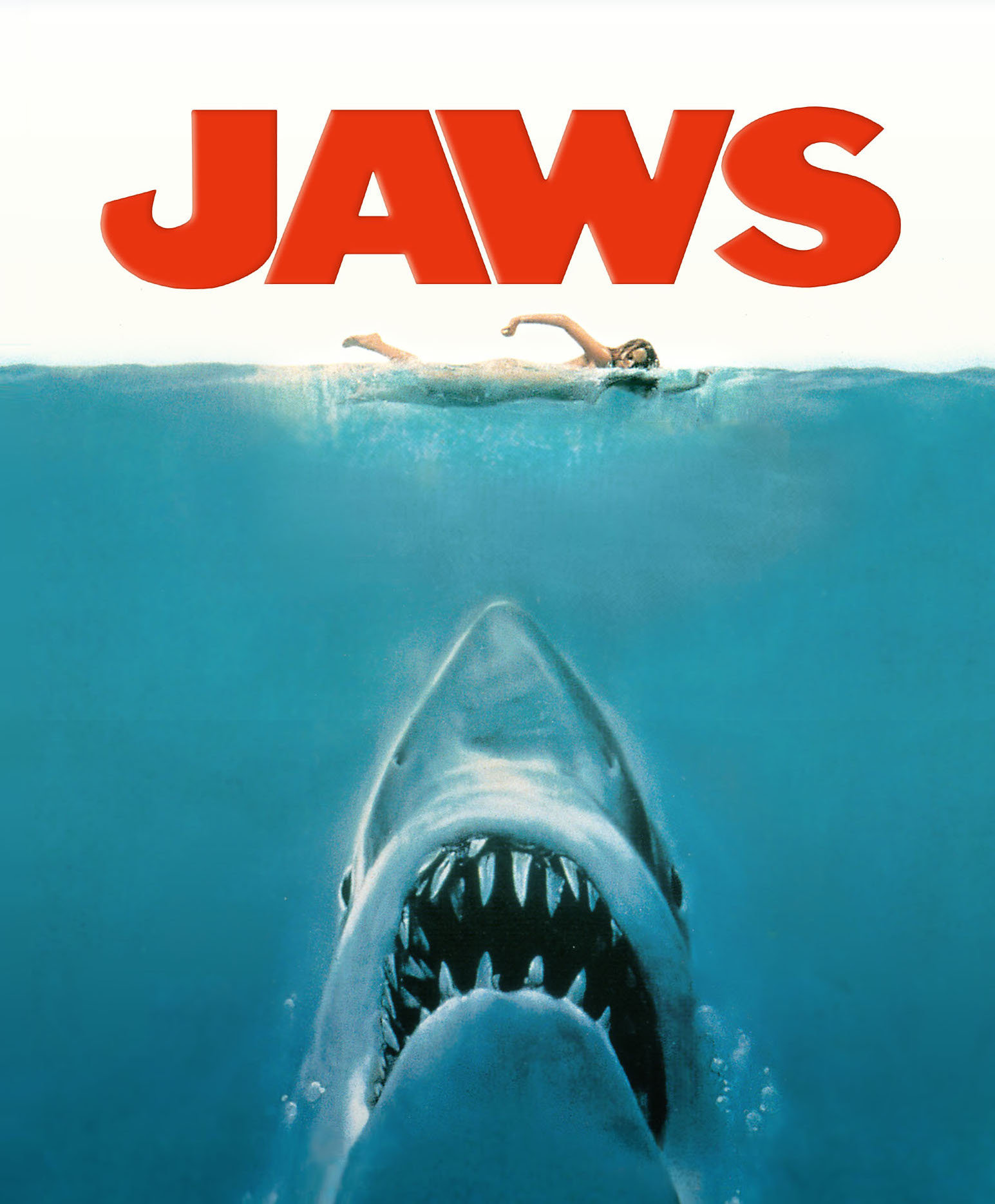
The poster for JAWS is perfect: a pretty young woman swimming along and a giant invincible shark roaring out of the depths of the ocean. It doesn’t get any more primal than that. We need the shark and a pretty girl. That’s it.
The JAWS movie poster is classic, and will always be classic, because it is simple and brutal and seven separate types of awesome. Steven the Spielberg, stick with this movie thing — you have talent.
Putting this knowledge to evil use
Our conscious brains aren’t really running the show. We’re like a mouse riding on top of an elephant, sometimes biting the elephants ear to go left or right.
How can we writers use that knowledge?
Tap into the reptile part of our brains. Go for the gut.
Blake Snyder hit this idea with his Hammer of Truth in SAVE THE CAT when he demolished the conventional wisdom of genres.
JAWS isn’t a horror movie. ALIEN isn’t a sci-fi movie. FATAL ATTRACTION isn’t a domestic drama. All three are the same story, the same primal threat: there’s a monster in the house. You can’t get away. Either you fight it and kill it, or it eats you.
Hollywood screenwriters are masters of the first five seconds. Fire up the google and check out “loglines” to see how they sum up a movie in a sentence. They make writers of novels look like silly chatterboxes. Think you’re being hip with a one-page synopsis instead of five pages? Hollywood laughs at a full page of text. One sentence, buddy.
Can you do it in a sentence?
How about nine words?
Copywriters are also world-class at those first five seconds. Visit copyblogger and soak up their wisdom. DO IT NOW.
The best five-second pitches — whether it’s a headline for a newspaper story, a poster for a movie or a pitch for a novel — tap into those primal needs and instincts that Blake Snyder talks about.
Survival vs. death. Love vs. loss.
You know what the stakes are. Instantly. Not 30 seconds into it. Not 15 seconds after learning about the when and where and who. You see what’s at stake, right away.
Here are four words: COMET WILL DESTROY EARTH.
That’s a newspaper story everybody will read. Everybody. It’s a movie people saw twice (ARMAGEDDON and DEEP IMPACT).
Part of the secret seems to what’s missing: the hero. You don’t hear a damn thing about the hero after you’ve boiled it all down, do you? Screw the hero. Heroes are plain vanilla and boring. The best ones, the ones that hook us, talk about the bad guy: the alien, the shark, the comet. Hmm. Maybe there’s a reason for that. But that’s a post for another day.


 The Red Pen of Doom