Every writer gets the notion — from college, from movies, from the Series of Tubes — that they should be in a critique group.
This notion is seven separate types of wrong.
It’s time for critique groups to go the way of the rotary phone — to make way for something better, faster and stronger.
Peoples of the interwebs: critique groups are obsolete
A critique group is useful for certain things:
(a) university professors who want students to break into groups and leave him alone for the next 45 minutes,
(b) writers who really, really like to read their work aloud,
(c) literary snobs who like to say silly pretentious things about the work of others, and
(d) happy writers who like to socialize with fellow writers and talk smack about the craft while drinking bourbon.
Sidenote: Yes, your particular critique group is wonderful, and you couldn’t live without it. No worries. I’m not driving to your house with the Anti-Critique Group Secret Police to disband it or anything. Also, your critique group’s amazing bylaws and secret handshakes mitigate all the typical disadvantages of plain old boring critique groups that are not nearly as awesome.
Reason No. 1: Critique groups take far too much time
During college, sure, you’ve got time to sit in a group, read chapters aloud and debate what Susie really meant by having the protagonist drink a bottle of ketchup in Chapter 2.
Once you graduate from college, get a job, get married, buy a house and have little pookies, THERE IS NO TIME for this type of nonsense. Do I have three hours to drive to somebody’s house, listen to chapters read aloud, then talk about what I remember of those words and drive home? No. I have ten flipping minutes to write silly blog posts.
People who write for monies, full time, do not gather around a table to read their text aloud while fellow writers and editors listen carefully and ponder the words. It does not happen.
Reason No. 2: Editing as a group is dangerous and slow
Anything written by a committee will stink up the joint, right? Writing is a solitary act.
Editing is, too. You write a thing, then you give it to an editor.
Typically, there are different levels of editing: at a newspaper, you ship your text to the city editor, who gives it the first whack and focuses on the big picture. Later, the draft goes to the copy desk for a different type of editing, more of a polish and proofing.
Also, editing is best done on a keyboard, or with a red pen. Not out loud in a social group, where peer pressure and weird dynamics can screw up a draft in two seconds flat.
Reason No. 3: Critique groups can’t handle most things we write today
Short stories and novels. That’s what critique groups are really built to handle.
And they do a bad job on novels. Why? Because reading a novel in tiny chunks every week will (a) take forever and (b) turn the focus onto pretty words rather than structure and story. You need to see the entire airplane before you can say, with authority, whether it’ll fly or not. Peeking at tiny pieces of it all year doesn’t work.
Traditional critique groups are bullocks when it comes to editing blog posts, speeches, opeds, screenplays, newspaper stories, magazine features, obituaries and haikus. That’s right, haikus. YOU CAN’T HANDLE THEM.
Reason No. 4: Because I say so
That’s it.
I could put some bullets beneath here, if you want to make it official. Here you go:
Because
I
Say
So.
Let’s invent something new
Now, there is a place for some kind of thing that’s LIKE a critique group, except better, faster and stronger.
Everybody needs an editor. And the more important a thing is, the more you should hire a professional editor who actually does this stuff for a living. But for a whole bunch of things that we write — including silly blog posts — hiring a pro would be a waste of money and time.
So let’s invent a new Writing Monster that’s better, faster and stronger.
Better
The Writing Monster should be flexible, able to handle the editing of any kind of writing, whether it’s a little blog post, a speech, a short story or a screenplay.
It should also expose people to new ideas and new ways of looking at writing, and inspire us to rip the pages out of stupid pretentious books.
And it should expose us to different types of writers and editors, not just fellow writers who have the same exact skills and writerly prejudices.
Faster
The Writer Monster Thing should use this thing we call the Series of Tubes and travel at the speed of light rather than the Speed of Steve’s Subaru as you carpool to Jane’s house for the critique group and hope that she didn’t make that bean salad again.
Stronger
The Writing Monster should be strong and resilient, living in the cloud and forging connections with writers and editors anywhere, like the Borg’s hive mind collective.
BTW: Resistance is futile.
The Writing Monster will NOT die because Steve moved to Idaho or Jane discovered that she hates Tyler’s novel and, to be honest, his stinking guts.
Also, the Writing Monster will focus more on short, important things like concepts, pitches and structure. Things that take up less than a page. (Kristen the Lamb is onto something with her Concept Critique Group idea.)
The alternative is spending every week for the next year dissecting Steve’s 125,000-word epic about vampire elves with lightsabers riding dinosaurs and Jane’s memoir about growing up on a potato farm in Idaho.
The news about Walter Berglund wasn’t picked up locally – (add spaces here to match dash format in 2nd graf) he and Patty had moved away to Washington two years earlier and meant nothing to St. Paul now – but the urban gentry of Ramsey Hill didwere not so loyal to their city as not to(if we can replace 10 words with one word, those 10 words are deader than Charlie Sheen’s acting career) read The New York Times, which ran According to a long,and very unflattering story in the Times, on how Walter had made quite a mess of his professional life out there in the nation’s capital. His old neighbors had some difficultytrouble reconciling the quotes about him in the Times (“arrogant,” “high-handed,” “ethically compromised”) with the generous, smiling, red-faced 3M employee they remembered pedaling his commuter bicycle (maybe bicycle geeks know or care, but humans do not get into bike vs. commuter bike, and I’m entirely unclear whether Walter was a U.S. Senator or a staffer or a lobbyist, and how he made the transition from bigshot in Congress or whatever to 3M employee on a bicycle, or whether he started as a nothing at 3M on a bike and went to D.C. or is now pedaling to work after screwing up big enough to be in the Times yet not go to federal prison) up Summit Avenue in February snow;. (let’s use a period, because semi-colons at the end of endless sentences are for professors and pretentious chowderheads)It seemed strange that Walter, who was greener than Greenpeace and whose own roots were rural, should be in trouble now for conniving with the coal industry and mistreating country people. Then again, there had always been something not quite right about the Berglunds.
Walter and Patty were the young pioneers of Ramsey Hill – the first college grads to buy a house on Barrier Street since the old heart of St. Paul had fallen fell on hard times three decades earlier. They paid nothing for their Victorian and then killed themselves for ten years renovating it. (contradicts last sentence of the first graf, since buying a beater house and working crazy hard to fix it says there’s something very right about the Berglunds)Early on,Some very determined person torched their garage and twice broke into their car before they got the garage rebuilt. Sunburned bikers descended on the vacant lot across the alley to guzzledrink Schlitz and grill knockwurst and rev engines at small hours until Patty went outside in (Drunken bikers would be afraid of some housewife? Um, no.)
(end of page 1)
Notes from the Red Pen of Doom
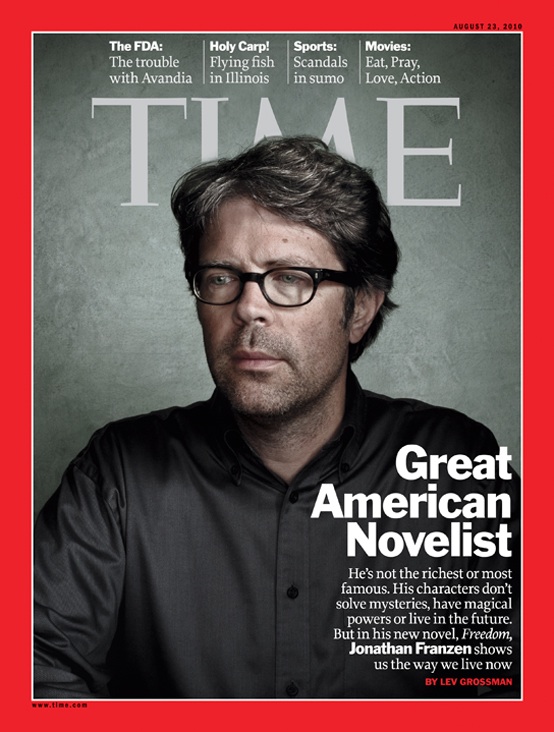
Yes, I know that critics went gaga over this book, and they loved THE CORRECTIONS, too.
I hate this first page. It rubs me wrong, and makes me feel like I’m about to read a 895-page doorstop of a book, something my sadistic Contemporary English Literature professor assigned me to read as punishment for my literary sins.
Here’s the deal: Franzen writes about families in the suburbs. Basically, the same topic that every sitcom has tackled for the last 50 years. Instead of making it funny, he makes it deep and depressing.
Is what Franzen writes – when he closes his eyes and composes after receiving inspiration directly from a muse that circles his head and descends, like a butterfly, or a silken bat, to kiss his unshaven cheeks with the kiss of creative genius – is it fun to read? No.
Don’t care about Walter and Patty as characters. I’d rather read about that biker gang guzzling Schlitz and grilling knockwurst while the talk smack and plan crimes that go epically wrong.
As with all literature – as Camryn Rhys or Elisa Logan would say, LIT-rah-SURE – the beginning is deep and mundane and depressing. It only gets worse from there. While the writing may be beautiful and amazing (though it is not beautiful or amazing on this first page yet) that’s not going to make me want to read more of the story. If I want to be depressed, I’d watch daytime TV.
The first page is all over the place. Also, he adores adjectives and adverbs, while I believe, deep in my dark heart, that all those modifiers simply mean Franzen should’ve picked stronger nouns and verbs in the first place.
It pains me that Franzen is half-Swedish and spent time in Germany as a student, because I am Swedish and lived in Germany as a child. But we are nothing alike, and I care nothing for this first page.
Which is too bad. Franzen has talent to burn. I bet if he wrote about the biker gang instead, it would be seven separate flavors of awesomesauce, and the Coen brothers would make a movie out of it.
Verdict: From this first page, you’d have to hand me stacks of purple euros to convince me that reading FREEDOM would be a good use of my limited time on this planet.
Howard Roark laughed. (I approve of this. It asks a narrative question – who is this guy, and why did he laugh? – and I like short sentences anyway.)
He stood naked at the edge of a cliff. The lake lay far below him.A frozen explosion of granite burst in flight to the sky over motionless water.(Whoah, whoah, hold up. So far, it was all tight and Hemingway-esque. “The pants fit him. They felt good.” Now you suddenly switch to purple prose, with granite bursting in flight? I didn’t know that granite rocks flew, or exploded when they did decide to take wing. No.)The water seemed immovable, the stone flowing. The stone had the stillness of one brief moment in battle when thrust meets thrust and the currents are held in a pause more dynamic than motion. The stone glowed, wet with sunrays. (More purple prose. Hate it. Though I do smile at all the double-entendre action. Let’s try again.)
The lake below was only a thin steel ring that cut the rocks in half. The rocks went on into the depth, unchanged. They began and ended in the sky. So that the world seemed suspended in space, an island floating on nothing, anchored to the feet of the man on the cliff.(What? I think Ayn Rand was smoking a bowl here.)
His body leaned back against the sky. It was a body of long straight lines and angles, each curve broken into planes.(Things are either curved, straight or angled. That pretty much covers it. Maybe the only other people in this book are Flat Stanley and the Blob.) He stood, rigid, his hands hanging at his sides, palms out. He felt his shoulder blades drawn tight together, the curve of his neck, and the weight of the blood in his hands. He felt the wind behind him, in the hollow of his spine. The wind waved his hair against the sky. His hair was neither blond nor red, but the exact color of ripe orange rind. (No man would ever describe his hair as “ripe orange rind.” He’d say, “I’m a red-head” or “I’m blond” or “I don’t know.”)
He laughed at the thing which had happened to him that morning (Oh, right. So funny!) and at the things which now lay ahead. (Yes — also hilarious. I laugh at that all the time. Maybe let’s use different ways to hint at backstory and do foreshadowing.)
He knew that the days ahead would be difficult. There were questions to be faced and a plan of action to be prepared. He knew that he should think about it. He knew also that he would not think, because everything was clear to him already, because the plan had been set long ago, and because he wanted to laugh. (Enough with the laughing about things that may or may not have happened, and difficult plans, and thinking about not thinking. We can go to this well once or twice, but not every sentence.)
He tried to consider it. But he forgot. (Or maybe we can jump into that well and stay there forever.) He was looking at the granite.
He did not laugh (Oh, we’re NOT laughing now?) as his eyes stopped in awareness of the earth around him. His face was like a law of nature— (You have got to be kidding me.)
End of Page 1
Notes from The Red Pen of Doom
I believe the readers of today – like me – don’t want (a) tons of purple prose, (b) paragraph after paragraph of character description or (c) 3.4 metric tons of purple prose that’s all character description and internal dialogue.
But there are bigger fish to fry here, both in the literary sense of Is This A Good Page One? and in the story sense.
Ayn Rand is a deity among conservatives, because her novels underpin what she calls the “philosophy” of objectivism, which says it’s quite unselfish to be selfish. This is obviously counter-intuitive and quite appealing in a juvenile kind of way, because hey, it’s now my moral duty to do whatever I want. The best way to take care of others is to only care about yourself. The surest path to aid the poor is to cut taxes for the rich. And so forth.
This philosophy intrudes upon the story. Roark, the hero of this novel, roughly has his way with Dominique, the heroine, when they first meet. She later describes it as rape. Dominique makes Sylvia Plath look mentally stable. To show her undying love for Roark, she marries … some rich man. Then she tries to destroy Roark, divorces that rich man to marry another rich dude, keeps on trying to destroy Roark, then finally divorces that other rich schmuck to marry Roark in the end, but only after Roark TRIES TO BLOW UP A BUILDING that he designed.
If you said “This is a book that makes a hero out of a selfish architect who’s a strong-willed, good-looking rapist and terrorist,” you’d kinda sorta be accurate. And yes, I read the entire book. Twice. I WROTE A PAPER ON IT.
So the first page does foreshadow a lot of things. Ayn Rand has “a frozen explosion of granite” in the second graf. She has a whole bunch of imagery and descriptions of Roark’s perfect body.
HOWEVER: If I hadn’t already read this book, I’d see this first page and think it was some kind of historical romance, with Roark’s kilt and dirk sitting over on that rock, his trusty horse waiting for him after he took a swim and rode off to rescue his favorite maiden, a red-haired beauty held captive by the twisted and disfigured Baron of Whateverthehell.
Otherwise, I don’t hate her writing per se. I merely despise it.
Usually, I can fix a line or a paragraph. Big chunks of this first page simply need to die. The best thing is to cut them out.
Does that whack about half of this first page? Yes.
Would that make it better? Yes.
There’s a weird mix of styles going on here. You get short, clipped sentences, tight and hard, with zero fatty modifiers. But then Ayn the Rand switches to long stretches of not only purple prose, but outright wackiness I expect from college sophomores writing flash fiction at three in the morning on the deadline day after hitting the bong FAR TOO HARD.
The Verdict:
There’s a reason 12 publishers rejected this novel before it found a home. Hate the first page. Hate the hero, and the heroine who tries to destroy Roark because she loves him so much. Hate the story. Hate the “philosophy.” It’s a tough call, whether THE FOUNTAINHEAD or OUTLANDER are more deserving of being thrown across the room. But I’m going with THE FOUNTAINHEAD.
It’s two in the morning. Everybody sane is asleep.
But a secret society of British editors was busy sneaking onto my blog, reading my love letter to all who wield the Red Pen of Doom to pay the mortgage.
I know this because a man in a black hood crept inside my secret lair, entered the bigger turret and whispered in my ear, “Me and my mates are dead chuffed.”
He wore a pendant around his neck that looked a lot like a sharp red pen, dripping blood. Also, he smelled like good tea.
I dig the British, and the Australians, so it’s a happy accident that a bunch of Brits and Aussies and New Zealanders read this blog.
The brilliant and beautiful British editors must have told their friends in Canada, who were also up early for some reason, and hitting my silly blog at an ungodly hour despite the fact that I know Canada is only five hours behind Eastern Standard Time, being up north with the sun either shining all but two hours in the summer and that same daystar hiding out for all but two hours in the dead of dark, dark winter.
It was hilarious to read their comments on Twitter, where I asked to join the Society for Editors and Proofreaders (SfEP), perhaps as Fetcher of Coffee — or maybe Puncher of All Who Need to Be Punched.
They said sure. Join our group.
So I might. Even their acronym looks cool, and I belong to the Swedish Institute of Learned Men Without Beards Who Truly and Absolutely Hate Acronyms, Poets and Mimes (SILMWBWTA).
Editors and proofreaders of the United Kingdom, I salute you. Start making two lists: coffee preferences and people who need instant nose jobs.
And just because I can, four of my favorite videos related to all things British, with the exception of Bond movie clips. 007 deserves his own post later.
I don’t care what you’re writing: whether it’s spy thrillers, speeches, newspaper stories or romances about men in kilts, the only thing that matters to the reader is the journey you take them on.
How far – and how fast – is that ride? Where does it start and where does it end?
The roller coaster you take readers on is far, far more important than how pretty you’ve painted things with words.
Oh, there are people who write so beautifully that they can make a trip to Safeway sound more interesting than the latest Michael Bay explosion of robots and cleavage. And yes, there are people who are bestsellers despite the wordsmithing skills of a middling sixth-grader whose main hobby is eating paste.
Those bestsellers are millionaires because story – structure, really — beats pretty words.
Ronald Reagan wasn’t considered the Great Communicator because of his verbal skills. Go back and listen to his Berlin Wall speech, considered a great one. He’s got all sorts of verbal tics and delivery problems. He wasn’t that smooth of a speaker. Reagan’s genius was in being a great storyteller.
The same thing is true of great reporters. It’s not the quality of the prose that makes us hand out Pulitzers and buy Bob Woodward’s books. What he’s truly good at is getting people to give him juicy things to write about, so he can tell a great story, with twists and turns and shockers.
Bad writing is all bad in the same way.
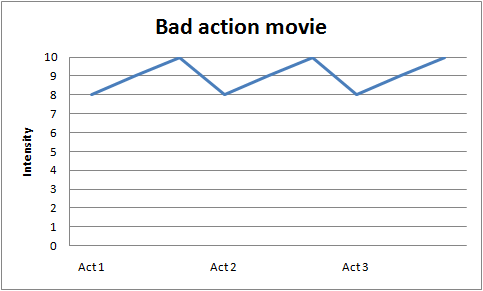
People want a thrilling ride? The Michael Bay School of Storytelling says OK, let’s blow their minds with the most intense story ever. Except when everything is dialed up to 11, the audience goes numb.
Here’s the script for every TRANSFORMER movie ever made. Act 1: Robots fighting! People running! Explosions! Act 2: Robots fighting! People running! Explosions! Act 3: Robots fighting! People running! Explosions!
You see the same problems with bad action movies starring Chuck Norris, Stallone and Schwarzenegger. If it’s exciting to watch the hero take on five bad guys on top of a roof, then it must be twice as awesome to have him dismember 10 thugs with a chainsaw in Act 2 and three times as cool to torch 20 thugs with a flamethrower in Act 3. Except it’s not.
It’s not much different with the typical Boring and Pretentious Literary Novel, which starts out wallowing in misery and angst in Act 1, moves on to more misery and angst in Act 2 and ends with, just for variety, an extra dose of misery and angst for Act 3.
Technically, the insanely rich hero does go on a journey. He goes to the country club. He goes to dinner. He goes to a polo game where he sneaks a rendezvous with his mistress, who he secretly despises.
The other kind of Boring and Pretentious Literary Novel features a noble poor person, who suffers even more than the rich schmuck, and yes, he also technically goes on a journey, though going from one cardboard box in a bad section of Skid Row three blocks down to a rattier cardboard box WITH HOLES IN IT in an even sketchier part of Skid Row isn’t much of a trip for the audience.
A story like this isn’t a thrilling roller coaster. It’s a slow slog on the Train of Misery.
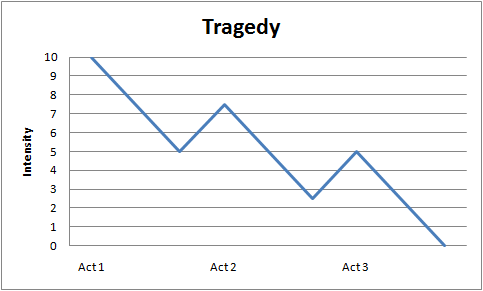
This is why tragedies work. Inherently, they are a fast and exciting ride, because you start at the very top, with a king or president or otherwise Important Person Who Has It All.
Then, because they can’t resist temptation, or otherwise succumb to hubris and stupidity, they plummet from the top to the bottom. Not that they don’t fight back. They try. They pull out of the slide a couple times, and you think they might make it until their inner demons get the best of them.
That is exciting. You’re letting the audience peek into a different, secret world – the Land of the Rich and Famous – and bringing one of the exalted few down to earth. Who doesn’t want to watch that, or read that?
Reporters make a living doing this. Greek playwrights were doing it 2.94 bazillion years ago. Novelists and screenwriters are still doing tragedies, and will be doing them until the sun turns into a red giant and fries the earth.
The reverse story, Underdog, is so simple and well-known that I won’t make a silly chart for it, because I have faith in you.
I believe, deep in my soul, that you have seen ROCKY once or twice, and watched THE KARATE KID many times, because that movie still rocks to this day despite the lame remake starring Will Smith’s kid, which didn’t involve karate at all, because IT WAS IN CHINA and was about kung fu, not karate. Though I do love Jackie Chan.
Unlike the Bad Action Movie, the hero in an Underdog plot doesn’t start out as some insanely skilled and handsome muffin of stud who, if armed with a folding toothbrush, can take on 43 bad guys. Driving tanks.
Rocky starts out as a washed up boxer, a loser. Ralph Macchio starts out as a skinny kid who gets his butt kicked by local bullies 25 hours a day.
Rocky and Ralph go on real journeys, from rock bottom to the top. Ralph goes from getting beat up by the bullies to beating the leader of the bullies in an honorable way, and having his foe shake his hand. He gains their respect. He suffers and sacrifices in order to change and grow. Also, Mr. Miyagi is the Man.
ROCKY has a more interesting plot, and the script won a freaking Oscar because of it. I kid you not: Sylvester Stallone, Mr. B Movie, started out by winning an Oscar for screenwriting. That is the only thing in the world he has in common with Matt Damon.
The end of Rocky isn’t your typical action movie, which features the hero (a) impaling the Villain of the Week, (b) throwing the Villain of the Week into a bottomless pit or (c) watching the Villain of the Week get impaled after he falls down the bottomless pit.
Rocky ends without a victory at all. He doesn’t beat Apollo Creed, despite all his sweat and blood.
He battles Apollo to basically a draw, and for him, that’s a huge moral victory. He has grown. He has changed. And when he gets the girl, it’s not perfunctory movie nonsense, the typical, “Oh yeah, it’s the end, so the hero needs to kiss the girl after he says some clever one-liner.” You care about this schlub getting the girl, even if you didn’t care one bit for TANGO AND CASH.
Sidenote: I did enjoy DEMOLITION MAN, mostly because Sandra Bullock was awesomesauce, Wesley Snipes was believably insane and they made it so after the apocalypse or whatever, every restaurant was Taco Bell.
To whoever wrote that script, I salute you.
The lesson here: no matter what you write, figure out the ending, and that determines the beginning.
If you have a down ending, you need an up beginning. Otherwise, you’re not taking the audience on any kind of ride.
If you have an up ending, you better have a down beginning. The lower, the better.
ROCKY and THE KARATE KID are minor examples.
Let’s go big. The billion-dollar stories follow this formula: STAR WARS, the Harry Potter movies and THE LORD OF THE RINGS are the three biggest stories on this planet, spanning many movies, countless spin-off books and enough merchandise to sink the continent of Australia.
George Lucas and J.K. Rowling have more money than God — end of debate.
All three of those stories start down. Way down. The evil emperor is gaining power. Harry Potter is an orphan because Voldemort killed his parents, and now he’s coming for Harry the Potter — and meanwhile, this big glowing eye on top of a volcano controls all sorts of trolls and scary dudes in hoods who ride black horses of the apocalypse. Our only hope is a tiny man with hairy bare feet and a magic ring whose mighty magic power seems to only turn him invisible and really grumpy.
Sidenote: while in Maui, I read the preface to the introduction to the liner notes for LORD OF THE RINGS, and around page 83, after the index of Elvish words and an anthropological study of Hobbit culture, I was still waiting for the actual story to begin. I did not throw the book across the room, because there were no men in kilts in it that I could detect, but I did lay it down gently and look hard for a hollowed-out pineapple full of alcohols.
Now, I’m not saying all stories are either comedies (up ending) or tragedies (down ending). That’s simplifying things way too much.
For example, dramas and sitcoms are the most common things on TV, right? And they are completely the opposite of what you expect, when you drill down into the story structure of dramas and sitcoms.
Hear me now and believe me later in the week: dramas are not tragedies. Dramas end up.
LAW AND ORDER is probably the most famous drama, since at least five cable channels play nothing other than reruns of LAW AND ORDER, LAW AND ORDER: CSI, LAW AND ORDER: LA, LAW AND ORDER: SPECIAL VICTIMS UNIT, LAW AND ORDER: SOME FIELD IN NEBRASKA and, best of all, LAW AND ORDER: BRITAIN, which I threw in here at the end as a sneaky segue allowing me to play The Best Video On the Planet.
Yes, dramas are about horrible things like murder and rape and war.
Except what they’re really about are heroic people who swim in the muck and chaos caused by idiots and greed. Dramas really say, “Despite how bad things are, there are people who’ll try to make things right.”
That doesn’t mean they succeed every time. About one out of twenty times, LAW AND ORDER lets the bad guy get away with it, and yes, it seems like one out of three times, but if you’re reading this, you’re a writer, and bad at math, and you’re not going to go back and watch all 4,398 episodes to do a tally. So I could make stuff up all day.
Comedies don’t always have down endings, per se – but they are NOT happy.
Comedies are about how absurd, hopeless and screwed up things are.
Specifically, comedies target an institution.
Sitcoms usually go after marriage and family life, usually middle-class suburban families.
M*A*S*H was an indictment of war.
ANIMAL HOUSE lampooned frats and college life.
Comedies have mixed endings. It’s OK for the hero to get what he’s after – but only in an absurd way. His best efforts to achieve his goal always backfire. Things don’t happen like they should. It’s screwball.
The other kind of mixed ending is ironic. The hero gets what he wants, but decides he doesn’t truly want it. He finds the king’s treasure after slaying the dragon and decides he doesn’t want all that money, that he’d rather go back home and be a simple farmer. That sort of thing. ROCKY is a bit of an ironic ending. He doesn’t win the fight. He wins other things: self-respect, a future, a girlfriend. Then in the sequels it gets all conventional and boring, though Mister T, for a brief moment in time, before he sold out and joined the A-Team, was a scary, scary man.
Bonus material for story nerds and intellectual types
There is another type of ending, Random Nonsense, which is more common in indie films with subtitles. Think black and white. Think French existentialism.
Here’s an example: the hero is a downtrodden detective, investigating a killer far smarter than he will ever be. His only son hates him, his boss wants to fire him and wife just left him, though he starts up a flirtatious thing with a girl who works at his local café. Just as he starts catching some breaks – he’s walking the café girl home from their first date when he spots the killer running from an alley, the scene of his latest crime – he’s hit by a drunk driver. The End.
Random Nonsense has a message, too, just like tragedies are about hubris, dramas are about the human spirit overcoming adversity and comedies are about how absurd life is. Random Nonsense is trying to make a point about existentialism and chaos, that we don’t really control events. Things just happen.
This may make for deep conversations in your Philosophy 301 class, and you may feel all intellectual talking about what the movie really meant at 3 a.m. at Denny’s while you eat sides of fries and drink bottomless cups of coffee while smoking cigarettes bummed from your roommate, the sociology major. Sociology!
But it makes for a terrible story. There’s no roller coaster. That’s why the audience for these kinds of stories fits on a postage stamp.
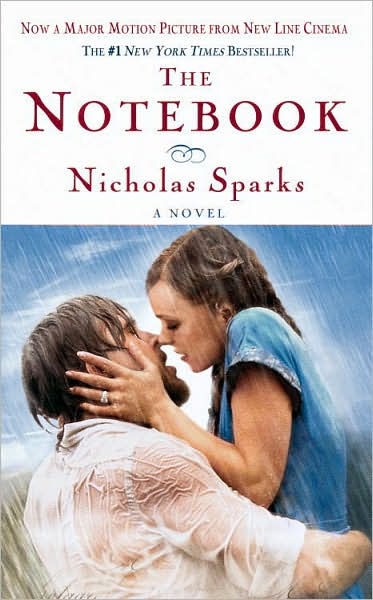
(The title makes sense, since the story turns on an actual notebook.)
by Nicholas Sparks
Chapter One: Miracles
Who am I? And how,I wonder, will this story end?
The sun has come up and I am sitting by a window that is foggy with the breath of a life gone by. (Melodramatic and clunky.) I’m a sight this morning: two shirts, heavy pants, a scarf wrapped twice around my neck and tucked into a thick sweater knitted by my daughter thirty birthdays ago. The thermostat in my room is set as high as it will go, and a smaller space heater sits directly behind me, clicking and groaning and spewing hot air like a fairytale dragon — and still my body shivers with a cold that will never go away, a cold that has been eighty years in the making. Eighty years. , I think sometimes, and dDespite my own acceptance of my age, it still amazes me that I haven’t been warm since George Bush was president. I wonder if this iIs this how it is for everyone my age?
My life? It isn’t easy to explain. It has Not been the rip-roaring spectacular I fancied it would be, but neither have I burrowed around with the gophers. I suppose it has most resembled a blue-chip stock:
(end of page 1)
THE NOTEBOOK by Nicholas Sparks. A book that belongs next to Hemingway. A movie that should have won many, many more Oscars, yes? Nicholas Sparks was ROBBED.
Notes from the Red Pen of Doom
The biggest problem isn’t the line editing, though it’s clunky. While clearly first-person P.O.V., he keeps inserting needless attributions like “I wonder” and “I think.” Here’s the monster problem: 90 percent of page one is spent telling the reader — repeatedly — that the first-person narrator is (a) 80 years old and (b) seriously obsessed with talking about how cold it is.
Space on page one is precious. It’s for raising narrative questions that won’t be answered for 400 pages. Compelling questions.
Life or death. Together or alone. Freedom or slavery.
I can imagine a story where being 80 years old and cold is the problem. Maybe a doctor is headed to a remote Alaskan village when his snowmobile breaks down. He’s the only doctor within 200 miles, the only hope for a mother who’s in the middle of a labor gone wrong. Now you’ve got public stakes and private stakes. If he doesn’t strap on snowshoes and get past hungry wolves and polar bears, he’ll die, and the mom in labor might die, and her baby might die — and they’ll be no doctor out in the bush for a lot of people.
So: a cold old man becoming warm can matter a lot in a story.
Not in this story. On this page one, it’s boring.
Having an 80-year-old hero can make this hard. Go back to the first line: “And, I wonder, how will this story end?” Not a lot of suspense there. It’s hard having high stakes when the protag is already looking back on his life, as if it’s already over.
This is why most novels and movies feature younger protags. The more you have to lose, the higher the stakes.
It’s why you have movies like INDIANA JONES AND THE TEMPLE OF DOOM, not INDIANA JONES AND THE CONTENTIOUS BINGO GAME.
You certainly can have great stories with older heroes. They just have to DO something.
Anthony Hopkins did a great job with Hannibal Lecter, an active and charming killer. Old, yes, but he didn’t act like Sparks’ old man. There is no book called HANNIBAL LECTER AND THE SPACE HEATER.
So, back to THE NOTEBOOK: the beginning should set up the ending. Does the climax hinge on whether our 80-year-old hero puts on another ugly Christmas sweater and finally stops kvetching about being cold? No.
It’s about whether or not he’s alone or together. Whether his wife remembers him or not.
So the first line is on track. Almost. Not “Who am I?” but “Who are you?” And that question should come out of the mouth of the wife.
Or, if Sparks wanted some misdirection, have that question come from somebody else. But since the end is about togetherness, about love and romance and faithfulness, the first chapter should be full of loneliness. Not cold. Not sweaters and scarves and space heaters.
Talk about how friends move, how coworkers get different jobs, kids grow up and stop calling. Spend the first page on loneliness, if you want the ending to be about togetherness.
Had I not read the back cover, and didn’t know the climax of this story, reading page one would not motivate me to read more.
If the narrator complains a lot, and doesn’t think his own life is exciting, why the hell would I keep reading about him? I will now praise the One Known as the Spork: the ending of this book, as a plot, isn’t bad. Page one doesn’t do it justice.
Verdict: Take out the Nine and shoot it full of holes, then burn whatever’s left and start over with a fresh sheet of paper.
I don’t care who you are — you need an editor. And you always will.
In fact, the more successful you are as a writer, the more editing you’ll need.
Here’s why:
The time crunch.
You’ll never have as much time as you did when you were struggling to break in.
A journalism student can get away with writing and polishing a major story for weeks or months.
Once you get a job as a reporter at The Willapa Valley Shopper, the first step on your path to The New York Times, you’ve got to crank out two stories a day, every day.
I used to write three or four stories before 10 a.m. every deadline day at papers of news. You get used to it. But it’s a shock at first. The time crunch is real. Which leads to problem No. 2.
The sophomore slump
Think about famous debut novelists who had a tremendous first book, and when you hopped inside your automobile and raced to Borders — back when Borders existed, and sold these things we called “books” — to buy their second novel on release day, it made you weep like a Charlie Sheen who’s run fresh out of tequila and tiger blood because that second book sucked like Electrolux.
Why does this happen?
Because debut novelists spend years polishing that first novel until it shines like a diamond made of words.
And when a debut novelist finally makes it, and has a three-book contract with Random House to crank out a book a year, it’s a struggle. They aren’t used to writing that good that fast.
You only need editing three times: when you start out, when you’re middling and when you’re a busy pro
Some people who write for a living — and didn’t spend time at newspapers or magazines getting edited every day — sometimes think success means they’re infallible. Their words are perfect, becausee otherwise why wouldn’t they be famous? Or they are richer than God and simply don’t care.
And even great writers sometimes just write long. They’re in a rush. They have to crank out the product and move on to the next thing.
Stephen King, who I adore, writes beautiful little short stories and novellas while cranking out novels that clock in at 800 or 1,000 pages.
I could close my eyes, reach onto my bookshelf in my secret lair and grab five King novels that weigh more than most second-graders. Some of these novels are fine being that long. Others are overloaded semis with a sleek sports car of a novel lurking inside and waiting to burst out.
Even literary snobs now admit that King’s novels — even the giant ones — are good. But you could chop 400 or 500 pages from any of his monstrously overlong novels and make them even better.
Think about J.K. Rowling, and how with every paycheck and movie deal, the next book in the Harry Potter series doubled in size, until Boeing had to invent a new freight version of the 747 just to deliver the last novel so we could find out why Hermione winds up with What’s-His-Face, the redheaded doofus sidekick, instead of Harry, her true love.
Get the right editor
Most people get the wrong kind of editor.
You don’t need an editor for nancypants nonsense like dangling modifiers and misplaced commas. That’s a proof-reader, not an editor. Any semi-literate fool can proof-read a document. Microsoft Word can take a whack at that.
The editor you need is (a) a professional who (b) edits or writes for a living in (c) the specific type of writing you want to do FOR MONIES.
Any old professional will NOT do
A roomful of reporters and editors at a newspaper is a good example. They all write and edit for a living, and 99 percent of them want to write the Great American Novel — but 99 percent of the time, they fail.
Because it’s not their specialty.
Hear me now and believe me later in the week: Writing short non-fiction newspaper stories is far, far different than writing 400-page novels. The structure reporters use for news stories — the inverted pyramid — is exactly backwards for fiction.
Now, there are exceptions. Opinion page editors and columnists could make the transition to speechwriters, and vice-versa. The structures and techniques for persuasion on the page are quite similar to the ones used in speech and rhetoric.
But if you want to make a switch, the fact that you already write for monies doesn’t guarantee anything.
It’s like professional sports. The fact that you play shooting guard for the Bulls doesn’t mean can play left field for the White Sox.
That’s exactly what Michael Jordan tried to do. This is the greatest basketball player of all time. He’d won enough NBA championships. He’d climbed every basketball mountain. He was one of the best athletes on the planet.
So when he decided to try playing major league baseball, it wasn’t a silly dream.
And he did it right. He didn’t try to muscle his way onto the White Sox starting lineup by having lunch with the owner. He trained with baseball coaches and played for the minor league Birmingham Barons, batting .202 with 3 home runs, 51 runs-batted-in and 30 stolen bases.
Batting .202 isn’t good enough. Jordan went back to basketball.
When you try to cross-over, you’ve got to be just as careful and serious and hard-working as if you’re trying to break in for the first time.
Your editor needs to do it for monies
If you really want to pay the mortgage writing full time, you’ve got to go all in with an editor who wields their Red Pen of Doom for monies, too.
Not your husband or wife or best friend. Not a coworker or a buddy who writes something sort of close to what you’re doing, even if they do it full time.
It’s an achy breaky big mistakey to use a non-pro as your editor. Friends and family may be great readers of books but horrible at editing. Either way, you’ll take what they say far too personally.
Dreams will be crushed. Friendships will fray. Marriages will sour. DO NOT DO THIS.
Even if you’re friends with somebody who writes or edits for a living, and they say sure, they’ll edit you as a favor, that might be OK for one small piece. A short story. Your first shot at a stump speech. But not anything of length. And not as a habit. When you start cashing checks for what you write, stop being a freeloader. Set your friend free.
Better yet, don’t lean on the friend too much in the first place. Because they’re your friend. They won’t tell you if you truly stink up the joint.
Your editor must be in your specific field
It’d be silly to use a professional writer or editor in a different field.
They won’t know the conventions and quirks of another type of writing. They’ll make you feel confident that your text is perfect when it has some formatting flaw or deadly structural boo-boo that neither one of you spotted, because your buddy writes screenplays and you’re doing a novel about elves with lightsabers who ride dragons.
Find an editor who does exactly what you want to do, whether that’s writing novels, newspaper stories, magazine features, non-fiction books or speechwriting for the politicians.
Now, the natural response to this is, “Professional editors cost money, and I am a poor, starving writer with six kids who lives in a cardboard shack and feeds my family Top Ramen, raw, like popcorn, because we can’t afford a pot to boil the stuff in, so there’s no way I can pay some fancy editor to bleed on my words, words that I carefully put on this paper towel in my own blood because Bic pens and Underwood typewriters and Toshiba laptops are out of my budget, unless I spend my every weekend robbing the local 7-Eleven, which for some reason hates AP style and won’t go with Seven-11.”
To this I say: suck it up.
Professional editors don’t cost THAT much. Scrape together $100 or $200 and have a pro look at the first chunk of whatever you’re writing. Believe me, they don’t need to read all 400 pages to know what your strengths and weaknesses are. Though it’s a lie that you can figure that out after five pages. It only takes one page, to be honest.
If you were trying to cut hair for a living, it’d cost you more than a couple hundred bucks to get a license. A writing conference plus three days in a hotel can run you $1k, and that’s if you NEVER EAT ANYTHING and completely abstain from bourbon. So suck it up and find somebody good to look at your first bit, long before you write the entire shebang.
Because a great editor is priceless.
Plug: Theresa the Stevens, who reads this silly blog and makes witty comments, is a professional editor and former literary agent who also edits for publishers.
Theresa the Stevens is also kind, because she does a special deal where she wields her wicked pen on the first 75 pages of a novel PLUS the synopsis PLUS the query letter.
Think about how long it takes a human being to write and rewrite and rewrite a novel and synopsis and query letter. Hundreds of hours. Bazillions. Think about paying yourself minimum wage for those hours.
Then close your eyes and imagine there’s a glowing mystical being who, for the price of the complete first and second seasons of The Jersey Shore on DVD, could save yourself hundreds of more hours of pain while making you (a) seem incredibly brilliant and (b) have ten times the shot of not only getting the thing published, but making decent money at it.
Is that worth a couple hundred bucks?
Cowboy up. If you really want to write for a living, and not toy with it as a hobby, find yourself the best professional editor possible. And pay them in something other than thank you’s and cups of coffee.



 The Red Pen of Doom