OBLIVION swings for the fences and misses

tinseltown tuesday meme morpheous

Hear me now and believe me later in the week: OBLIVION is an interesting and beautiful movie that could have been classic.

Why did it flop?

Let’s look at the prime suspects:

5) Tom Cruise fatigue

This is an easy target. Cruise has gone from “Biggest Movie Star on the Planet” to “Incredibly Excited Actor Jumping on Oprah’s Couch” to “Scientologist Who Gets Divorced a Lot.”

As a huge fan of Lee Child’s Reacher novels, I have to say that Reacher is something like 6’5, 250, blond and quietly sarcastic, while Cruise is short, light, dark-haired and loudly cocky.

HOWEVER: I will give the man his due, because Cruise did a fine job of acting in this movie. The average sci-fi apocalypse movie would have a hot new 20-something actor mumble his way through the thing looking stoned while trying to seem macho. Cruise was an upgrade from the typical New Action Hunk.

You could’ve put Matt Damon, Ryan Gosling or George Clooney in this sucker and it wouldn’t solve the problem. Cruise gets a pass.


4) Double mumbo-jumbo

Screenwriter Blake Snyder (may he rest in peace) says in SAVE THE CAT that audiences will buy one crazy piece of magic or sci-fi. They’ll buy a giant robot assassins with heavy Austrian accents or they’ll buy witches with real magic powers–but they won’t suspend disbelief to see a movie featuring magical witches battling a robot assassin.

Audiences might buy sci-fi techno stuff mixed in with a little magic if you distract them with lightsabers and don’t try to over-explain the magical stuff. But if you start talking like an idiot about the magic being caused by science, say something insane like “midi-chloridians,” they will turn on you, and hate you for ruining things forever.

OBLIVION throws all kinds of stuff in here: an apocalypse, an alien invasion, evil robot drones, massive human cloning, frozen astronauts who are 85 years old or whatever plus and a serious fetish for spiffy helicopter-things.

All of this, however, is under the happy umbrella of technology. Even the craziest stuff seems plausible given the setting of the movie. Also: Cruise should spend his salary from this movie to make a working replica of his helicopter-jet thing, which I’m gonna call the Tom-mobile.


3) Insanely confusing plot

This is a good suspect. While the movie technically avoid the double mumbo-jumbo trap because it’s all science, there are enough plot threads to weave a throw rug.

We’ve got dream sequences in black-and-white, Morgan Freeman channeling Morpheus by way of Mad Max, some Minority Report flavorings and a dozen other subplots thrown into the blender.

Even so, the director holds it together. You understand it. So the confusing parts of the plot aren’t what keeps this movie from being an instant classic.


2) Happy endings are for suckers

The ending is happy, which fanboys never like. Tom Cruise Clone #1 and the dying Morgan Freeman blow themselves up in the mothership of the aliens, saving the world, and later we see Tom Cruise Clone # 2 finding his wife and baby daughter.

Reunited and it feels so good. Except it doesn’t feel great.


1) The villain

There are three parts to a villain, which I’m making that up right now.

Let’s call it Guy’s First Law of Villainy, which states villains must be motivated, fascinating and scary.

Motivated: If your villain is simply doing bad things for no reason, it’s nonsensical.

This is a huge problem with OBLIVION, since these aliens invading Earth go through all kinds of trouble to (a) find Earth in the first place, (b) travel a bazillion light years to get to our precious rock orbiting the sun, (c) wage a long and brutal war to gain control of the planet so they can … (d) suck up all the water in our oceans to create nuclear fusion or whatever.

Hold up.

Water is no big flipping deal. Hydrogen is the most common element in the universe. Oxygen isn’t exactly rare. You can find water on asteroids, comets and planets. There’s some moon orbiting Jupiter or Saturn that we think is a giant ball of water with a frozen crust of ice on top.

I don’t buy aliens going through massive amounts of trouble to steal our water. Sci-fi needs to make sense, because sci-fi fans are smart people who care about this stuff. So this is a huge problem.

Fascinating and scary:

If you’re going to have an alien invasion movie, don’t forget the aliens.

OBLIVION has no aliens. I kid you not.

It has all kinds of drones, which look like angry flying cousins of Pac Man, yet tiny little drones aren’t scary of fascinating. Give us big, threatening bad guys, not cute little ones.

Who is the ultimate villain of the movie? A big faceless computer.

That’s not fascinating or scary. At all.

To make this movie work, we needed amazing aliens, the kind that are incredibly fun to watch. ALIEN got this right, as did ALIENS.

PROMETHEUS forgot about this rule, and therefore wasted the gross domestic product of Paraguay on Michael Fassbender and special effects for no good reason.

This is the reason OBLIVION failed as an alien invasion classic: no aliens. You can’t expect audiences to go wild for a boring, faceless computer as the bad guy.

It’s the same trap that doomed THE MATRIX sequels. We never saw Neo battle the ultimate bad guy in charge of the machines. He died playing anti-virus cleaner for the machine lords, which put the B in Boring.

The Red Pen of Doom whips SWITCH by Camryn Rhys

SWITCH

by Camryn Rhys

Alexandra popped a steaming potsticker into her mouth and bit down. The crisp bottom skin gave way and thick, salty pork stuffing spilled (“thick, salty pork stuffing spilled” is a whole lotta modifiers and alliteration) salty pork spilled onto her tongue. She waited for the spicy heat of the sriracha to start burning up the back of her throat, but it didn’t come. Chewing, chewing, chewing, and no heat. Without a thought, she plucked the skillet from the heat and dumped the rest of the plump, white puffs into the trash. with a sliding sizzle (More alliteration brought to you by the letter S, which is too much for the same paragraph)

She snapped (snapped is bitchy) turned around, coming face to face with the new prep cook, Marcus, who waited on her response. His brown eyes round (I believe most eyes are round instead of square ), he stared back in unblinking silence. Lexi (Hold up: is this a new character, or the same one? Let’s pick a first name for the heroine and stick with it) slammed the skillet onto a cold burner and sucked in what she hoped was a menacing breath.

“How much hot sauce did you use? Precisely.”

Marcus stammered,. He picked up the wrinkled, hand-scribbled (Do people scribble with toes or put notecards in their laser printer?) notecard, and skimmed it. (Three commas in that little sentence is maybe three commas too many. Two short sentence with no commas is better.) “I followed the recipe.”

“You eyeballed it.” She drew closer to him, suddenly aware of how much she towered over his willowy frame. (Wait, is this a little kid, a student? I did not sign up to read LOLITA meets HELL’S KITCHEN) A quick twinge (Of what, chest pain?) almost made her back off, but Fiona’s words rang in her ears: hHow can you teach these kids if you don’t come down on them? How like Fiona (Who is Fiona?) to encourage beating someone into submission. Channel your inner Domme, honey. Easier said than done.

Notes from the Red Pen of Doom

There’s a deep connection between food and sensuality, so even a giant Swede like me can understand where Camryn is going with the whole foodie-romance thing. While Camryn the Rhys is a great writer and a good friend, I will resist the urge to go easy on her. She’s the female version of Batman — she can take it.

It’s well done. Nice mix of action, description and dialogue. Emotions also come through clearly.

Camryn can clearly write.

I like the idea of food and romance. Great. And the setup of this heroine — Alexandra or Lexi, whichever name you want to go with — is fine for a romance.

Little things threw me off, especially the kid thing. Do I want to picture a towering teacher being all mean to a scared little student? No. Lexi doesn’t seem sympathetic.

We need to see her save the cat, as Blake Snyder says, before we see her be this snappy and unpleasant.

But forget the little things. Let’s think about the big things for a bit.

Page one is the beginning. How is this character going to change on the page that says THE END?

My wild guess is that she’ll still be tough, if not dominant. That she won’t change that core part of her personality.

Maybe I’m wrong. Maybe she flips, and becomes kind in the kitchen and elsewhere after realizing that she put thousands of high school students and ex-lovers in therapy. Maybe she becomes a nun in Tibet after reading a biography of Mother Theresa.

I do know this: whatever genre the story may be, the best stories make characters take long, interesting journeys. Not as tourists snapping photos. As people.

For any romance, the ending is up, right? Two lovers get together.

So for a big journey, the hero or heroine should be alone and unloved on page 1.

And if we’re doing a foodie-romance, the end has the hero or heroine eating delicious food with a yummy love affair cooking on the front burner. Let’s think of the biggest possible journey: if the end is her being in control, in love and in touch with all her senses, then Page 1 should start with her being alone, afraid and out of touch with her senses.

So: I’d like to see this Lexi change and learn and grow. Is this a flat character that goes on a series of romps, or is there a real journey? Page one is where that journey starts.

What if the person on Page 1 lost their sense of smell and taste in an accident, and had to rediscover cooking and kissing and all of that? Hmm. That would be a big journey, wouldn’t it?

The Verdict: Good writer, good writing. I worry about the head fake toward LOLITA meets HELL’S KITCHEN, and I want to see Alexandra/Lexi/Fiona or whoever actually change and grow from Page 1 to THE END.

Writing secret: Light as air, strong as whiskey, cheap as dirt

Those nine words are magic.

And those words help sell 5.842 gazillion miles of barbed wire back in the late 1800s, when the West was still wild and there weren’t handy trees or stones to make fences.

Light as air, strong as whiskey, cheap as dirt – I’ll remember that for days. Forever, maybe.

It’s honed down to perfection. Nine words, and not a one is wasted.

barbed wire
A little strand of steel with a twist and BOOM, you are golden. Photo by Guy Bergstrom.

In the five seconds it takes to hear those words, or read them, you’re sold.

Writers struggle with those first five seconds.

  • What’s the best way for a reporter to convince the city editor put a story on A1 instead of buried next to the obituaries on B15?
  • How can you sum up a 100,000 novel in a single page – or a single sentence?
  • When a magazine editor is buried with pitches, how does yours stand out from the slush pile?
  • What should a screenwriter say about his script while riding in an elevator for 30 seconds with Steven Spielberg?

Science shows us secrets

Here comes the science: people make up their mind about you – or your writing – in the first five seconds.

Viscerally. Unconsciously.

Their little reptile brains see your face or your words and make a split decision.

Later on, our oversized frontal lobes justify that snap judgment.

It’s not a rational thing. I’ve seen the science. Go read BLINK by Malcolm Gladwell. (Go on, read it. I’ll be over here, drinking Belgian ale.)

Different researchers testing for different things found the same result.

  • The first five seconds of a job interview determines whether you get it
  • The first five ticks of the clock during a professor’s first lecture of the semester, with the sound turned off, can be used to predict exactly how students will rate that professor.
  • A quick glance – less than – at two candidate mug shots will predict who will win the race. This works with adults or five-year-olds. Mug shots. No names. No parties. The shape of the face.

This last result fascinated me. Researchers had people glance at those mugs, then rate the candidates on attractiveness, intelligence, competence and whatnot.

They thought attractiveness would matter.Nope. They thought race and sex and age would matter. Nope.

Competence was the only thing related to the eventual winner.

This makes sense. If somebody’s attacking your village, you don’t pick Nerdy McNerdy as the leader of the defense. Brains without brawn won’t work.

You don’t pick Miss America to lead the troops into battle, either, because she’ll simply be nice to look at while you all get slaughterd.

And you don’t pick Mr. Neanderthal, tough but stupid.

Who do you want? Somebody who looks competent – tough but smart. A Clint Eastwood, somebody who looked like he knew what the hell he was doing.

Hold it out and squint

Alright, you’re already thinking of the Greatest Squinty Eyed Tough Guy in Movies, so remember this rule: Hold it out and squint.

Hold out your first page of your text and squint.

Is it a sea of gray?

Is there a photo or graphic? Are all the paragraphs the same length? Do you have any subheads or anything to break up the text?

Now, this doesn’t work for certain things. You can’t have photos and whatnot in screenplays or manuscripts.

Later on, though, it will make or break you.

When you go to rent a movie (yes, I know Blockbuster is dead to you and it’s all Netflix now, so pretend you’re clicking away with Mr. Mouse), you make decisions in far less than five seconds. You glance at the front cover and move on.

Same thing with books. Glance and move. Glance and move.

Maybe you pick a book up and read the text. What makes you pick it up? Images first. Maybe a good title. Glance and move.

That’s why the Squint Test is so important.

Think about movie posters with too much going on. When you squint, you don’t know what’s what.They’ve got the star and the co-star and seven different sidekicks in there, plus the villain and two random thugs. It’s a mess.

Less is more. Simple works best.

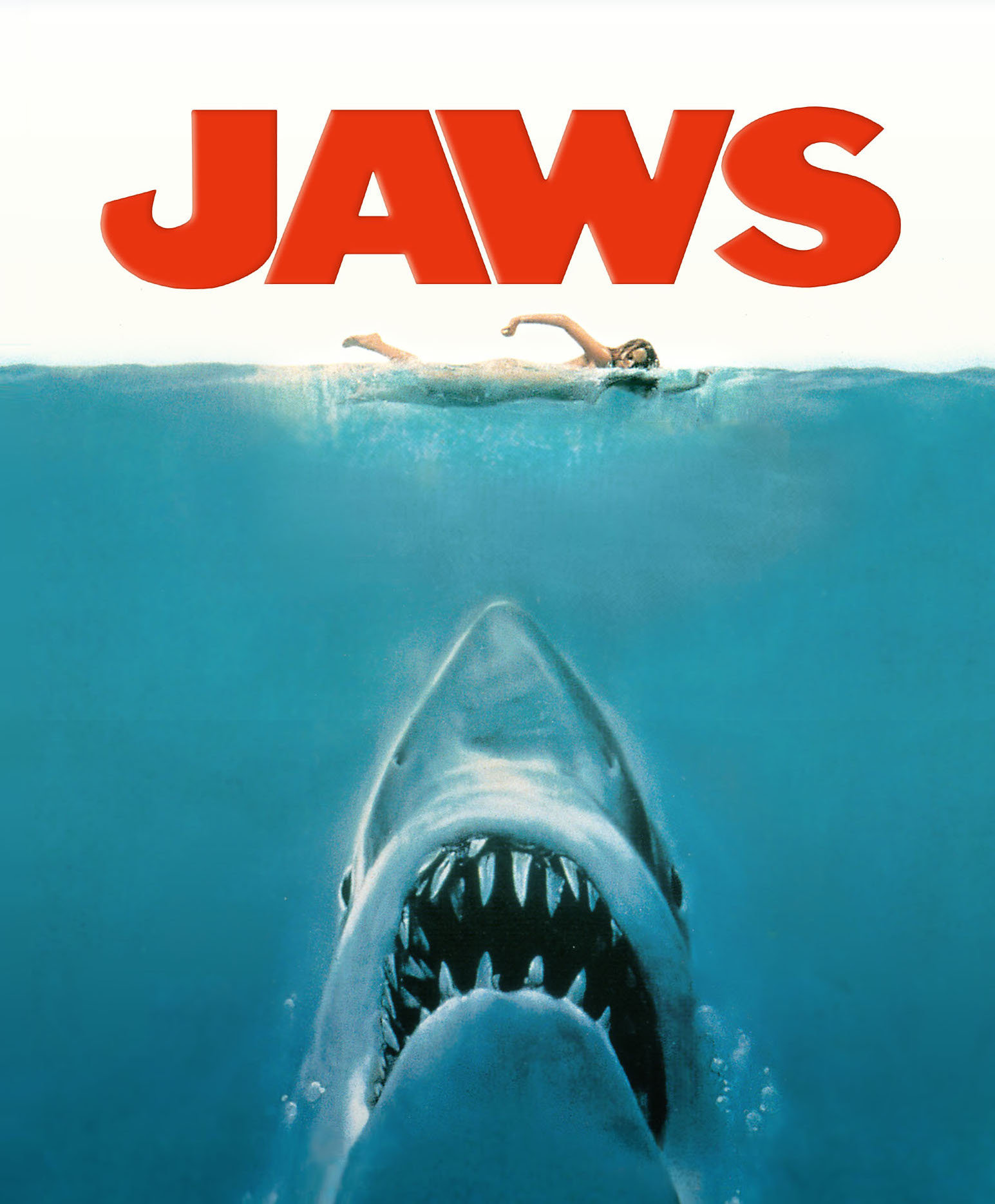
The poster for JAWS is perfect: a pretty young woman swimming along and a giant invincible shark roaring out of the depths of the ocean. It doesn’t get any more primal than that. We need the shark and a pretty girl. That’s it.

jaws movie poster
The JAWS movie poster is classic, and will always be classic, because it is simple and brutal and seven separate types of awesome. Steven the Spielberg, stick with this movie thing — you have talent.

Putting this knowledge to evil use

Our conscious brains aren’t really running the show. We’re like a mouse riding on top of an elephant, sometimes biting the elephants ear to go left or right.

How can we writers use that knowledge?

Tap into the reptile part of our brains. Go for the gut.

Blake Snyder hit this idea with his Hammer of Truth in SAVE THE CAT when he demolished the conventional wisdom of genres.

JAWS isn’t a horror movie. ALIEN isn’t a sci-fi movie. FATAL ATTRACTION isn’t a domestic drama. All three are the same story, the same primal threat: there’s a monster in the house. You can’t get away. Either you fight it and kill it, or it eats you.

Hollywood screenwriters are masters of the first five seconds. Fire up the google and check out “loglines” to see how they sum up a movie in a sentence. They make writers of novels look like silly chatterboxes. Think you’re being hip with a one-page synopsis instead of five pages? Hollywood laughs at a full page of text. One sentence, buddy.

Can you do it in a sentence?

How about nine words?

Copywriters are also world-class at those first five seconds. Visit copyblogger and soak up their wisdom. DO IT NOW.

The best five-second pitches — whether it’s a headline for a newspaper story, a poster for a movie or a pitch for a novel — tap into those primal needs and instincts that Blake Snyder talks about.

Survival vs. death. Love vs. loss.

You know what the stakes are. Instantly. Not 30 seconds into it. Not 15 seconds after learning about the when and where and who. You see what’s at stake, right away.

Here are four words: COMET WILL DESTROY EARTH.

That’s a newspaper story everybody will read. Everybody. It’s a movie people saw twice (ARMAGEDDON and DEEP IMPACT).

Part of the secret seems to what’s missing: the hero. You don’t hear a damn thing about the hero after you’ve boiled it all down, do you? Screw the hero. Heroes are plain vanilla and boring. The best ones, the ones that hook us, talk about the bad guy: the alien, the shark, the comet. Hmm. Maybe there’s a reason for that. But that’s a post for another day.