This is a follow-up to my querying letter about a million-word fictional novel trilogy. You can read that letter anywhere on the planet by firing up AOL and clicking on this World Wide Web thingy here: The Mother of All Query Letters.
Maybe you haven’t gotten to reading it yet, seeing how you’re busy selling my trilogy to Warner Brothers for one million dollars (I figure a dollar a word is fair). My niece Daisy has a library card and her nose in all kinds of books, not just Twilight, and when I told her about my fictional novel, she said I need to send every agent and editor in Manhattan a synopsis.
Now, “synopsis” sounded Latin and possibly dirty to me, so I asked whether that word involved sins, and Daisy said, “That’s a good way to look at it. List all the sins you commit in that book of yours.”
So here’s my list of the sinful things happening in each book of the trilogy, with each novel coming in at 333,333 and 1/3rd words apiece.
Book 1: I KNOW WHERE THE BODIES ARE BURIED, DARTH SAREK OF VULCAN
A grave-digger falls into a grave and hits his skull on a fat hunk of rock, then wakes up on an alien planet to find he’s six inches taller and half-ninja, half-Jedi, half-Vulcan.
First off, he’s bound for alien slavery on a pirate ship, and I believe slavery to be a sin, despite what Uncle Will says about the War of Northern Aggression.
Second, he kills bushels of aliens, and killing is a sin, though he does it to win his freedom from slavery, so I figure those sins cancel each other out.
Third, our hero does have relations outside of marriage with an alien princess or three, plus an android on a planet run by robots and an evil super-magneto computer made by Bill Gates himself after he bought up an entire Best Buy and started soldering stuff together.
Book 2: LOST IN SPACE AND TIME WITH A GREEN LASER SWORD AND A PURPLE ALIEN PRINCESS
The robot king and his super computer can plug you in, like that Matrix or that Tron video game they had at the 7-Eleven on third street until some pansy replaced it with Ms. Pac Man.
The robot king makes our hero think he’s waking up in that grave, and that nothing in the first book really happened, kinda like that season of Dallas before J.R. got shot and such, and let me tell you, I’d shoot that man myself with my grandpa’s Colt and proudly do whatever time a judge handed down with the bang of his mighty gavel.
Back to the story. After learning kung fu and how to bend more spoons than Yuri Geller, the hero busts out of the fake holodeck world of the robots and uses his laser sword to cut Bill Gates and his super-magneto computer clean in half. Murder is a sin, but he says his prayers and gets forgiveness from his maker while the aliens rejoice in their freedom and put him in charge of their army of spaceships and purple alien princesses.
Book 3: MASTER OF OUTER SPACE,INNER PEACE AND DESTROYER OF SUNS
There’s peace in the galaxy with the hero running things, so he studies his Jedi and his Vulcan to learn the secrets of immortality, raises generation after generation of his young ones with the purple alien princess who’s his queen, and teaches the purple alien army how to be kung fu ninjas — but a new threat arises.
See, suns are alive. That’s right — they’re born, they live, they evolve and they die, with new baby suns arising from the dusts of their supernova. And they see themselves as gods, seeing how they create all the elements in the universe and provide all the heat and light and such. They’re mad as tarnation and they’re not gonna take it one second longer.
I see this third book as a tale of redemption, seeing how the hero starts out committing all kinds of sins in books one and two. Now he’s married and living right, unlike my second cousin Nellie, who’s on her fourth divorce and odds are she’ll hit number seven before we wheel her into the Willapa Valley Nursing Home.
Back to this book: Our hero flies right up to the face of the biggest, maddest, meanest sun and finds a way to communicate, but the solar gods are hell-bent on war and destruction, and they start frying alien planets like eggs on a hot grill with a fine sheet of lard already melted on top.
As a last act of sacrifice at the age of 984, the hero mind-melds with the suns and hypnotizes them into calmness by bringing them into his memories and dreams, which lands himself into a coma for a spell until I figure out the next trilogy of 1 million words, which I figure has to involve the only thing bigger, badder and more amazing than killer suns: black holes with father issues not even Dr. Phil can solve.
So, that’s a full-on synopsis of the first trilogy, with book one attached as an encrypted WordStar document and also available on 5.25″ floppies. Though like I said in that querying letter, I’m running out of those floppies, so make it snappy.
Sincerely,
Sensei George Lucas King
P.S. This is my new pen name, guaranteeing my trilogy sits smack dab next to all those books by Stephen King while appealing to fans of Star Wars and all those kung fu movies, which I figure covers just about every man still breathing, then you got the alien princess love story thing for the women. To write me checks, you’ll need my full legal name, though I’d prefer cash on account of some trouble with the IRS that started in 1997.
His hero, Reacher, is beloved by fans for having the brains of Sherlock Holmes and the body of Conan the Barbarian. The man never gets outsmarted and is invincible in a fight. Here’s the last post about these books: Secret recipe for any Lee Child novel
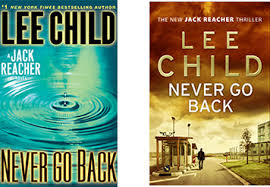
The latest Reacher book, NEVER GO BACK, slams smack-dab into the Superman problem. Because an invincible hero puts the B in Boring.
Did I enjoy the book? Yeah, it’s always fun to read about Reacher. With every new novel, though, Reacher struggles less and less to overcome the bad guys.
If the hero doesn’t sweat, the reader doesn’t worry. Or care.
Because I do care about Reacher and Lee Child, here are six ways to fix NEVER GO BACK.
Lee Child’s NEVER GO BACK. Buy two copies, one of each cover, because I say so.
1) Don’t simply remake THE ENEMY
The only other novel with Reacher in the Army was Child’s best book: THE ENEMY, a true mystery with all kinds of crazy twists and turns and a real sense of menace. Just like that book, the latest novel has big-shots in the Pentagon and such as the criminal masterminds, using other officers as their puppets.
That book was first-person and visceral. It put you in the head of Reacher and made you feel what he felt, see what he saw. I’ve happily read that book seven bazillion times.
NEVER GO BACK starts out feeling like that book, with the full force of the Pentagon and Homeland Security poised to squash Reacher … until he escapes them, easily and repeatedly.
THE ENEMY was amazing, and the ending isn’t a clear win. Reacher is demoted and leaves the service. This latest novel doesn’t hold a candle to that classic. Which proves that yeah, you should never go back.
2) Give Reacher a real daughter, not a fake one
What are the odds that the bad guys randomly picked a fake daughter for Reacher who looks like him, thinks like him and even talks like him?
I’ll tell you the odds: zero.
The fake daughter is an achy breaky big mistakey. It feels like Child planned on making the daughter real up to the end of the book, then decided nope, Reacher can’t have a teenage daughter, because that would tie him down in future books. So he turned her into a ruse.
If you’re gonna do it, do it.
3) One-sided beatings aren’t really fights
Fight scenes are a Reacher staple. A novel without Reacher getting blood on his elbows would be like a Jean Claude Van Damme movie without him doing the side splits and kicking a single guy in the face.
However: there’s a big difference between a fight and a beating. Every fight in NEVER GO BACK is a cake walk for Reacher, who doesn’t even break a sweat when he takes out two angry rednecks with both hands behind his back.
Give us a real fight. Let’s be realistic and let the bad guys land a punch for once.
This leads to Number 4.
4) Tough guy villains better be tough
In this book, there’s one thug we keep getting told is a giant muscle-freak with weird ears. A monster who looks like a match for Reacher.
So for hundreds of pages, you keep expecting the final battle between these two men to be epic. I was getting the popcorn out.
The fight between Reacher and this incredible hulk was over in about two seconds. Boring, and a huge let-down. Come on. That’s like showing us Darth Vader on screen for 90 minutes and Luke training with Yoda for 20 minutes only to have the two meet for the Greatest Lightsaber Battle of All Time … and have Luke cut Darth Daddy in half within two seconds. No.
The badder the bad guy, the longer the fight should last. Redneck idiots can get dispatched in a paragraph. Medium baddies should take a chapter. The boss villain should take a couple of chapters.
When every villain, big or small, goes down without Reacher chipping a nail, or doing anything at all (see Number 6), it’s not exciting.
5) The Girl with a Gun has to be some kind of Challenge
It’s totally fine for Reacher to swim in a sea of attractive women, just like 007.
What’s not fine is for the Girl with the Gun to fall in love with Reacher in about two micro-seconds and be like a loyal puppy dog for 300 pages. THE ENEMY had a good love interest, with a conflict: he was an officer, and her commanding officer, and she was a sergeant. There was risk, and you got a real feel for the sergeant with them doing the investigation a long time before falling in the sack. It was credible and interesting.
A perfect woman who falls in love with Reacher instantly and never really does anything, well, she’s cardboard and snooze city.
6) Finish with a bang
So the bad guys are two high-powered dudes with insane connections, the ability to track Reacher in real-time, a lust for power and a network of thugs. It’s suicide for Reacher to go after them, right? They have the full reach of the Pentagon and Homeland Security to smack him like a fly.
Yet the final confrontation … never happens. Because the bad guys shoot themselves in the head.
What?
Maybe I’m nuts, but I believe, deep in my Swedish soul, that the end of a novel or movie should be more exciting than the beginning. The beginning was exciting. This ending wasn’t even as suspenseful as six random rednecks surrounding Reacher in the motel.
If you set up Reacher as some kind of invincible Superman, the bad guys can’t be cream puffs who fold at the end. To make it interesting, you have to make the villains even tougher than Reacher.
That hasn’t happened yet. Not even close.
I hope someday it will. Because that would be an amazing book.
I am writing to you, or your agency, to acquire literary representation in Manhattan, Hollywood, London and wherever else such deals are made to publish books and turn them into movies.
Why? Because my 333,333 1/3rd-word fictional novel (Book One of a 1 million-word trilogy) is guaranteed to be bigger than Star Wars crossed with Fifty Shades of Gray with Oprah and Brad Pitt on top, like two cherries on a chocolate sundae instead of the single little cherry they give you at Dairy Queen over on 15th Avenue because those cherries, let me tell you, they taste like rubber mixed with corn syrup.
Now, I know the book world establishment is liable to pigeonhole books, and a person could say I KNOW WHERE THE BODIES ARE BURIED, DARTH SAREK OF VULCAN is a mystery about an ordinary gravedigger who’s secretly a half-ninja, half-Vulcan, half Jedi and only finds this out on account of him falling into a freshly dug grave on a Saturday night and waking up in a strange world where he’s six inches taller, has pointed ears and a sweet green laser sword.
And I suppose you could say it’s a romantic comedy set in a sci-fi action universe, since this hero gets more action than James Bond himself judging one of them Miss Universe contests, but that would be selling this story short. Who doesn’t want to see ninja Jedi adventuring through space and time with laser swords and starship battles? Also, instead of green alien women, I’ve got purple and orange ones.
It’s got fighting, cussing, dark deeds, giant space battles with starships way out in outer space and new life forms with their own languages and strange ways of fighting, cussing and doing dark deeds.
As for reviews and such, all five of my cousins, my momma and even Grandma Wilma, who hasn’t read a book since she stopped reading Archie’s Digest back in 1963, well, they all say this story sounds like a sure-fire winner, the kind they’d pay full price to see at the drive-in, long as the weather held up.
The full fictional novel is attached as an encrypted WordStar document. It’s also available on 5.25″ floppy disks, and I’m running out of those, so act now. I’ll give the winning agent the password to read it. Also, I’m fixing to finish the screenplay for the first two books before Christmas, so the best agent should also sell a lot of of movies.
Some agents want a synopsis, but reading the story is a lot better than reading about the story, especially the parts after the hero falls into that grave and wakes up.
My cousin has one of those internet phones and says agents want to know about my publishing credits. So listen: I’ve been a professional gravedigger for 23 years and have published 983 stories all over that world wide web on http://www.blogger.com, keeping my site set to private because I don’t want people stealing my ideas. See? That’s how VALUABLE they are.
The only question is this: are you gonna hop on this money train or are you gonna let it pass on by?
Sincerely,
Stefan Kingsley
P.S. This here is my pen name, guaranteeing my trilogy sits smack dab next to all those books by Stephen King, who I figure from looking at his photos is older than Roy Rogers’ uncle by now and fixing to retire or die, whichever comes first. To write me checks, you’ll need my full legal name, though I’d prefer cash on account of some trouble with the IRS that started in 1997.
However, John Hodgman did something beautiful with Ayn Rand recently in The New Yorker, and you need to read this thing. It’s a long-lost advice column in Parade Magazine, written by Ayn Rand in 1980.
Some of you wrote in last week to express surprise that, when I appeared on the Phil Donahue program, I told him that I was a fan of “Charlie’s Angels.” This just shows how poor your critical thinking is. It should be obvious why I love “Charlie’s Angels.” The show is about three beautiful women who are not ashamed of their beauty or their ability at solving crimes. And when their talents were not appreciated by the police department and they were forced to become crossing guards, they refused!
They refused to take money from the government to train American children to believe that the state will forever protect them from risk! They left their jobs and made new lives for themselves in a private capitalist enterprise. They went Galt. (This is a reference to my book “Atlas Shrugged,” which will be made into a movie in the year 1982, and the market will reward it with success. We have already cast Kris Kristofferson—my first choice!—as John Galt.)
Like you, dear reader, I devour books. I eat them for breakfast, munch on them for lunch and blast through an endless buffet of books in bed, waiting for the Sandman — because books, they are THE BEST.
However: there are books, even famous best-sellers and literary masterpieces that eager graduate students dissect for their dissertations, that are simply unreadable. You start them, you want to be blown away by them and instead, you toss them through the air to test their aerodynamics.
Goodreads asked their peoples about books they started, and wanted to love, but simply couldn’t finish.
Some books at the top of their Couldn’t Finish List include:
THE GIRL WITH THE DRAGON TATTOO, written by a fellow Swede, and I wanted to love this book, I really did, but couldn’t get past page 30-whatever.
ATLAS SHRUGGED by Ayn Rand, who couldn’t write her way out of a wet paper bag if you handed her a sharpened pencil. I took a red pen to the first page of her most famous book here: The Red Pen of Doom murders THE FOUNTAINHEAD by Ayn Rand
CATCH-22, which I’ve read a zillion times and love. Maybe I’m crazy.
THE LORD OF THE RINGS, an immense and dense tome that I started to read and despite being (a) on a beach in Maui and (b) chock full of mai tai’s, I couldn’t (c) get past the 60-page introduction to the prologue or whatever because it was massive amounts of academic text lecturing me about the sociology of hobbits and elves, with no story whatsoever, and it put the B in Boring.
So I agree with Goodreads about throwing most of these books on the ground.
CAPOTEX — A vintage 1960s designer drug. Unlike most other banned literary substances, this drug is often used by fiction writers and non-fiction writers alike. Artificially increases prose style and sophistication. May cause speech patterns to be affected. Known to induce cutting, witty remarks in some test subjects. Long-term use can lead to literary irrelevance.
SPILLAGRA — Boosts literary testosterone levels. Known side effects include involvement with femme fatales, consumption of rye whiskey in dive bars, and over-reliance on colorful similes. If hard-boiled dialogue persists for over four hours, contact a doctor immediately.
ORWELLBUTRIN — Regulates and encourages the production of dystopamine in the brain. Developed as a means of social control, but now listed as a “doubleplus ungood” substance by the Ministry of Health. In rare cases, subjects may imagine that they can hear animals talking. Should only be taken after the clocks strike thirteen.
There is no surprising plot in a romance novel. That is both their sin and secret.
A romance novel offers the comfort of fantasy where love and life ends well.
So the success of a romance novel lies in its twists in plot, in the dialogue, in character development, in its writing.
What it cannot be is boring and simplistic in its handling of the plot.
I have read 50 pages of Kat Martin‘s re-released book DEEP BLUE (2005) and I cannot read another page.
It is agony.
I am going to get my $7.99 back. Plus tax.
Kat Martin has written good books. This is not one of them.
As an avid reader of romance novels, nothing tolls the death of a book faster than heated glances, a random emergency which sends the heroine to the Caribbean to hook up with an ex-seal treasure seeker who is attached to an archeologist?!
If you dabble in implausibility, the characters better sing off the page. But Martin’s Hope Sinclair is a heroine who is poorly developed and is a loser. She is paperboard thin.
Hope is a reporter. Her home is ransacked and it is her editor that thinks of the reason why: a story that she is working on. Ta-da!
Her reaction to her home in shambles — or being pulled from a hot story — creates an equally vapid response. This investigative reporter on the brink of a major corruption story has no instincts, no nose for the story and blissfully goes off to a happy piece in the Caribbean.
The journalist I know would sell their Granny to stay on the scent of a truly hot scoop. I remember going on errands with my husband — a former reporter — who would follow the lights and sirens of any fire or police who crossed our path. Reporters have a calling, which makes them like crazy rabid dogs (but in a good way).
That is why Hope Sinclair is a wash-out. And if you can’t love the heroine, there is nothing else to attach to and the story is lost.
Kat Martin knows how to write a good book, and I own about five of her novels which are good, but she did not do so with the DEEP BLUE.
That’s the acid test for every writer: four words.
If somebody in line with you for the Largest Latte Known to Man asks what you’re working on, can you explain it in four words?
How about eight words?
Because if you can’t, you’re not really done.
And I don’t care that you’ve spent the last seven years locked away in a French monastery, slaving away 25 hours a day, eight days a week to perfect (a) The Great American Novel, Even Though It Was Written in France, (b) the movie script that will turn Hollywood on its ear and stop it from spending $250 million apiece on Michael Bay explosion-fests involving robots that transform into cars or whatever or (c) a punk-rock masterpiece with song after song with lyrics so beautiful, and rebelliously ugly, that anyone who listens to it quits working for The Man and buys an electric Fender so they can learn the only three chords you need to know to become AN INSANE ROCK GOD.
So let’s get down to it. If you haven’t already, read these posts to get all educated and such, even though it is technically cheating — because today, there is a quiz.
Loglines, which, if you weren’t paying attention, are short little summaries of movies and books and such.
There are two ways to score this quiz, the first involving length and the second quality.
Four words or less gets you an A, five words is a B and so forth.
Quality is subject, but even if your logline is insanely brilliant, anything over eight words gets a big fat F, and F that glows in the dark and follows you around for a week like a bad cold or a moldy metaphor, which is like a simile, but different.
Sidenote: If you are a Literary Muffin of Stud, go ahead and share your brilliant answers in the comments. Then we’ll talk smack.
Sidenote on the side of that sidenote: If you are a shy lurker, as 99.9 percent of writers are, print this and scribble your answers, then share your brilliant answers somewhere, with somebody. Because it’s time you stopped being a shy lurker writer type. YOUR HEAD WILL NOT EXPLODE. Maybe you’ll even make a friend over the Series of Tubes and such, fall in love, get married and move to a former dairy farm in Vermont or whatever. These things have happened.
Quiz Part 1) Write a logline for your favorite movie, but turn the villain into the hero without changing the story.
Example
STAR WARS: Wise ruler fights to stop murderous rebels, who keep blowing up invaluable public property.
Shot the length rule to bits there. Let’s shorten it to five words.
STAR WARS: Wrinkled leader battles murderous rebels.
There we go. I like it. Could have nailed four words if we smited “wrinkled,” but I don’t care.
Bonus, because we hit five words and give ourselves an A++ and such: Palpatine’s Greatest Hits, Vol. 1.
Quiz Part 2) Take your current project — movie, novel, performance art piece involving a dance number that expresses your feelings about unemployment — and write a logline making fun of it.
Go ahead. Have at it.
It’s more fun than you’d expect.
Quiz Part 3) Write five fresh loglines by twisting or rewriting stupid books and movies that had promise, then took all that promise and blew it to pieces with The 12-gauge of Utter Stupidity.
Examples
MATRIX REVOLUTIONS: Man wins war against robot enslavers.
Six words. It’s a better plot, because not Keanu “Whoah” Reeves doesn’t sacrifice his life to play virus cleaner for the robots, therefore protecting the status quo and ensuring a cycle of endless war and nuttiness. His death actually changes things with this logline. But six words is still too long.
MATRIX REVOLUTIONS: Man frees mankind from robots.
Five words. Too many “mans” in there. Where’s Trinity and such? But it’s better.
ONE SHOT: Tom Cruise is a foot too short to play Reacher.
Yes, I am a bad man. The trailer still looks awful. Couldn’t they find some short actors to play the thugs who Tom Cruise beats up? It looks like junior high bullies hassling a second-grader for his lunch money.
ONE DAY: Man meets girl, loses girl, gets girl back.
That’s the standard plot for every romantic comedy ever, but it’s also 1,398 times better than the actual plot of ONE DAY where man meets girl, man loses girl, man loses girl again, man finally marries girl, girl gets RANDOMLY PANCAKED BY A TRUCK, man is sad, roll credits.
TRANSFORMERS 3: DARK SIDE OF THE MOON OR WHATEVER: Magic robots leave Earth, because why would magic robots need our lame technology and such anyway? Also, Megan Fox buys a pair of pants.
I’m cheating again, though it is fun. Alright, TRANSFORMERS 3: Robot war obliterates Earth.
Much better. Also, it’s right up the alley of Michael Bay, who loves nothing more than blowing up stuff anyway.
As is my custom, and habit, and my Bobby Brown prerogative, I’m going to go with the first page — as printed.
You know, printed with ink at these places we used to call “stores of books,” where you handed the nice folks who live there paper decorated with dead presidents and they let you walk out with ALL KINDS OF YUMMY WORDS.
So if you read the first page of this thing on a Kindle or iPad or Atari 2600, your page 1 will doubtless look different and such. Please give my regards to the Complaint Department.
After a line edit of Page 1, we’ll talk about our general literary impressions — about how metaphors are like similes, only different; about how my hatred of semi-colons runs deeper than my loathing of A-Rod; and how somebody wrote a mainstream and incredibly successful novel about sexy nonsense without putting any sort of sexy nonsense whatsoever on page 1.
Does the title and cover matter? Nah. Only if you want to sell 40 bazillion books.
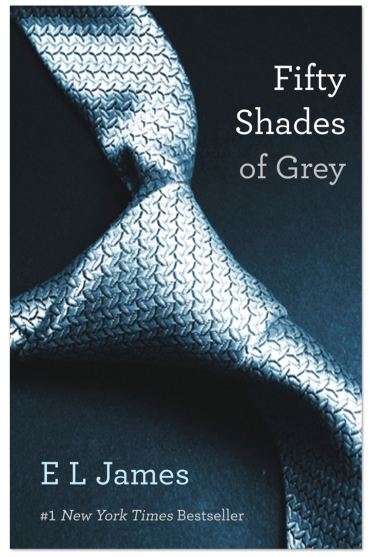
FIFTY SHADES OF GREY
I scowl with frustration at myself in the mirror.(This may be a world record. Bam, in the first sentence, she breaks a cardinal rule of fiction writing: don’t tell readers what the hero or heroine looks like by having them stare into a mirror, gaze upon their reflection in a pond or, I don’t know, whip out their driver’s license and say, “Huh, five-foot-ten, a hundred and twenty pounds, red hair, green eyes and a few freckles. Howbout that?” Ugh. This is not exactly “Call me Ishmael.”) Damn my hair – it just won’t behave, and damn Katherine Kavanagh for being ill and subjecting me to this ordeal.(Unless the heroine’s hair is crucial to the plot — unless she starts out with unruly hair in Act 1, switches to a bob in Act 2 and shows how much she’s grown and changed by rocking a purple Mohawk in Act 3, the hair, it is Boring, and a Distraction. Also, nobody refers to friends and such by their full name. If she’s your bestie, you say “Katherine.”) I should be studying for my final exams, which are next week, yet here I am trying to brush my hair into submission. I must not sleep with it wet. I must not sleep with it wet. (Enough already with the hair. Seriously. The only two words with any kind of real conflict and potential are “final exams,” and unless she flunks those, and therefore gets kicked out of university and has to live under a bridge in a cardboard box, it does not matter for the story.)Reciting this mantra several times, I attempt, once more, to bring it under control with the brush. (More about the hair? MORE? Not necessary, not interesting and not entertaining, unless her hair is secretly a sentient being, organizing a plot to take over the world, one follicle at a time. I’m guessing Bruce Willis, being immune from such attacks, will get recruited to foil this plot in DIE HARD 17: THE HAIR DYES HARDEST.) I roll my eyes in exasperation and gaze at the pale, brown-haired girl with blue eyes too big for her face staring back at me, and give up. (Back to the staring-at-the-mirror trick, which has to go. Find another way to describe the heroine and make the reader care about what the heroine looks like in the first place. I don’t know, a conflict, a situation, a hook.) My only option is to restrain my wayward hair in a ponytail and hope that I look semi-presentable.(Now we’re beating the Dead Hair Horse on its way to the glue factory.)
Kate is my roommate, and she has chosen today of all days to succumb to the flu. Therefore, she cannot attend the interview she’d arranged to do, with some mega-industrialist tycoon I’ve never heard of, for the student newspaper.(Awkward. First reference is Katherine Kavanaugh and now she’s Kate — just call her Kate both times. Also, how many student newspapers score interviews with “mega-industrial tycoons” … who you’ve never heard of? If they’re really mega, then you have heard of them. Bill Gates, Steve Jobs and so forth. If you haven’t heard of them, they aren’t mega at all. Edited text follows in red.)Kate is my roommate and she’s chosen today, of all days, to succumb to the flu. That means I’m stuck interviewing some industrial tycoon for the student newspaper.So I have been volunteered. (Redundant.) I have final exams to cram for, (already said that) one essay to finish, and I’m supposed to be working this afternoon, but no – today I have to drive a hundred and sixty-five miles to downtown Seattle in order to meet the enigmatic CEO of Grey Enterprises Holdings Inc. As an exceptional entrepreneur and major benefactor of our university, his time is extraordinarily precious – much more precious than mine – but he has granted Kate an interview. A real coup, she tells me.
Damn her extracurricular activities. (The last sentences were brought to you by the letter E: enigmatic, exceptional entrepreneur, extraordinarily, extracurricular. There are other modifiers that start with the letter E: extraneous, excruciating and ejector seat. I am looking for the handle, because it’s time to pull it.)
Kate is huddled on the couch in the living room.
“Ana, I’m sorry. It took me nine months to get this interview. It will take another six to reschedule, and we’ll both have graduated by then. As the editor, I can’t blow this off. Please,” Kate begs me in her rasping, sore–throat (compound modifier) voice. How does she do it? Even ill
(end of page 1)
Notes from the Red Pen of Doom
Are you kidding me? ARE YOU KIDDING ME?
I thought THE FOUNTAINHEAD was a bad Page 1 (here’s my post about that debacle), but Ayn Rand is flipping Shakespeare compared to FIFTY SHADES OF AWFUL.
Page 1 of this turkey consumed barrels and barrels of red ink, even though all my red ink is digital and such. Had to change my way of editing to handle this thing, because usually, anything edited gets turned red, but if I did that to this first page, 90 percent of this thing would be red, and it would be all Confusing and such.
So this is a mess, and not a hot mess.
God bless anybody who sells a ton of books or movie tickets. I adore books and movies, and the more people read books, and see good movies, the better. HOWEVER: the first page of a book is a lot like the trailer for a movie. You start out with your best stuff, and it’s a rock-solid guarantee that the writing doesn’t get magically better ten pages or 100 pages later.
The first page, and the first chapter, get polished and polished until they are a shiny diamond made of words.
Maybe you could argue this book is the one exception to that rule.
So why did something like this sell like hotcakes?
I believe, deep in my soul, that packaging matters more than the product. Not because that’s how things should be. It’s just reality.
The title of a book — or a movie, or a TV show — can save your bacon or kill you dead.
What else can sell or sink you? Images. That’s why the cover of a book or punk rock album is so important. It’s why we remember the movie poster for JAWS. When we’re thinking about what to spend our monies on in Barnes and Noble, and what to see on Friday night at those giant buildings where popcorn costs $9 a bucket, covers and posters and titles are where we start. Images are more visceral and powerful than words. I am not making that up. THERE IS SCIENCE AND SUCH.
If you gave this a more typical title for the genre, and a more typical book cover, you’d probably end up with a title like A BUSINESS AFFAIR and some kind of Ryan Gosling clone wearing a suit on the cover with the heroine nearby, messing with her pony tail while she wears the highest of high heels and a business suit with a skirt that is just this side of immodest. Or the cover would feature a blindfold and a pair of handcuffs.
If you really want to go traditional, it’d be Fabio wearing a suit while he holds a blindfold and a pair of handcuffs.
And if you put that different title and cover on this very same book, it wouldn’t sell 40 bazillion copies and get turned into a movie. It’d be just another book in a genre that isn’t exactly new and wanting for titles.
I bet you anything the unusual title and cover is why FIFTY SHADES OF GREY went viral and became a smashing success.
True story: guess what the author of THE GIRL WITH THE DRAGON TATTOO wanted as a title for his novel? Go ahead. Guess.
Originally, Stieg the Larsson wanted to title his novel MEN WHO HATE WOMEN. Think would sell more than five copies to his mom?
I am not making this up: Larsson wanted to go with MEN WHO HATE WOMEN.
Raise your hand if you think that title would have set the world on fire and led to hit movies starring James Bond.
The title and cover — the packaging — are 90 percent of the battle. The packaging matters more than the product.
FIFTY SHADES OF GREY is an interesting, literary title. The cover photo of a grey tie is also atypical of the genre and really stands out. The combined effect gives the book a literary veneer.
Some people might feel embarrassed getting on Flight 435 to Frankfurt and pulling out a paperback titled A BUSINESS AFFAIR with Fabio holding a blindfold and handcuffs on the cover. And you can bet the male audience for such books is hard to find with a microscope.
Give the same novel a different title and cover — and the gloss of lit-rah-sure — and that makes it OK for people to read what they might otherwise never get caught dead: romance and erotica.
This reminds me of the early Eric van Lustbader novels, like THE NINJA, which were hot sellers because they slipped in page after page of shockingly naughty scenes to readers — mostly men — who simply expected ninjas fighting with swords and such. It was like a James Bond movie where they didn’t fade out when 007 kissed the girl, but switched from a nice safe PG movie to something unsafe and dangerous and wild. I can tell you 14-year-old boys around the globe had their minds blown. You can print this kind of stuff without getting arrested? I can buy it at the store and they don’t ask for my driver’s license, because I don’t have one yet? NO WAY.
Verdict
Back to FIFTY SHADES OF GREY and why the first page, aside from the awkward messiness of it all, is just not interesting. You could hire a team of authors to rewrite the same plot points and they would throw up their hands and say forget it, we can’t do magical things with wet unruly hair and cramming for finals week, because there’s nothing truly at stake here.
It is beyond boring to read about some college student kvetch about her hair and her schedule. Try having a job and a kid and a commute, then talk to me.
There’s no conflict, no reason to care about the heroine. Is she fighting for any cause greater than herself? Are there public stakes at all? No. Private stakes that we can divine? No. Maybe if her boyfriend just dumped her, hey, now we have somewhere to go. A catalyst, a hook. But we’ve got nothing to work with here.
The heroine seems shallow and self-centered. I have no feelings about her, Kate or this Mr. Grey, because there’s nothing on the page to make me care, and no foreshadowing that anything more exciting or interesting might happen on page 2, page 22 or page 222.
I don’t mind entertaining trash, no matter the genre. In fact, better that a book or movie embraces its entertaining trashiness than beats me on the head with the Cudgel of Prententious Nonsense, which is never any fun at all.
HOWEVER: Entertaining trash better be GOOD trash, and not forget the entertaining part. This page 1 is an epic fail on both counts.
Oh, if I could go back in time, and whisper in the ear of my younger self during journalism school.
Not that I was busy screwing it up. Editor-in-chief of my college newspaper, graduated No. 1 in my class, won a bunch of awards, blah-blah-blah. (Related: Who is this Guy?)
But the traditional things that most journalism students think they SHOULD be doing — well, often those are seven separate kinds of wrong.
And there are other things Serious Journalism Majors scoff at, things that you actually should not only embrace, but hug tightly to your bosom.
So here we go with the Top 10 Myths of Journalism School.
Myth No. 10: Hard news is the only true love of a Serious Journalism Major
Sure, unfiltered Marlboros and Jim Beam come close. But nothing beats a scoop about an amazing scandal. You laugh at people trying to make the words flow for their feature story on dumpster divers, a story packed with all these photos, which are for nancypants who don’t have the stones to write more words.
Here’s the truth: hard news is all about news gathering and using the inverted pyramid, which is a horrible structure for any sort of writing and needs to be taken behind the barn and shot.
Hard news is worthy, and does the public a great service. Yet if all you do is hard news, you won’t truly learn journalism — or how to write.
Myth No. 9: Journalism school will teach you how to write
Once you get that pigskin from j-school, and land your first journalism gig — at The Willapa Valley Shopper or The New York Times — you’ll go home after 12 hours of banging on the keyboard to stay up past midnight, banging on the keyboard some more while smoking Gallouise Blondes and drinking cheap whiskey sours as you write (a) the next Great American Novel, (b) a Broadway play involving a debutant who falls in love with a struggling young reporter or (c) a Hollywood screenplay about a vast government conspiracy unraveled by an intrepid young intern at CBS.
This will be a lot of fun, and you’ll remember this as being the Best Thing Ever until you’ve been doing it for seven months and turning every draft of your extra-curricular writerly fun into three-point attempts. Also, you will miss this thing we call “sleep” and these other things we call “money in the checking account” and “a social life that does not involve typing on a keyboard chatting with a person who may, or may not, actually exist.”
J-school will teach you to be a journalist, but not how to write. You’ll know the AP Stylebook better than the people who wrote it, and your noggin will be stuffed full of the mechanics of writing news stories, how to put out a newspaper or produce a magazine. It may even teach you how to produce radio and TV shows.
Journalism school won’t, however, make you an all-purpose writer. And to truly learn how to write, you need to learn how to edit. I don’t mean copy edit or proof.
Sidenote: I wrote this in a crazy hurry and have not proofed it, or copy edited it, much less edited-edited the sucker. My apologies. God knows what kind of felony crimes against journalism were committed on this silly blog today.
Myth No. 8: Copy editing is editing
Sure, you sleep with your AP Stylebook, and proof-reading marks are like a second language. But that’s not editing.
There’s proofing, copy editing and true editing. Vastly different things.
Anybody who’s literate can proof. Do I want a great proofer? Sure, I want the best around, because errors are inevitable, and it takes a special person to have the stamina to read page after page. This isn’t rocket science, though.
Copy editing is important. When something is written on deadline, in a huge hurry, the copy editor is a Writing God, saving you from making gigantic factual errors or crimes against the English language.
True editing, though, is different, and you won’t learn it in journalism school. Not unless you seek it out.
Myth No. 7: You should specialize in your special thing while pish-toshing PR, because that’s for cheerleaders
Maybe you’re a sports guy, and all you want to do is write about baseball. It’s your passion. In fact, it’s your dream to cover the San Francisco Giants as a beat reporter. Anything else would be a let-down.
Out in real newsrooms, you’ll switch beats — and newspapers, or TV stations, or whatever — all the time. One month you might be covering politics and the next month it’s a huge murder trial. As a reporter, I covered city council meetings that lasted until midnight, got up the next day and did a flood, a fire or a bumbling serial killer. You never knew what was going to happen, and that’s why journalism is fun. The smaller the paper or media outlet, the more different things you get to cover. The bigger the paper or TV station, the more specialized you get.
So in college, try everything you can. Features, sports, the opinion page. Give radio a shot, and TV if you can. Somebody who can do lots of things, and is interested in many things, is a lot more marketable and fun than a journalist who’s obsessed with one solitary thing.
Also, public relations isn’t something journalism majors should take because it’s a required course. Chances are, you won’t do journalism forever.
Maybe five or ten years after you start working at papers of news, you’ll meet an amazing girl, or a wonderful boy, and the two of you will get married and decide that living on Top Ramen was fun for the first year, and kind of unfun the second year, and if you ever want to have babies and buy a house and send your pookie to college, the job thing may need to get revisited. And instead of selling Toyotas, you want to stick with some kind of writing gig, except one that pays decently and won’t make you worry about the next round of layoffs and such.
This happens. It’s OK, and public relations is a growing field — social media PR is crazy hot right now — while traditional journalism is shrinking before it changes and takes flight again. (I have hope.) Take the PR classes and learn from them. You will not die.
Myth No. 6: All you need is a pen and notebook
These days, it’s a pen, a notebook, a laptop, a camera and a smart phone, though the phone is a given, and would require a surgical team / SWAT team / NFL team to separate most people from their phones.
A lot of print reporters are taking their own photos these days, with newsroom cutbacks for photo staff. There are far fewer photographers on staff than reporters. Can’t send a shutterbug out on every story, only the biggest ones.
Get a decent SLR and practice. A lot.
That camera will also shoot HD video, and most papers and radio stations are also putting video up on their blogs. Learn how to edit video a little, and to edit photos a whole bunch.
Sidenote: when I say “learn to edit photos,” I don’t mean firing up Instagram and applying the Lux effect.
Myth No. 5: Creative writing and drama people are weird
Yeah, they dress in black and like to quote Sylvia Plath and Oscar Wilde.
Get over it. Instead of taking tons of political science classes and such (I was guilty of this), take all the creative writing and drama that you can. Because you want to be a great journalist and writer instead of a U.S. Senator, right?
If your college has a screenwriting class, take it. If they don’t have screenwriting, buy SAVE THE CAT by Blake Snyder and STORY by Robert McKee. Read them all the way through while taking notes. Then go back and read them again, because those two books are all about structure, which is the secret to great writing. Not pretty words. Structure.
Also: speech and debate — or editing the opinion page of your college paper — are both crazy smart. You need to learn how to (a) speak in public and (b) persuade other human beings to do things, such as (c) getting sources to reveal secrets to you and (d) charming editors to run your story on Page 1 instead of burying it on Page 15 next to the obituaries. I got lucky by doing speech and debate, and being an opinion page editor, along with all the hard news. Those things gave me different ways of writing aside from the inverted pyramid. So hop on the happy train of storytelling and rhetoric. DO IT NOW.
Myth No. 4: Your resume, GPA and 5-pound stack of clips — those are the ticket to success
They’re important to get into grad school, sure. And yeah, employers are a lot more impressed with somebody who has a 4.0 and a great resume than a loser.
But after your first real job, nobody cares about your grade point average and such. Or even where you went to school, unless it’s something insanely great (Harvard) or wacky beyond belief (French Polynesian College of Scientology and Barber School).
Here’s a secret: people get stacks of resumes that tower over their desk. They spend about two seconds per resume to sort them into three piles: YES, NO and MAYBE. Three-page resume? The NO pile. Weird font? NO. Paper as stiff as cardboard or so flimsy it tears? NO.
Here’s the cat who helps bosses around the world sort through stacks of resumes.
Then they go back into the YES pile and winnow it down until they’ve got enough people to call for interviews. And that’s if they even ask for resumes.
Also: one amazing clip with photos is better than three great clips or 5 pounds of good clips. NOBODY WILL READ ALL YOUR CLIPS. They’ll read the lede of the first graf of your first clip, maybe. I’d throw some more journalism slang in that sentence, but it’d just be piling on.
Myth No. 3: You can apply for any open job
A lot of times, jobs aren’t advertised. You won’t ever know they existed.
Why? Because people off the street are always a risk. Somebody with the Greatest Resume Known to Man could be a sociopath.
This is why the most important thing isn’t “who you know” but “who already knows you.” There’s a difference, and that segues to the next myth.
Myth No. 2: Internships are glorified slavery
You’re not getting paid for this free work. Why dress up, shave (face or legs), fight traffic and work like a dog while this paper of news / TV station / magazine makes all kinds of money from your free labor? Who cares if you’re late by 15 minutes or leave early? Who cares if you play Angry Birds on your phone during meetings?
Here’s the truth: internships mean jobs. Bosses would much rather skip the whole advertising for a job thing, which involves tons of paperwork, sorting through resumes and sitting through weeks of interviews. It’s a royal pain. If there was a couple interns they just had, people who were professional and hardworking, why not call them both up and hire one of them?
This happens far, far more than you think. And not just with internships. I’m ten times more likely to answer an email from somebody who’s chatted with me on Twitter than a total stranger (delete). The same thing is true for freelance jobs.
Myth No. 1: You’ll win the Pulitzer prize and retire to a villa in France
After you work for six months, putting in all-nighters to uncover the Biggest Scoop Journalism Has Ever Seen, and blow the socks off every Pulitzer Prize judge, your hometown will throw a ticker-tape parade, the mayor will give you the keys to the city and The New York Times will fight it out with The Washington Post to see who can give you $1.3 million a year along with your own set of minions.
Oh, that’s a nice dream. It would make a great movie. I know people who’ve won the Pulitzer Prize for Journalism, and while it’s a great honor, they didn’t get snatched up by the national biggies or have buckets of monies rain upon their noggins. Yeah, it’s a big deal, and the best possible award for journalists, and everybody pronounces it wrong.
Despite all that, winning the Pulitzer Prize is not like holding the winning ticket to MegaMillions.
HOWEVER: Journalism isn’t about getting famous or getting rich. It’s about serving your audience, and giving them news and information. The profession is interesting and fun, and even though it’s changing fast, the need for information — and for people who can write — is only growing.
If you choose journalism, you won’t get rich. You won’t get famous.
What you will get is an interesting life. And that’s something worth more than paper decorated with dead presidents.




 The Red Pen of Doom